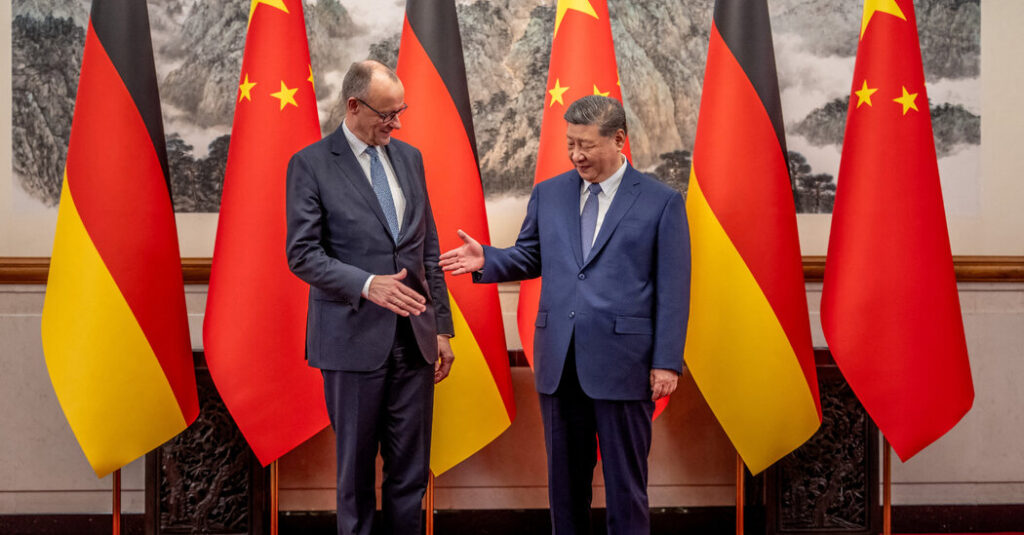
Chancellor Friedrich Merz of Germany arrived in China on Wednesday with an outstretched hand and a list of complaints for his hosts, asking for closer diplomatic ties but also relief from economic policies that he said were impeding “fair competition.”
Mr. Merz, who took pains before the trip to say he would not be “lecturing” Beijing, laid out his critiques in a speech at a meeting of the Advisory Council of German-Chinese Business, to an audience that included Premier Li Qiang, China’s second-highest ranking official.
The chancellor was more blunt and more specific in his criticism than other western leaders, including the prime ministers of Britain and Canada, who have recently trekked to Beijing to reset relations with China amid the turmoil caused by President Trump.
Mr. Merz called on China to reduce subsidies for its domestic manufacturers, to allow the value of its currency, the renminbi, to rise, and to ensure continued exports of raw materials, such as critical minerals — all of which would benefit German industry. Doing so, he said, would allow Germany and China to forge a tighter bond.
“In view of the uncertainties caused by customs policy that we see around the world,” Mr. Merz said, addressing Mr. Li directly, “we can now set a different example in our bilateral relations, through the reliability and security of the economic relations between our two countries.”
Following a series of discussions with Mr. Li and Chinese leader Xi Jinping, the chancellor appeared pleased. He announced a Chinese pledge to order up to 120 new aircraft from the European aerospace giant Airbus, and said more deals could follow.
“After today, I am very optimistic,” Mr. Merz said. “This is a good path for German-Chinese relations, both in the coming months and years.”
Mr. Merz’s approach in China bore similarities to his visit to Washington last year. There, he praised Mr. Trump and stressed the importance of Germany’s alliance with the United States, even as he pushed the president to bend toward Mr. Merz’s position on support for Ukraine and other issues.
Mr. Xi, in his own remarks, offered sweeping language about the partnership and their shared destiny, while avoiding mentioning the specific trade frictions Mr. Merz and other German leaders have long raised.
“The more the world becomes chaotic and intertwined, the more China and Germany must strengthen their strategic communication and enhance strategic mutual trust,” Mr. Xi told Mr. Merz at the Diaoyutai State Guesthouse in Beijing.
Mr. Xi has been working to solidify ties with Washington’s closest partners at a time when many of them are feeling alienated by the Trump administration. Mr. Merz is the latest Western leader to visit Mr. Xi since December, following the president of France, and the prime ministers of Canada and Britain.
Wednesday’s meeting took place as tensions between Europe and the United States are under growing pressure. European Union officials said on Monday that they would pause work on implementing their trade deal with the United States after the Supreme Court ruled last week that Mr. Trump’s tariffs were unlawful. Many of the levies agreed in that deal are higher than the 10 percent duties that the president has since imposed on global imports.
Mr. Trump will likely be watching to see how close Mr. Merz draws to Mr. Xi. Mr. Trump had warned that it was “dangerous” for Britain and Canada to look to China as the answer to their economic woes, after their prime ministers’ recent visits to Beijing
Mr. Merz was accompanied on his two-day visit by the heads of more than two dozen German companies, including Volkswagen, BMW and Siemens. He was to meet with executives at Mercedes-Benz in Beijing on Thursday before traveling south to the city of Hangzhou to visit the headquarters of a Chinese robotics firm, Unitree Robotics, and meet with the chairman of Siemens Energy in China.
Germany’s relations with China have become strained in recent years over complaints that Beijing was employing unfair practices that had contributed to a growing trade imbalance that has led to a flood of Chinese exports into Europe. In 2023, Germany defined China as a “partner, competitor and systemic rival,” and it has moved to reduce its dependency on Chinese goods and tightened export controls.
Ties have also been tense because of Beijing’s support for Russia during the war in Ukraine.
Mr. Xi and Mr. Merz discussed the war, according to an official Chinese summary of their meeting, which referred to the conflict as a “crisis.” The exchange appeared to break little ground, according to the report of the discussion in Chinese state media, though Mr. Merz said afterward that he welcomed China’s “commitment to peace in the region.”
Mr. Xi reiterated China’s longstanding position that the conflict should be resolved through “dialogue and negotiation” and that the “legitimate concerns of all parties” should be addressed — language that has frustrated European leaders because it avoids assigning blame to Russia and implicitly validates Moscow’s justifications for the full-scale invasion.
Germany has hoped that China could use its influence over Russia to help work toward a peace agreement.
Mr. Merz also said on Wednesday that he told Mr. Xi that Germany opposed any effort by China to use military force against Taiwan.
Beijing is hoping to persuade Berlin to stop labeling China as a “systemic rival” and abandon its efforts to “de-risk,” or distance German businesses from China.
Chinese officials and state media have portrayed Mr. Merz’s visit as long overdue and a reset in ties that is beneficial for both countries. Beijing also needs Europe to keep its markets open to China’s exports, a major driver of growth in a Chinese economy hobbled by a yearslong property crisis.
China is “concerned about trade protectionism, not only from Trump, but also from Europe, which may impose restrictions on Chinese products,” said Zhu Feng, a professor of international relations at Nanjing University.
Yet China no longer presents the same opportunities to Germany that it once did. German firms have seen their profits in the country steadily erode as Chinese companies have gained market share. The same is happening globally for the likes of German carmakers, chemical producers and machinery manufacturers that are trying to compete with Chinese rivals, resulting in the loss of thousands of industrial jobs in Germany each month.
“China was a driver of German prosperity in past decades,” said Noah Barkin, an expert on European-Chinese relations at Rhodium Group, a research firm. “Now it represents the biggest external threat to Germany’s economic well-being.”
Siyi Zhao contributed research from Beijing.
David Pierson covers Chinese foreign policy and China’s economic and cultural engagement with the world. He has been a journalist for more than two decades.
The post Germany’s Leader Delivers a Blunt Warning to China on Trade appeared first on New York Times.