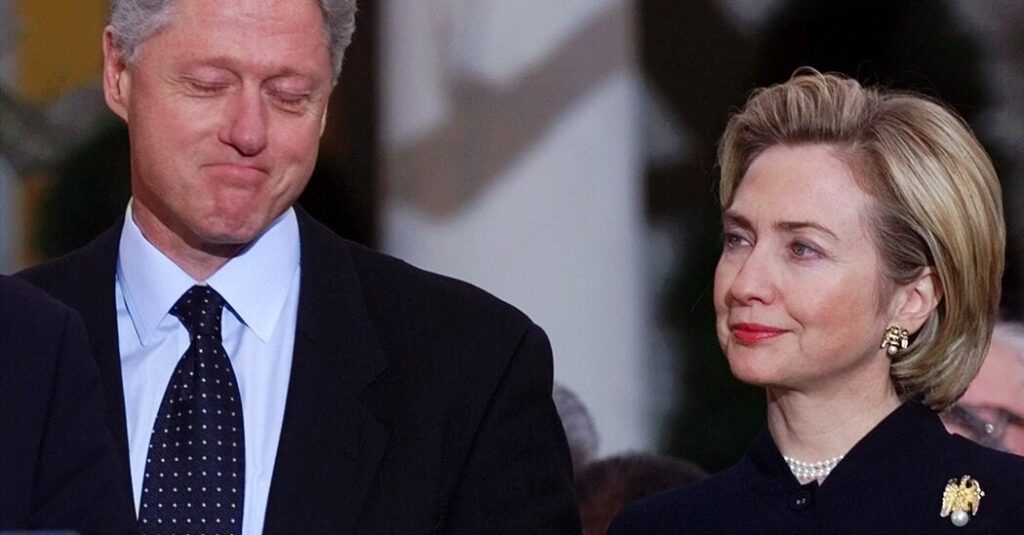
It was Jan. 26, 1992, and Hillary Clinton was seated on a couch next to her husband, answering probing, personal questions about her marriage after a former local newscaster from Arkansas, Gennifer Flowers, claimed she had a 12-year affair with Bill Clinton.
Mr. Clinton, then a young governor running for president, did most of the talking in that now-famous “60 Minutes” interview. But it was Mrs. Clinton’s feisty, defensive response to the crisis that was credited with saving her husband’s campaign and career — and cementing her complicated place in the national consciousness for the next three decades.
“I’m not sitting here, some little woman standing by my man like Tammy Wynette,” said Mrs. Clinton, wearing her signature headband of that decade and a teal green jacket. “I’m sitting here because I love him, and I respect him, and I honor what he’s been through and what we’ve been through together. And you know, if that’s not enough for people, then heck — don’t vote for him.”
More than 34 years later, Mrs. Clinton will be back on the proverbial couch on Thursday because of her husband, forced to field in-depth, potentially uncomfortable questions that ultimately require her, once again, to answer for her spouse’s actions and relationships.
This time, she is set to appear in Chappaqua, N.Y., near her home, for a closed-door deposition in front of the House Oversight Committee as part of its investigation into Jeffrey Epstein, the disgraced financier and convicted sex offender with whom Mr. Clinton once associated.
Mr. Clinton will appear for his deposition on Friday, becoming the first former president ever to be compelled to testify in a congressional investigation against his will.
Mrs. Clinton’s appearance is notable for different reasons. It will act as a reminder that even after serving eight years in the Senate and four years as secretary of state, and running for president twice, Mrs. Clinton is still stuck in the awkward position of answering for her husband.
“For almost the entirety of her married life, she has had to answer questions about her husband’s actions,” said Patti Solis Doyle, a former top aide to Mrs. Clinton. “She has supported him throughout. There is no reason for her to have to suffer this last indignity. She has nothing to do with it. It is infuriating. She is a global icon, a trailblazer for women. It is heartbreaking that she has to do this.”
Mr. Clinton had a relationship with Mr. Epstein years before Mr. Epstein’s sex crimes conviction. The former president took four trips on Mr. Epstein’s private jet in 2002 and 2003 and appears in photographs in the files released by the Justice Department. But Mrs. Clinton did not. She has said that she “cannot recall ever speaking to Epstein,” and that she met Ghislaine Maxwell, his longtime associate, only a few times.
During the period when Mr. Clinton was building the Clinton Global Initiative and interacting with Mr. Epstein and Ms. Maxwell, Mrs. Clinton “was busy being a U.S. senator,” said Ms. Doyle, who worked for her at the time. “She was not involved.”
Representative James R. Comer of Kentucky, the Republican chairman of the Oversight Committee, has raised the issue of a nephew of Ms. Maxwell’s who worked for Mrs. Clinton during her 2008 presidential campaign and then at the State Department. But Mrs. Clinton’s lawyer has asserted that Mrs. Clinton never knew that the employee, Alexander Djerassi, was related to Ms. Maxwell.
Mrs. Clinton’s name appears in over 700 files in the Epstein documents, almost all of which are simply news articles about her 2016 presidential campaign that were shared with Mr. Epstein.
(In one 2013 exchange with Olivier Colom, a former French diplomat with close ties to Mr. Epstein, Mr. Colom asks if his friend can arrange a “discreet meeting between Sarko and Hillary Clinton in NY.” Mr. Epstein replied that “meetings with Hillary are not easily discreet” and does not appear to have been able to offer any help.)
Still, during a monthslong battle with Mr. Comer to avoid testifying, Mrs. Clinton has presented a unified front with her husband. They have relied on the same team of lawyers to speak for both of them. Together, they fought the subpoenas until they capitulated to Mr. Comer’s demands and both agreed to sit for the depositions. They did not try to distinguish between their two distinct situations.
“In this instance, they are coming for both, at the same time, for the same baseless reason,” said Philippe Reines, a longtime Clinton adviser. “This isn’t about one Clinton defending the other. It’s about the Clintons being attacked as a unit and fighting back as a unit.”
After decades in public life together, most of it under attack from Republicans, that may be partly a function of muscle memory.
When Mr. Clinton was under investigation for a sex scandal involving Monica Lewinsky, then a White House intern, Mrs. Clinton defended her husband and dismissed the escapade as part of a “vast right-wing conspiracy.” Later, after the House voted to impeach Mr. Clinton for perjury and obstruction of justice, Mrs. Clinton appeared on the South Lawn with her husband to help him pre-empt calls for his resignation.
David Brock, a longtime enforcer for Democrats who was once a self-described “hired gun” for Republicans, said that Mr. Comer was using a decades-old playbook of lumping the two Clintons together for maximum impact.
“The old Clinton scandal machine is revving up again,” Mr. Brock said. “Historically speaking, there’s a symbiotic dynamic at work: Sometimes the target is Bill, sometimes it’s Hillary, with the only goal here being harassment and embarrassment. The Republicans must have figured they could get two for one, as they used to say.”
(During his 1992 campaign, Mr. Clinton promised voters that they could buy him for president and get his intelligent wife for free, a conceit the public quickly soured on.)
Many House Democrats, however, appeared to see a difference between the two Clintons regarding the Epstein investigation. Just three Democrats on the Oversight Committee voted with Republicans to hold Mrs. Clinton in contempt of Congress for defying its subpoena, compared with nine who voted to hold Mr. Clinton in contempt. They continue to be skeptical that there is any good reason to question her.
“I’m not seeing anything to suggest she ought to be a part of this in any way,” Representative Kwesi Mfume, Democrat of Maryland, said at a hearing last month, noting that it looked as though the former secretary of state had been included because “we want to dust her up a bit if we get her before this committee.”
Nor do Democrats believe that Mr. Comer is actually interested in using the Clintons’ testimony to help “inform how Congress can strengthen laws to better combat human trafficking,” as he has also stated.
Last year, the State Department laid off 70 percent of its Office to Monitor and Combat Trafficking in Persons, which carries out the government’s main anti-trafficking mission. And the annual Trafficking in Persons Report that is required to be delivered to Congress by June 30 each year was delayed past July and released only after intense pressure from House Democrats.
Addressing the Epstein matter at the Munich Security Conference last week, Mrs. Clinton said that she supported the full release of the documents and that people implicated in crimes should be held accountable.
“I want everybody treated the same way,” she said. “That’s not true for my husband and me.”
She noted that other witnesses had been allowed to submit written statements under oath instead of testifying.
“Why do they want to pull us into this? To divert attention from President Trump,” she said. “This is not complicated.”
Annie Karni is a congressional correspondent for The Times.
The post For Hillary Clinton, an Epstein Deposition Is the Latest ‘Stand by Your Man’ Moment appeared first on New York Times.