The Trump administration has worked hard to ensure that this year’s celebration of the nation’s 250th anniversary celebrates President Trump as well. Perhaps nothing reflects its concerted efforts better than a plan for a one-dollar coin depicting the president in profile, despite a national tradition of avoiding symbolism that even faintly evokes a monarchy.
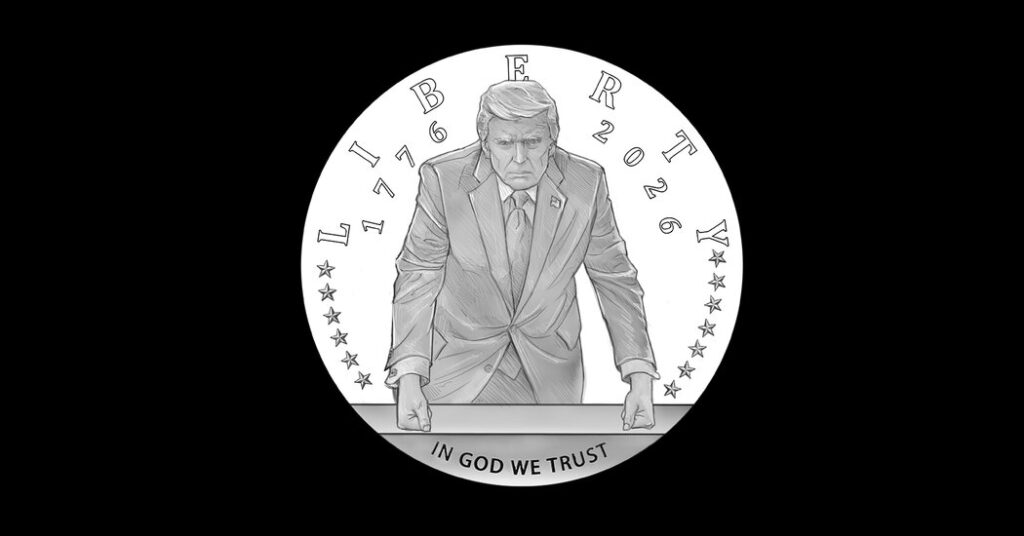
But one Trump coin, it seems, is not celebration enough. The administration has now proposed an additional coin that portrays the president with fists planted on a desk, his face evoking a determination bordering on fury. This coin would match the dominant color scheme of just about every nook, cranny and plaster cherub in the Trump Oval Office.
Gold.
But the numismatic glorification of Mr. Trump has repeatedly met resistance from one of the more obscure corners of the federal government: an entity known as the Citizens Coinage Advisory Committee.
Statutorily required to review the themes and designs of proposed coins, the committee has wielded its limited powers to slow, if not block, these Trump coins from being struck by the U.S. Mint in time for the anniversary celebrations this summer.
The committee’s latest move came at the start of its monthly meeting on Tuesday, a few days after a curious notice appeared in the Federal Register. It was a last-minute addition to the meeting’s agenda by the U.S. Mint that said, simply: “review and discussion of a Semiquincentennial Gold Coin.”
The committee’s acting chairman, a lawyer and Democrat from New Jersey named Donald Scarinci, began the meeting by announcing that, on behalf of a majority of its members, he had removed this last-minute addition. There would be no discussion of a gold coin.
But Mr. Scarinci, who has served on the coinage committee for more than two decades, went on to note the disconnect in proposing coins that feature a sitting president as a way to commemorate the signing of the Declaration of Independence, which rejected governance by a king.
“For 250 years, since that great document was signed — with a few controversial exceptions — no nation on earth has issued coins with the image of a democratically elected leader during the time of their service,” Mr. Scarinci said. “Only those nations ruled by kings or dictators display the image of their sitting ruler on the coins of the realm. God bless America, and may God preserve our nation.”
For all the boldness of Mr. Scarinci’s words, there still lingered the sense that, one way or another, Mr. Trump would have his coins, just as he has his image looking down from banners adorning federal buildings and his name branded on everything as pedestrian as national park passes to as grand as the John F. Kennedy Center for the Performing Arts.
At the meeting, a Mint official acknowledged that the idea for these coins had not come from within the Mint; a Mint spokeswoman did not respond to several questions from The New York Times, including whether it was the White House that had pushed for a gold Trump coin. Even so, its proposed design, featuring the president all but glowering over his desk, mirrors a photograph he is known to prefer, so much so that just last month it replaced another photograph of Mr. Trump in the National Portrait Gallery.
The Citizens Coinage Advisory Committee is a bipartisan creation of Congress, established in 2003 to review proposals for circulating and commemorative coins and national medals. It then recommends its preferences to the Treasury secretary, who has final say on what coins and medals depict and convey.
The committee’s 11 members, all appointed by the Treasury secretary, represent an approximation of national consensus. Four members are recommended by the Senate and House leaders of both parties; three represent the general public; and four have special qualifications — in American history, numismatics, numismatic curation and medallic art and sculpture.
Trump Administration: Live Updates
Updated
- The U.S. Embassy in Israel is bringing consular services to Israeli settlements in the West Bank.
- As U.S. businesses push for tariff refunds, the Trump administration signals it may be ready for a fight.
- Trump’s speech gets a mixed reaction around the world.
For many years, the committee went about its business without much controversy; the country had little reason to wonder what the Citizens Coinage Advisory Committee was up to. That all changed when Mr. Trump returned to office in 2025 — which Mr. Scarinci described on Tuesday, numismatically speaking, as “the darkest year of my 20 years of service.”
The tensions center partly on the committee’s belief that the Trump administration is ignoring the panel’s statutory mandate, and partly on how the country’s coins will be used to commemorate its 250th anniversary. In other words, whose version of American history will be jingling into the future?
First, the coinage committee made several design recommendations for a set of semiquincentennial coins that would be both collectible and legal tender: a dime, a half-dollar and five quarters. Its choices for the quarters, intentionally diverse, featured the abolitionist Frederick Douglass, the civil rights activist Ruby Bridges at age 6 and, in keeping with a statutory specification to reflect the contribution of women, a World War I-era suffragist.
But the Treasury secretary, Scott Bessent, bypassed these recommendations, choosing instead a less complex and decidedly whiter version of American history, more in keeping with White House messaging. His selections included several images of famous presidents and, to meet the mandate about the contribution of women to American history, one of a woman from the Plymouth Colony in the protective embrace of her Pilgrim husband.
Members of the committee acknowledge that Mr. Bessent has the right not to adhere to its recommendations. But they say that, for the first time in its history, the designs were chosen without proper review by the committee, as required by statute.
Then there is the matter of the Trump coin. The first Trump coin, that is.
Last fall the Treasury announced plans for a semiquincentennial coin, a one-dollar coin, that would depict the president. The proposal alarmed many numismatists and historians, who noted that the country’s first president, George Washington, rejected a proposal to include his likeness on a coin.
Such a coin, they argued, would violate the spirit of several coin-related laws. These include a 2005 act that, in authorizing circulating dollar coins honoring former presidents, stipulated that none “bear the image of a living former or current president,” and that none be issued for a deceased former president until two years after that leader’s death.
But the administration plowed ahead. A spokeswoman for the Mint said last year that the 2020 law authorizing coins for the semiquincentennial included no express prohibition “on placing living persons on the obverse (front) of coins.” And Mr. Bessent has said on social media that “there is no profile more emblematic for the front of this coin than that of our serving President, Donald J. Trump.”
In November, after the coin committee’s agenda had been established, the Mint requested a last-minute addition to include consideration of the one-dollar Trump coin designs. But the chairman at the time, Peter van Alfen, said it was too late and removed the item from the agenda.
A series of back-and-forth communications between the Mint and the committee continued into December, ultimately resulting in no meeting, and no review of the Trump portfolio.
The Mint did not submit the portfolio for review at the committee’s meeting in January; it now maintains that a majority of the committee had made a conscious decision not to review it. But the Mint did present the proposed designs to the Commission on Fine Arts, an advisory panel that Mr. Trump has recently packed with allies.
At its meeting last month, the arts commission favored an image of Mr. Trump in profile that one member said “has a statesmanlike quality to the coif of the hair.”
At Tuesday’s meeting of the coinage committee, one member, Kellen Hoard, a student at George Washington University, asked Mint officials about the two Trump coins. His pointed questions came rat-a-tat fast.
He asked about the propriety of coins featuring a sitting president. He asked who had proposed the one-dollar coin and who had proposed the gold coin, the design for which includes neither a proposed denomination nor an indication of its purity of gold. (It does depict, on the reverse, a bald eagle perched atop the Liberty Bell.)
A lawyer for the Mint, Greg Weinman, repeatedly declined to answer. But at one point he seemed to indicate that a sitting president might soon appear on American coins.
“The Mint has moved forward accordingly,” he said.
Dan Barry is a longtime reporter and columnist, having written both the “This Land” and “About New York” columns. The author of several books, he writes on myriad topics, including New York City, sports, culture and the nation.
The post For America’s 250th, Should the Coin of Trump’s Realm Be Gold? appeared first on New York Times.