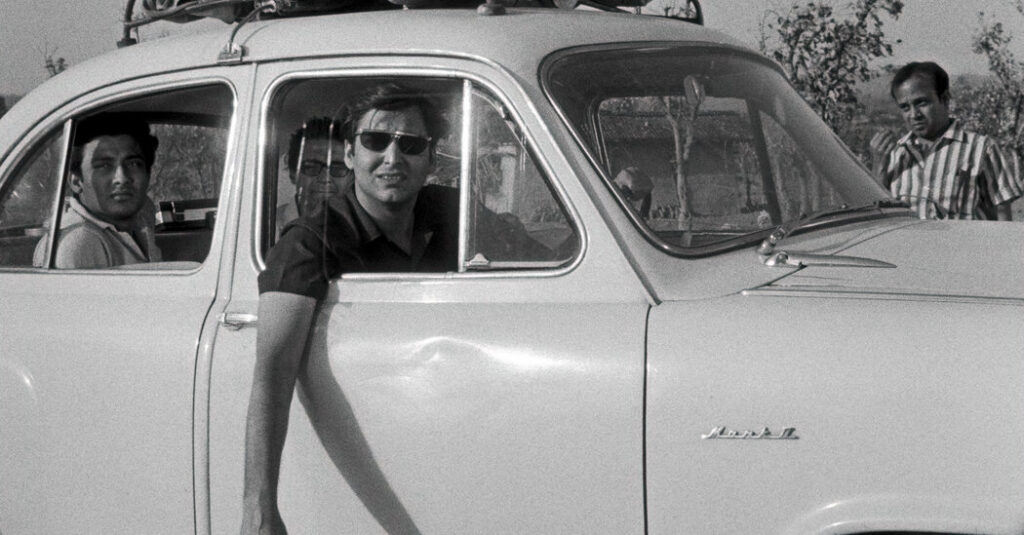
While it’s been years since the great Bengali director Satyajit Ray had a New York retrospective, this new 4K restoration of his insufficiently known “Days and Nights in the Forest” (1970), shown last fall at the New York Film Festival, could well prompt one.
It’s now being revived for two weeks at Film Forum. “Days and Nights” is a not-quite road film and a gently satirical pastorale with a suggestively enchanted title, a Chekhovian premise and a socially critical backbeat.
Four 30-something, upper-caste men, educated and unmarried, take off for a few days of adventure in a rustic district populated by Santhals, an Indigenous group, a few hundred miles northwest of the men’s native Kolkata (then known as Calcutta). Harinath (Samit Bhanja) is a self-involved sportsman; Sekhar (the comic actor Rabi Ghosh) is a clownish ne’er-do-well; sensitive Sanjoy (Subhendu Chatterjee) and diffident Ashim (Ray’s frequent leading man Soumitra Chatterjee) are would-be writers who have abandoned their youthful ambitions.
Their sense of entitlement is apparent immediately. Arriving at a woodland lodge without a reservation, they bribe the humble watchman to let them stay — not the last time they reveal their reflexive contempt regarding perceived inferiors. “Thank God for corruption,” Ashim jokes in English.
The city boys are excited by their primitive surroundings, equally impressed by the strong local alcohol, and apparently uninhibited Santhal women. They end their first night drunkenly singing the patriotic anthem “Our Hindustan” — a traditional expression of opposition to British rule. That the Santhals had themselves rebelled against the British, as Ray’s Indian audience would surely know, is a comment on the men’s smug ignorance.
The next morning the men come across two young women of their own background also on vacation: Aparna (Sharmila Tagore) the daughter of an older Brahmin with a nearby summer house, and Jaya (Kaberi Bose), the widowed daughter-in-law of the house’s owner.
Flirtation ensues, along with embarrassment, mild comeuppance and perhaps life-changing revelations. The key incidents include a memory game, a misplaced wallet, a display of public intoxication, a visit from a local official, the seduction of a Santhal woman and a carnival in which Ashim and Aparna pair off, as do Sanjoy and Jaya.
“Days and Nights” was shown once in the 1970 New York Film Festival — Howard Thompson’s brief notice in The New York Times characterized it as “subtle, perceptive and serene” — and disappeared into distribution limbo, rescued two and a half years later by a short commercial run.
Reviews were mixed, although the movie was championed by the critic Pauline Kael, who, noting the men’s frequent ostentatious use of English phrases, took it as a critique of British colonialism. In fact, the film’s politics are more introspective. At heart, “Days and Nights” is a scathing portrait of the complacent Bengali bourgeois (the student-supported Naxalite insurgency that then roiled Kolkata universities is a structuring absence), not to mention a study of male privilege.
Chatterjee and Tagore, who played opposite each other in two earlier Ray films, are a natural couple. The most powerful scene, however, belongs to Jaya, the young widow played by Bose. The men may have gained a bit of self-knowledge in the forest; the depth of her yearning is not only revelatory but also heartbreaking.
Days and Nights in the Forest
Through March 12 at Film Forum in Manhattan filmforum.org.
The post ‘Days and Nights in the Forest’: Into the Woods With Satyajit Ray appeared first on New York Times.