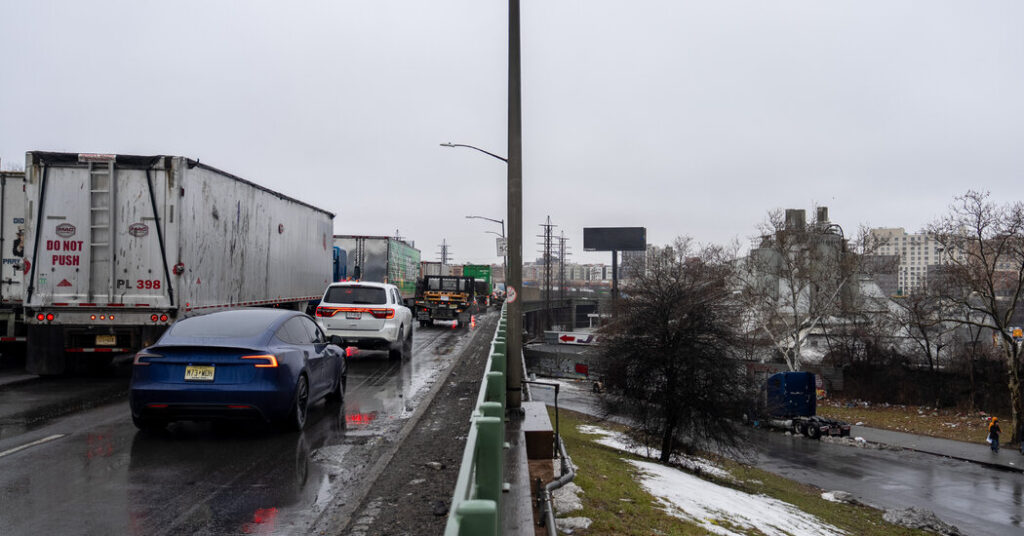
As reviled roads go, the Cross Bronx Expressway has what many consider supervillain status.
The nearly seven-mile stretch, devised by Robert Moses in the 1940s and built over decades, runs like a scar across parts of the Bronx that include the poorest congressional district in the United States. Nearby residents suffer from some of New York City’s highest asthma rates, largely because of standstill traffic. And the expressway has long been blamed for holding back the economic development of the borough, even as it serves as an important commercial corridor for the region.
Now, as Gov. Kathy Hochul prepares to announce a plan for a $900 million overhaul to repair and expand a one-mile elevated section of the aging highway, a group of community advocates are pushing the state to consider options that would repair the road without widening its footprint.
And instead of a walkway attached to the elevated highway, they are asking Mayor Zohran Mamdani to build bus lanes and bike paths that they say would better serve residents. (While state officials are leading the highway repairs, the city controls the streets around it.)
The State Department of Transportation is expected next month to choose one of three repair plans, each of which would fix a series of bridges along a portion of the expressway, between Rosedale Avenue and Boston Road. Construction could start this year and be completed by 2032.
But each of the plans would widen this stretch of the six-lane highway by about 25 to 50 feet, pushing traffic — and its pollution — closer to an adjacent public housing complex.
“It’s had such a harmful impact over the last 60 years, that anything that increases the impact just feels tone-deaf,” said Siddhartha Sánchez, the executive director of the Bronx River Alliance, a conservation group that does not support any of the three options.
Mr. Sánchez was among the advocates who appeared at a news conference on Wednesday at the Bronx River Art Center, where critics of the state’s proposals said they were mostly beneficial to people who lived outside the borough.
“The Cross Bronx Expressway has polluted our neighborhoods, displaced families and left our communities with some of the highest asthma rates in the nation,” said Akia Squitieri, the executive director of the art center, which borders the proposed highway construction. “Now, instead of repairing that harm, the state plans to widen it.”
Both community advocates and state officials agree that it is crucial to repair the Cross Bronx Expressway, which carries up to 150,000 vehicles a day, far more than originally intended.
But Norma Saunders, the tenant association president of the Bronx River Houses, the large public housing complex that abuts the expressway, said it should not be done at the expense of local residents’ health.
“You’re killing my residents,” Ms. Saunders said about the current proposals, which would bring the roadway, and its pollution, even closer to tenants suffering from asthma and other respiratory illnesses. “We breathe this every day.”
Tiffane Thorpe, 36, lives in the Bronx River Houses with her three children, two of whom have asthma. She said commercial vehicles often parked close to the expressway so their drivers could take a break between routes, adding to the congestion of the neighborhood.
“We are a rest stop for trucks,” she said. “It’s right outside my window.”
The state’s Transportation Department has acknowledged the harm that Mr. Moses, the powerful city planner and public official who pushed for the Cross Bronx Expressway, caused to the area.
The construction of the highway displaced tens of thousands of residents in the path of the project, an approach to urban planning that Mr. Moses’s biographer, Robert Caro, likened to swinging a “meat ax.”
“We’ve been doing transformational work in the South Bronx to right the wrongs of past generations,” Marie Therese Dominguez, the department’s commissioner, said in a statement, noting that the governor had committed $35 million for a study on how to reimagine the expressway.
But she said this stretch of the highway, a key part of Interstate 95, was “in desperate need of safety upgrades” and that it was necessary to make improvements.
All of the plans being considered to repair the bridges — there are five along the stretch in question — involve expanding the expressway’s footprint, widening its shoulders by roughly 25 feet to meet modern safety standards.
But two of the proposals also call for building an approximately 30-foot-wide pathway that would facilitate construction and later be converted for pedestrian and cyclist use.
The proposals with the shared pathway are estimated to cost close to $800 million each, before additional expenses — about $100 million more than the one without.
The Transportation Department has already made some concessions. Earlier plans for the project involved building a diversionary road — essentially a second highway — to expedite construction. In October, after vocal opposition, the agency abandoned the proposals involving that plan.
It may seem counterintuitive for residents to oppose the idea of a new walkway attached to the elevated highway, Mr. Sánchez said, but he argued that the inconvenient nature of a winding path nearly 100 feet in the air meant it would be sparsely used.
The construction of the walkway would take years and cause disruptions at Starlight Park, a recently renovated green space below it.
“They spent 20 years building this place up with public money, and now we’re taking a step back,” Mr. Sánchez said about the park, a 13-acre stretch along the Bronx River that was once littered with toxic waste.
Instead, the groups that oppose the expressway plans are lobbying the New York City Department of Transportation to improve bus and bike access at busier but neglected thoroughfares around the neighborhood.
Public transit is vitally important in the Bronx, one of the city’s most bus-dependent boroughs. Nearly three-fourths of households living near a busy Tremont Avenue bus route don’t have access to a car, according to a 2025 presentation from the city’s Transportation Department.
But it can be difficult for pedestrians to get to bus stops in the area, because the expressway forces them to walk circuitous and sometimes dangerous paths.
Advocates want the city to revive a plan to create a dedicated bus way on Tremont Avenue, where the Bx36 carries 34,000 passengers a day at speeds of less than five miles per hour, making it one of the slowest buses in the nation.
The project would create a dedicated path for buses, trucks and emergency vehicles along a critical choke point that could speed up the route and encourage more drivers to take public transit.
The bus way, which would function similarly to one built in recent years on 14th Street in Manhattan, was considered but stalled under former Mayor Eric Adams’s administration.
The community groups are also seeking better lighting and bike infrastructure along East 174th and East 177th Streets, two frequently traveled but disjointed thoroughfares that residents use to get around the highway.
Improvements on these streets, they say, would make nearby park land and public transit more accessible.
The streets, which connect apartment complexes and businesses to bus stops and an elevated subway station, are strewed with garbage and run near a tangled mix of industry, including a concrete plant and the West Farms Bus Depot.
Vincent Barone, a spokesman for the city’s Department of Transportation, said the agency was refining potential bus and bike lane projects after two years of public outreach, and would “share more with the community soon.”
Anna Berlanga, an organizer for Transportation Alternatives, an advocacy group that supports the bus way, wants the city and state to focus on road work that improves local residents’ daily lives.
She said the bus way could have a profound effect on working mothers in particular, who are more likely to leave jobs because of commuting hardships.
“You can’t be 15 minutes late to child care every single day,” she said.
Wesley Parnell contributed reporting
Stefanos Chen is a Times reporter covering New York City’s transit system.
The post Can a Long-Hated Bronx Highway Be Repaired Without Doing More Harm? appeared first on New York Times.