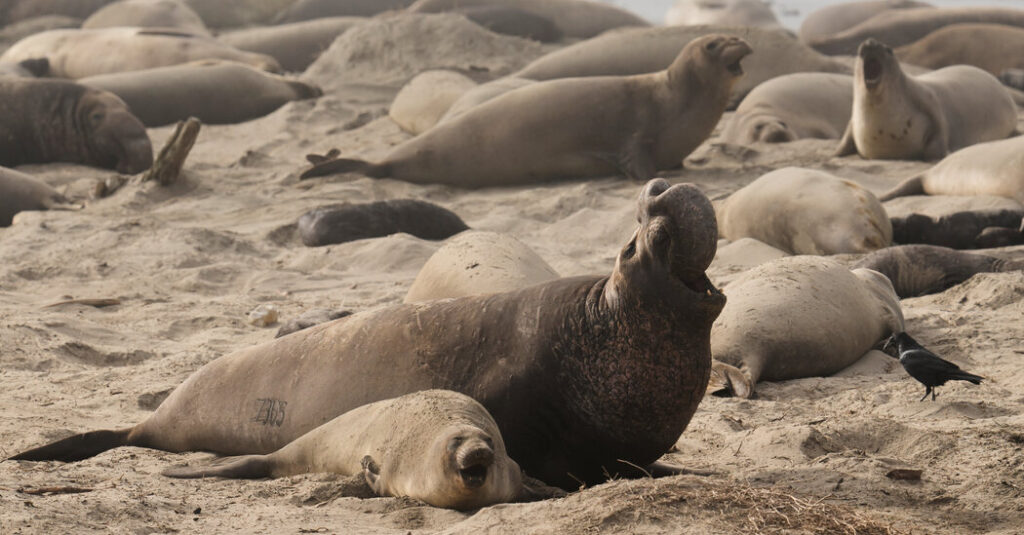
A lethal form of bird flu, which has already killed tens of thousands of elephant seals in the Southern Hemisphere, is now spreading in a colony of elephant seals in California, scientists announced on Wednesday.
Seven elephant seal pups at Año Nuevo State Park have tested positive for the virus, known as H5N1, becoming the first recorded cases in northern elephant seals. They are among about 30 seals that have died at the park since late last week and the first to have been tested, said Roxanne Beltran, an ecologist at the University of California, Santa Cruz, who leads a long-term monitoring project on the seals.
Results on the other suspected cases, all but one of which have involved weaned pups, are still pending.
Roughly 5,000 elephant seals crowd onto the beaches at Año Nuevo State Park every winter to breed and give birth. They are a popular tourist attraction at the park, which has closed its seal-viewing areas and canceled its elephant seal tours for the rest of the season.
So far, Dr. Beltran said, a majority of the colony’s seals seem healthy. “There are some hopeful signs,” she said. “One of them is that we haven’t seen an exponential uptick in mortalities.”
Still, recent bird flu outbreaks in southern elephant seals, a closely related species, have resulted in “catastrophic losses,” she noted. “I think we’re really nervous about the trajectory of this outbreak, which, of course, we can’t predict.”
A large-scale outbreak could pose a significant threat to the seals, which were hunted almost to extinction in the 19th century, as well as to people. When H5N1 hit a southern elephant flu colony in Argentina a few years ago, the virus seemed to spread from seal to seal and pick up mutations that made it better adapted to mammals.
The current risk to the public is low, Dr. Christine Johnson, a veterinary epidemiologist at the University of California, Davis, said at a news briefing on Wednesday. “At the moment, we’re just asking people to take simple precautions,” she said, including keeping their distance from marine mammals.
“Our primary concern right now is to limit spread in this colony,” she added.
Avian influenza viruses are typically best adapted to birds and affect a limited number of species, such as farmed poultry and wild waterfowl. But over the last several years, a new version of H5N1 has infected an unusually broad array of birds, including bald eagles, peregrine falcons and Gentoo penguins.
It has also spread to both wild and domesticated mammals, including foxes, bears, cats and cows. In the United States, the virus has raced through dairy cattle, affecting more than 1,000 herds in 19 states.
Since 2024, the Centers for Disease Control and Prevention has also received reports of 70 infections in people; one older adult in Louisiana, who contracted the virus from infected backyard birds, died in January 2025.
Despite the threat of a pandemic, the Trump administration canceled a contract with the drugmaker Moderna to develop a vaccine against bird flu. The vaccine relied on mRNA technology, also used in the Covid shots and widely considered by scientists to be the fastest option for developing a vaccine in a rapidly moving outbreak.
The national stockpile has a few million doses of a vaccine based on an older technology, but it’s unclear how well that shot might perform if the virus changed significantly.
The stockpile also includes millions of doses of the antiviral oseltamivir, or Tamiflu, but recent studies indicate that a different antiviral drug, baloxavir, may be a better bet against the virus.
So far, H5N1 has posed a bigger threat to animals. In cats, the virus crosses into the brain, infiltrating neurons and other cells and causing the animals to behave erratically before gruesome deaths.
In wild mammals, the virus has taken an especially heavy toll on southern elephant seals, which live in and around the Southern Ocean.
The seals spend most of their lives at sea but come ashore to breed, congregating in large, crowded colonies on beaches that they may share with infected seabirds.
In late 2023, H5N1 infiltrated the southern elephant seal population on Argentina’s Valdés Peninsula, where the virus killed an estimated 17,400 pups, and on the sub-Antarctic island of South Georgia, where more than 50,000 adult females may have died.
But until now, the virus had not been detected in northern elephant seals, which breed along the Pacific coasts of the United States and Mexico.
The Año Nuevo colony is one of the most well-studied elephant seal colonies on Earth; researchers at the University of California, Santa Cruz, have been tagging, tracking and monitoring the seals for six decades. The scientists are out on the beaches every day of breeding season, which runs from December through March.
That regular presence, plus stepped-up bird flu surveillance, which began in 2024, may have helped experts detect the outbreak in its earliest stages.
“This virus can be very difficult to track in wild populations” Dr. Johnson said at the briefing.
The researchers first noticed a problem late last week, when they discovered several dead pups and others displaying strange behaviors and neurological symptoms, including tremors and seizures.
A postmortem examination of one of the dead pups revealed significant tissue damage in her brain and lungs, said Dr. Megan Moriarty, a wildlife veterinarian at the University of California, Santa Cruz.
Fortunately, Dr. Beltran said, by the time the outbreak began, most of the adult females in the colony had already finished weaning their pups and left the beach for the season. But roughly 1,350 seals remained on shore, and there have been about five new sick or dead pups a day, Dr. Beltran said. Most have been clustered at the southern tip of the beach.
It’s too early to say how the virus is spreading and whether the seals are transmitting it to one another — as southern elephant seals did in Argentina — or picking it up from infected birds on the beach, scientists said.
Because many of the seals at Año Nuevo are outfitted with individual flipper tags and tracking devices, the researchers hope to be able to reconstruct how the virus moved through the colony and to continue monitoring the seals after they head back to sea.
“We spend our entire lives trying to get to know these seals,” Dr. Beltran said. “That makes it especially difficult to watch the animals that we followed for years and for many, many, many, many generations become sick and die.”
Emily Anthes is a science reporter, writing primarily about animal health and science. She also covered the coronavirus pandemic.
The post Bird Flu Strikes California Elephant Seals for the First Time appeared first on New York Times.