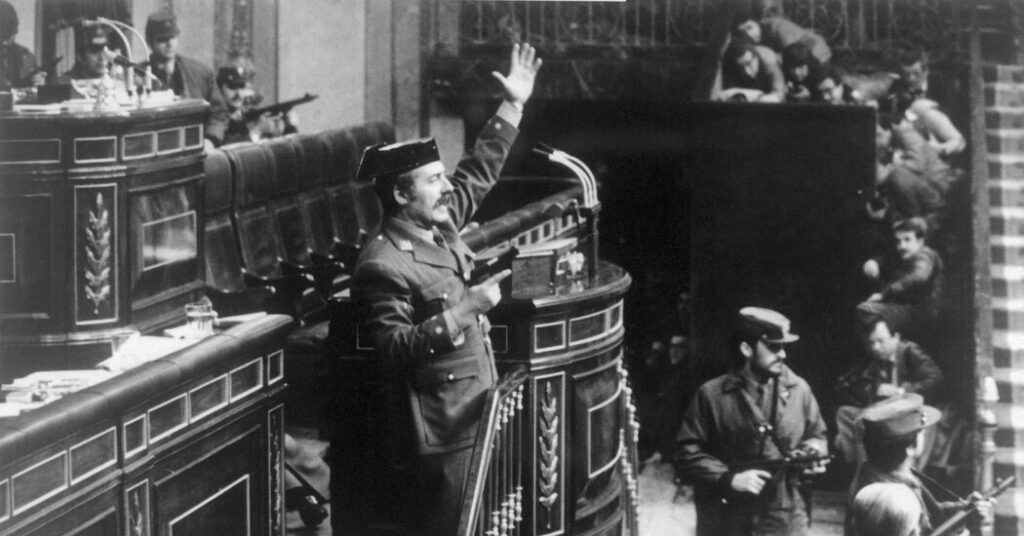
Antonio Tejero Molina, a pistol-toting Civil Guard officer who led an overnight takeover of the Spanish Parliament as part of an attempted coup that foundered when King Juan Carlos I of Spain came out in support of the country’s nascent democracy, died on Wednesday in Alzira, Spain, outside Valencia. He was 93.
His death was announced by his family’s law firm, A. Cañizares Abogados.
He died on the same day that the government declassified 153 documents from a state investigation into the revolt, saying it was releasing all of the files on the matter that it had found.
The coup attempt, on Feb. 23, 1981, threw into sharp relief the strains in Spanish society six years after the death of the long-ruling dictator Francisco Franco, some of whose followers continued to yearn for the authoritarianism of the past rather than a democratic future.
Backed by scores of armed supporters — estimates varied from 150 to 280 — Lieutenant Colonel Tejero Molina effectively took the Spanish cabinet and Parliament hostage for 18 hours before surrendering when it became apparent that he had little support among most of the country’s armed forces.
The beginnings of the takeover were broadcast live on television, providing Spaniards with riveting footage of Colonel Tejero Molina — distinguished by his stocky build, ceremonial tricorn hat and bushy mustache — squeezing off rounds from his service pistol as supporters in green uniforms fired automatic rifles into the air to quell lawmakers’ protests.
On the evening of Feb. 23, just after 6 p.m., the plotters burst into the lower house of Parliament as deputies voted on a new prime minister, Leopoldo Calvo Sotelo, to replace Adolfo Suárez, who had resigned weeks earlier, igniting a political crisis.
In the febrile atmosphere of the times, senior military figures had expressed growing concern about the spread of terrorism, ascribing it to Basque separatists, who they said were targeting the security forces. Despite its failure, the coup attempt embedded itself in the psyche of post-Franco Spain and became widely known as 23-F, for the date on which it began.
Colonel Tejero Molina had recruited his contingent of supporters from a motor pool within the 64,000-member Civil Guard, a paramilitary gendarmerie unit with a strong tradition of conservatism. They reportedly arrived at the Parliament building in a convoy of buses bought two months earlier by the lieutenant colonel’s wife, Carmen Diez Pereira, using funds donated by an unidentified business figure.
While Colonel Tejero Molina indicated that he was expecting other plotters to support him, the most significant sign of a wider coup came in the Valencia military region, in the eastern part of the country, where Lt. Gen. Jaime Milans del Bosch declared a state of emergency and ordered tanks into the streets. The general was known in Spain for his role in Franco’s Blue Division, which had supported Hitler’s campaign against the Soviet Union in World War II.
At the same time, soldiers backed by light tanks took over Spain’s radio and television complex on the outskirts of Madrid, but withdrew a couple of hours later.
After seizing Parliament, Colonel Tejero Molina told his captives that within minutes “the appropriate military authority” would announce a “new government, military of course.” But no such authority emerged. He was said to have called General Milans del Bosch to give him a message in the legendary code of the Spanish Civil War: “Sin novedad, mi general,” or “no news, my general” — meaning, “mission accomplished.”
But like Colonel Tejero Molina, the general was arrested as the coup fizzled. Remarkably, no injuries were reported.
The episode rattled Spain, reinforcing a sense that the roots of the country’s representational institution were shallow indeed. For their part, the conspirators sought to give the impression that they had the support of King Juan Carlos. One of the identified plotters, Gen. Alfonso Armada Comyn, sought an audience with the king, hoping to reinforce the idea of royal support, but the king, having secured broad backing from the security elite, rebuffed him.
At 1:14 a.m., King Juan Carlos went on television in full military uniform, as commander in chief of the armed forces, to condemn the rebellion. “The crown, symbol of the permanence and unity of the fatherland, cannot tolerate in any form actions or personal attitudes that aim at interrupting by force the democratic process,” he declared.
Colonel Tejero Molina surrendered at about noon that day.
He initially became a folk hero to Spain’s extreme right. He received so many visitors at a military prison outside Madrid that the authorities transferred him to the fortress of La Palma at El Ferrol in Galicia, in northwestern Spain, the headquarters of the Spanish Navy and the birthplace of Franco. Even there, the colonel received scores of visitors every week and at one point took the salute from the crew of a passing Navy corvette.
A year after the episode, 32 officers and a civilian went on trial before a court-martial. Colonel Tejero Molina, who was accused of leading the insurgents who had taken over Parliament, said under oath that General Armada had told him that the headquarters of the coup would be the Zarzuela royal palace, where “the king will be convinced of this operation.”
The role of General Armada, who was another alumnus of Franco’s Blue Division and who was deputy army chief of staff at the time of the attempted coup, was particularly piquant, as he had been a tutor to the king and was head of the royal household until 1977.
In June 1982, the court-martial convicted General Milans del Bosch and Colonel Tejero Molina. The general was sentenced to 26 years and eight months; Colonel Tejero Molina was sentenced to 30 years — the maximum permitted under Spanish law. General Armada, who was also convicted, was sentenced to six years.
Colonel Tejero Molina bridled at his punishment. He appealed and, in October 1982, sought and remarkably won legal approval of a quixotic plan to run for Parliament in elections that month, hoping to secure immunity. Some 25,000 people voted for him — not enough to win a seat.
In April 1983, a civilian court stiffened the court-martial’s sentences, increasing General Milans del Bosch’s term to 30 years, lengthening shorter sentences for 13 other conspirators and overturning eight acquittals.
General Armada was released early on medical grounds in 1988 and died in 2013. General Milans del Bosch was freed in 1991 because of old age and died in 1997. Colonel Tejero Molina was the last of the plotters to be released, in 1996.
Antonio Tejero Molina was born on April 30, 1932, in Alhaurin el Grande, a small town near Malaga in southern Spain. Little is widely known of his early years. He joined the Civil Guard in 1951 and served in several parts of Spain, including Galicia and the Canary Islands.
He became a lieutenant colonel in 1974 and was assigned to the Basque region, where he had a reputation as a dissident, opposed to any attempt to loosen Madrid’s hold on restive provinces. In 1978, he was jailed for seven months after conspiring in a coup plot, code-named Operation Galaxia for the Madrid cafe in which it was hatched.
For many years after he was released from prison, Colonel Tejero Molina continued to hover on the fringes of the news headlines, notably in 2019, when journalists reported his presence at a ceremony in which Franco’s remains were exhumed from an underground basilica for reburial in a family crypt near Madrid.
Colonel Tejero Molina and his wife had three sons and three daughters. Their family had close ties to the Civil Guard, a law enforcement agency with a broad portfolio of responsibilities: Two sons joined the Civil Guard and two daughters married members of it, the newspaper El País reported.
A complete list of survivors was not immediately available.
One son in the Civil Guard, Antonio Tejero Diez, was stripped of a high-ranking position in Madrid in 2014 after reports that he had organized a paella lunch at a guard facility to honor his father on the 33rd anniversary of the failed coup, El País said.
Colonel Tejero Molina’s third son, Ramón, who became a Catholic parish priest, defended the event and denied that it had been held as a commemoration. “My brother was not celebrating anything,” he said in El País. “At home, we never celebrated 23-F. Certain people are making that up. It is like Satan’s black smoke, as Paul VI used to say.”
Natasha Rodriguez and Ash Wu contributed reporting.
After a long career as a foreign correspondent for The New York Times based in Africa, the Middle East and Europe, Alan Cowell became a freelance contributor in 2015, based in London.
The post Antonio Tejero Molina, 93, Dies; Spanish Colonel Led Failed Coup appeared first on New York Times.