Last-ditch talks to avert a full-blown conflict between the U.S. and Iran are scheduled to take place today in Geneva, but both countries are preparing for things to escalate.
Two U.S. aircraft carrier groups and dozens of fighter jets, bombers and refueling aircraft are massed within striking distance of Iran; President Trump, according to my colleagues in D.C., is telling advisers that if the country doesn’t give up its nuclear program, he’s considering regime change options.
Iranian officials, for their part, are operating on the assumption that U.S. military strikes are “inevitable and imminent,” according to my colleagues’ reporting, and are working to ensure the system survives whatever might be coming, even if its leadership doesn’t.
Both sides still say they want to avoid war. But today, I’m writing about why they might end up in one anyway.
Why it’s so hard for Iran to give up its nuclear program
Do the U.S. and Iran understand each other?
I was struck recently by reporting from my colleague Erika Solomon, who is our bureau chief for Iraq and Iran, that suggests they may not. American officials, she writes, have been “bewildered” by Iran’s refusal to concede to demands on its nuclear program, even in the face of war with a more powerful country that could end in the overthrow — or even the death — of the Islamic Republic’s leadership.
The Trump administration views Tehran as weakened to the point that it should be ready to cave to U.S. demands. In part, they’re not wrong: Over the past year, the country has indeed been rocked by a succession of domestic and international crises, leaving Iran in its weakest position in decades.
But any U.S. plan to bring Iran to the bargaining table also has to factor in the scale of the Islamic Republic’s commitment to its nuclear program — especially in the face of its own weakness.
Most analysts Erika spoke to said they think the current government views giving in to U.S. demands as riskier than going to war — that caving would “encourage the U.S. to go for the jugular,” as one put it. As for the nuclear program, another analyst told her, Iran’s supreme leader, Ayatollah Khamenei, sees uranium enrichment as “a pillar of the regime itself.”
And so those who study the region increasingly see a new conflict as “almost inevitable,” Erika writes. That’s in part because of “a dangerous mismatch in perceptions between Iran and the United States.”
Nukes and national identity
It’s worth revisiting a story from last summer written by my colleague Mark Landler, who covered nuclear negotiations between the U.S. and Iran during the Obama administration. The story, written shortly after Trump launched strikes against three Iranian nuclear installations, was about why the government was unlikely to give up its nuclear dreams despite the attack.
Iran’s nuclear program, Mark wrote, has become intertwined with the country’s sense of security and national identity.
Ever since a civilian nuclear program began under the shah, Iran’s leaders “have viewed it as a proud symbol of the country’s leadership in the Muslim world, a reflection of its commitment to scientific research, and an insurance policy in its dangerous neighborhood,” Mark wrote.
That commitment has only grown stronger under the Islamic Republic: In the mid-2000s, Mark wrote, the nuclear program was “turned into almost a fetish”: During daily state-organized protests, dancers held vials said to contain some form of uranium to celebrate Iran’s right to enrich.
But even some Iranians who are angry at the current government, or who don’t care about issues like “strategic deterrence,” still see the nuclear program as a source of national pride, Mark wrote. That pride would make it hard for any government to give it up for good, even if the U.S. did succeed in toppling Khamenei.
Iran’s survival strategy
For now, the Islamic Republic is focused on a survival strategy.
My colleague Farnaz Fassihi, who has covered Iran for three decades, has been doing remarkable reporting, speaking to half a dozen senior Iranian officials, people who intimately know the inner workings of the Islamic Republic.
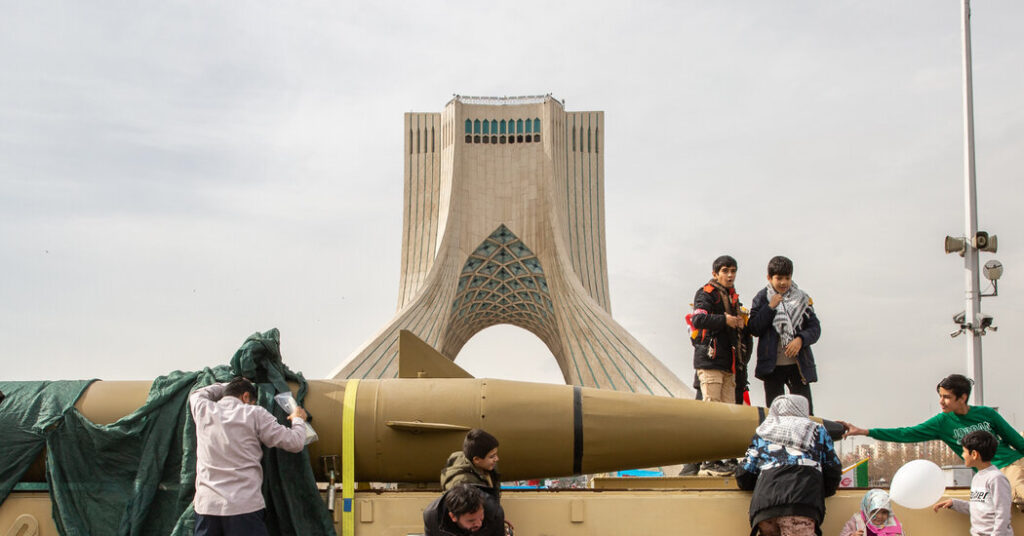
They told her that Iran was positioning ballistic missile launchers along its western border — close enough to strike Israel — and along its southern shores on the Persian Gulf, within range of American military bases.
Khamenei has delegated responsibilities to a tight circle of confidants in case communications with him are disrupted or he is killed. While in hiding last June during 12 days of war with Israel, he named three candidates who could succeed him. He has appointed a former Revolutionary Guards Corps commander to run the country who has been instructed to ensure that the system survives any assassination attempts on its top leadership.
Khamenei “is expecting to be a martyr,” one expert told Farnaz. “He is distributing power and preparing the state for the next big thing, both succession and war, aware that succession may come as a consequence of war.”
‘I’m going crazy’
There is still a potential offramp. My colleagues report that one proposal being considered is a very limited nuclear enrichment program that Iran could carry out solely for purposes of medical research and treatments. But it’s not clear either side will agree.
The Trump administration seems to be betting that, facing the prospect of serious U.S. action, Iran’s government will find a way to give up its nuclear dreams. The analysts my colleagues have spoken to think that’s unlikely. We’ll soon find out who’s right.
In the meantime, I want to recommend one more story — about how the people of Iran are coping with the stress of waiting to find out whether they’ll be under attack soon. It’s a reminder that the stakes here go beyond statecraft.
“I’m going crazy,” said one woman named Sara, a chemist who lives in Tehran. “I wish whatever is supposed to happen would happen so we could get out of this limbo.”
MORE TOP NEWS
Maduro’s final days in power
Former President Nicolás Maduro overestimated the strength of his position and misread his exchanges with the Trump administration in the weeks before his capture by U.S. forces, according to interviews with a dozen Venezuelan senior officials.
Just days before a team of elite U.S. commandos launched a raid in Caracas, Maduro was surprisingly relaxed, and he celebrated New Year’s Eve at home with family and friends. He repeatedly claimed that the Trump administration would not dare launch an attack, according to people close to him. Read how the final weeks of his presidency unfolded.
OTHER NEWS
-
There are many challenges ahead for Mexico’s government after its military killed “El Mencho.” Watch this video from my colleague Maria Abi-Habib.
-
Cuba said its border troops exchanged fire with a Florida-based speedboat that had entered its territorial waters, killing at least four people.
-
On the defensive over the economy, Trump painted Democrats as unpatriotic and “crazy” in his State of the Union address. Here are the takeaways.
-
Pope Leo will visit Africa, where the number of Roman Catholics is growing faster than anywhere else.
-
On a visit to Beijing, Chancellor Friedrich Merz of Germany complained about China’s economic policies.
-
The U.S. is planning to offer consular services to an Israeli settlement in the occupied West Bank, a move that both Israelis and Palestinians view as a shift of U.S. policy.
-
Christophe Leribault, who runs the Palace of Versailles, will lead the Louvre Museum after its president resigned in the wake of an audacious jewel heist.
-
As the war enters its fifth year, Ukrainians are tired of being called resilient.
EPSTEIN FILES
-
Files released by the U.S. government are missing records tied to a woman’s unverified accusation that Trump assaulted her when she was a minor. Trump has denied wrongdoing.
-
The former Harvard president Lawrence Summers will resign from teaching at the end of the academic year, after new documents showed his close relationship to Jeffrey Epstein.
-
The former Prince Andrew is still eighth in line to the British throne. Here’s how Britain could remove him from the royal line of succession.
WHAT ELSE IS HAPPENING
-
The brains of super-agers have a unique ability to grow new neurons, a new study found.
-
Fans of “Heated Rivalry” will soon be able to rent the Canadian cottage featured in the show’s finale.
-
Top of The World: The most clicked link in your newsletter yesterday was about Trump’s State of the Union address.
SPORTS
Football: As Real Madrid host Benfica in their second Champions League playoff match, Jose Mourinho returns to face his former club amid controversy.
Boxing: Three of the world’s biggest sports promoters are embroiled in a potential billion-dollar legal battle that could shape the future of the sport.
WORD OF THE DAY
“Lowkenuinely”
— A slang word made from two adverbs smashed together by young TikTokers. “It just means low-key and genuinely at the same time,” explained one student, who recently told a friend that 7-Eleven was “lowkenuinely out” of the type of iced tea her friend wanted.
MORNING READ
The West Yorkshire area of northern England, where Emily Brontë wrote “Wuthering Heights,” remains a place of startling natural beauty. Tourists flock to Haworth, the village where the Brontë siblings grew up. But the wider region is plagued by economic stagnation.
In the mid-19th century, Haworth was bustling and nearby Bradford, with its textile mills, was a symbol of industrial prowess. But modern Bradford, where voters head to the polls today for a special election, has twice as many unemployed workers as the national average. Its decline illustrates the poverty and regional economic inequality that are reshaping politics in Britain. Read more.
AROUND THE WORLD
Meet Afghanistan’s futsal phenom
Alireza Ahmadi, 17, became a national hero last year after scoring the winning goal against Afghanistan’s archrival, Iran, at the Asian Youth Games. His sport is futsal, a faster indoor variant of football played with five on each side rather than 11.
The victory spurred an outburst of joy that has become rare under Taliban rule. “We’re trying from our end to show a different image of Afghanistan,” Alireza said. “There was war here. Now we want to host more games with foreign teams.”
Wherever the team has traveled since its victory, Afghans have celebrated en masse. But the squad’s success has also brought a complex reality into focus: Alireza and nearly all of his teammates are Hazaras, a minority long marginalized by the Taliban. Read more.
RECOMMENDATIONS
Embrace: Double-breasted suits and sharp shoes are in, as fashion turns to jazz for inspiration.
Read: In “The Mixed Married Project,” the author wonders whether her father, a white anthropologist, married her Black mother for love — or for research.
Live: Want to age well in place? Take our room-by-room tour of the ideal setup.
RECIPE
Eprax is a multilayered casserole of Kurdish-style stuffed vegetables and lamb chops. The ingredients are layered in a pot, steamed until tender and tipped out into a messy, delicious pile to be eaten with flatbread.
WHERE IS THIS?
Where is this coastal path?
TIME TO PLAY
Here are today’s Spelling Bee, Mini Crossword, Wordle and Sudoku. Find all our games here.
You’re done for today. See you tomorrow! — Katrin
We welcome your feedback. Send us your suggestions at [email protected].
Katrin Bennhold is the host of The World, the flagship global newsletter of The New York Times.
The post A Last Chance Before War appeared first on New York Times.