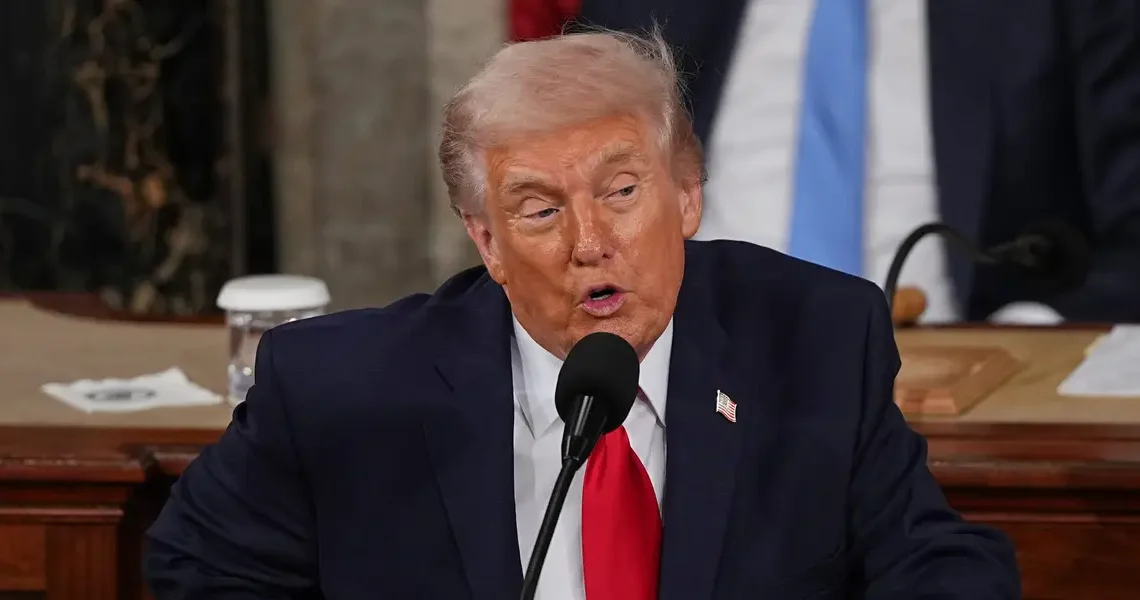
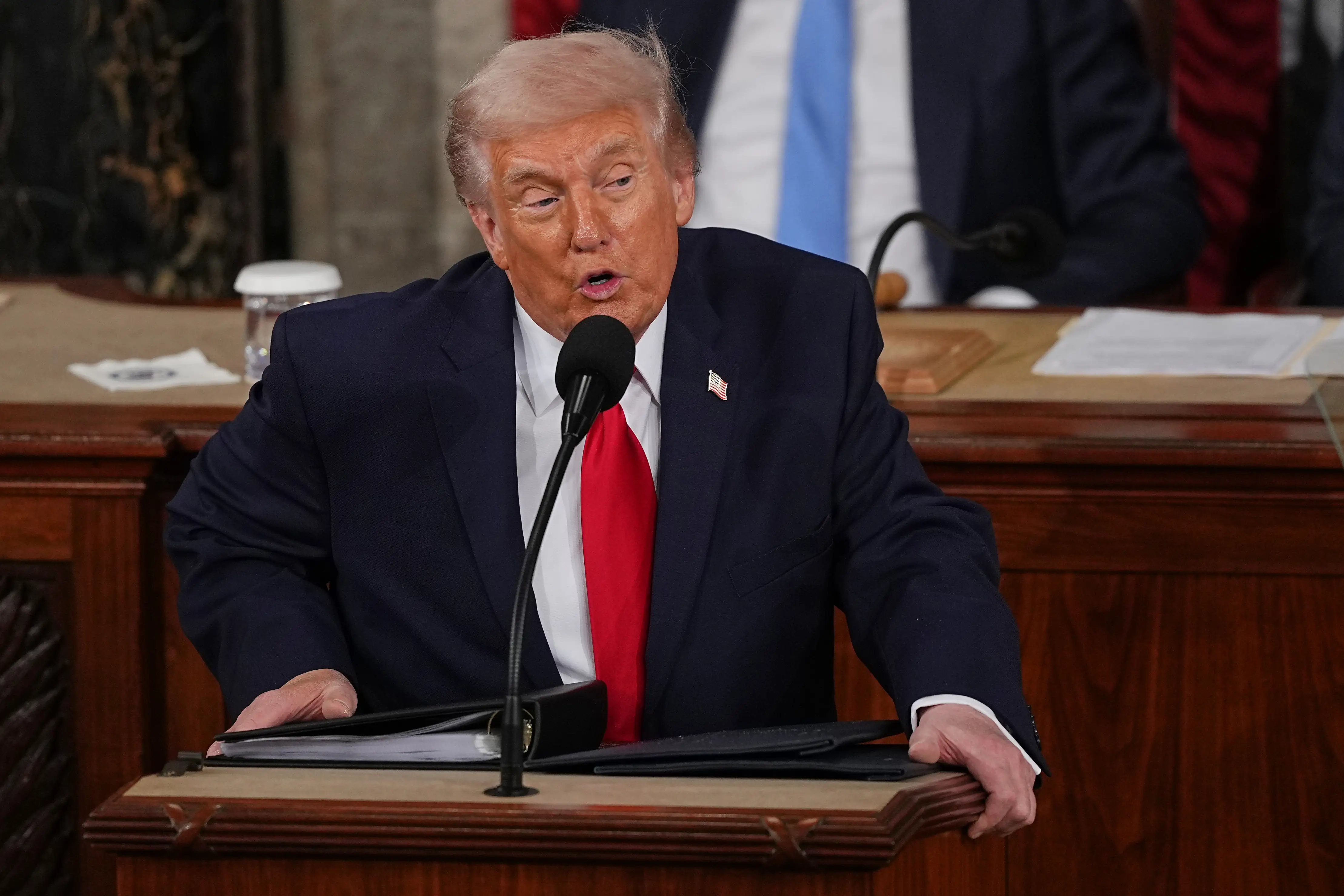
President Donald Trump gave his annual State of the Union address on Tuesday, the longest in US history.
In a two-hour speech delivered to a joint session of Congress, Trump spotlighted several topics, including the military budget, consumer prices, and tariffs, touting wins from his economic agenda.
It was light on new policy but heavy on Trump’s greatest hits: Lowering crime rates, abolishing DEI frameworks, and strengthening borders. He gave out medals to veterans, talked about voter ID fraud, and called for further restrictions on transgender rights.
Here are our key takeaways from the 2026 State of the Union.
Lower consumer prices
Trump focused much of his speech on his economic agenda, touting his administration’s effort to lower consumer prices.
“From trade to healthcare, from energy to immigration, everything was stolen and rigged in order to drain the wealth out of the productive, hardworking people who make our country run,” Trump said, adding, “Now we are the hottest country anywhere in the world.”
The president blamed Democratic lawmakers for high inflation rates, which remain above the Federal Reserve’s 2% goal. He said his policies have lowered the cost of housing, healthcare, and energy — though the financial reality is more nuanced for many Americans.
Trump spoke about tax breaks in his One Big Beautiful Bill Act, Trump Accounts, his recently-unveiled plan to increase healthcare cost transparency, and his efforts to make mortgages more accessible. He also defended the White House’s tariff policies, despite what he called a “disappointing” ruling by the Supreme Court last week.
One thing is clear: Trump wants America to think of the economy as “roaring.”
AI companies should shoulder energy costs
Trump said energy demands from AI data centers could “unfairly” drive up utility costs on Americans.
He proposed a “rate-payer protection pledge” that would require tech companies to provide their own power needs and “build their own power plants.”
“We’re telling the major tech companies that they have the obligation to provide for their own power needs,” Trump said.
“They can build their own power plants as part of their factory so that no one’s prices will go up, and in many cases, prices of electricity will go down for the community,” he said.
He added that the US has an “old grid” which could “never handle the kind of numbers.”
Trump targets affordability through tax policies
Trump mentioned a few tax policy levers aimed at relieving pressure on US households, including a no tax on tips or overtime, a tax incentive for consumers who buy American-made cars, and tax-free investment accounts named after the president.
In those proposals, Trump cast affordability as an income-side problem that could be addressed through tax relief rather than mechanisms such as direct price controls.
Tariffs, tariffs, tariffs
Trump unsurprisingly praised his tariff strategy as a catch-all solution, going as far as to say that it could replace the US income tax system.
He said tariffs were a major revenue engine bringing in “hundreds of billions of dollars” that could also bring in jobs and investments to the US. He also called it a diplomatic lever he has used to settle wars, and said that the revenue from tariffs could “substantially replace the modern-day system of income tax.”
Trump also called the recent Supreme Court ruling that blocked his sweeping policy “unfortunate” in front of the Justices who customarily attend the SOTU address. Present at the address were Chief Justice John Roberts, Justice Elena Kagan, Justice Brett Kavanaugh, and Justice Amy Coney Barrett.
Of those present at SOTU, Roberts, Barrett, and Kagan had voted that the Trump tariffs were illegal.
Congress should pass the Stop Insider Trading Act, Trump says
Trump made statements in support of the Stop Insider Trading Act during his speech, saying that members of Congress shouldn’t be allowed to “corruptly profit from using insider information.”
This is a GOP-sponsored bill introduced by Rep. Bryan Steil of Wisconsin, which would place restrictions on stock trading on lawmakers and their spouses.
The moment drew bipartisan applause, which the president called out, saying he was “impressed” that Democratic lawmakers were in support of it.
Debates about congressional insider trading and violations of the STOCK Act — a federal law designed to stop conflicts of interest and insider trading — pre-date the second Trump administration.
A trillion-dollar military budget
Trump said the administration had approved a trillion-dollar military budget for next year.
“We have the most powerful military on earth. I rebuilt the military in my first term. We’re going to continue to do so. Also, we just approved a trillion-dollar budget; we have no choice,” he said in the speech.
This is lower than the figure Trump floated in January. In a Truth Social post in January, he said he had decided to raise the military budget in 2027 from $1 trillion to $1.5 trillion to protect the US during “very troubled and dangerous times.”
He said the larger budget would be financed by tariff revenue.
Read the original article on Business Insider
The post 6 takeaways from Trump’s State of the Union speech appeared first on Business Insider.