What Brontë Country Tells Us About Britain Today
Feb. 24, 2026
Nestled among the wide-open moors of West Yorkshire sits Haworth, the English village where Emily Brontë wrote “Wuthering Heights,” the gothic romance that inspired Hollywood’s latest steamy adaptation.
The cobblestone streets and rugged hills here still conjure the hardscrabble life and wild forces of nature that underpin the novel.
As it did in 1847, when the book was published, the region offers a window into the stark contrasts and economic struggles that challenge Britain. Now, as then, social and demographic change, rising food prices and widening wealth inequality are driving populist political movements, calls for reform and spasms of unrest.
Haworth is eight miles from Bradford, a town that Emily’s father, Patrick, visited often in his role as an Anglican priest. In the mid-19th century, Bradford was a wealthy, fast-growing center of textile manufacturing, home to powerful parliamentary lawmakers and a destination for tourists and traders.
The city’s decline is typical of the hollowing-out of many postindustrial towns and cities in northern England, fueling the poverty and frustration that are shaking up British politics.
A special election on Thursday and countrywide voting in May are expected to underscore how Britain’s traditional two-party political system is fragmenting. Many voters say they will support Reform U.K., a right-wing populist party, while the Green Party is winning over left-wing voters disillusioned with the governing Labour Party.
Today, Bradford has twice as many unemployed workers as the national average. Forty percent of children live in poverty. And immigration, encouraged by the government to fill labor shortages here after the second world war, has at times prompted division and tension.
“It’s been very neglected,” said Naz Shah, a Labour member of Parliament who represents the Bradford West area. “We do have some of the most deprived wards in the country.”
Wool Capital of the World
In the 1830s, Bradford was a symbol of England’s industrial prowess. Steam-powered mills made it the wool capital of the world, turning owners into a new wealthy elite and creating an underclass of impoverished workers.
Now, the city’s wealth and power has mostly evaporated. The wool industry fell victim to globalization amid the shift to cheaper manufacturing in Asia and the rise of mass-produced synthetic fabrics.
Bradford’s City Hall, a gothic edifice inspired by the Palazzo Vecchio in Florence, still towers over the center, and some large businesses are headquartered here, including Morrisons, one of Britain’s biggest supermarket chains. But the downtown is filled with betting and vape shops and shuttered businesses.
“Being born here, I see the good and the bad,” Darren Edwards says in a walking tour of his hometown that he posted to YouTube. He points out a few of Bradford’s beautiful but “overlooked” buildings. But as he walks past an abandoned shopping mall, he concludes that “everything’s filthy, neglected, grimy, closed.”
For decades a Labour stronghold, Bradford voted to leave the European Union in 2016, and polls show that Reform U.K., whose leader, Nigel Farage, championed Brexit, is surging in popularity. “I do recognize there’s a rise of Reform,” Ms. Shah, the Labour lawmaker, said. “You’d be naïve not to recognize that.”
Yet Labour’s traditional dominance here is threatened by other forces as well. In the 2024 general election, Ms. Shah held her seat by just 707 votes. Her closest challenge came from an independent candidate, Muhammed Islam, who criticized Labour for not being more condemnatory of Israel’s conduct in the Gaza war.
Scenic Haworth
One afternoon in November, tourists gathered to listen to a banjo player outside the Villette Coffee House in Haworth. Couples walked their dogs. Parents struggled to push their strollers along the deeply rutted cobblestones.
Bradford’s woes can seem far from here.
Many people believe, incorrectly, that the Brontë siblings grew up in a remote, backward place.
As Juliet Barker writes in “The Brontës,” Haworth was actually “a busy, industrial township” with 13 small textile mills in the area when Patrick Brontë became curate in 1820. The village had its own surgeon, a wine merchant, a watchmaker and three cabinetmakers. It was overcrowded, however, and had primitive sanitation. An 1850 report found that more than 2 in 5 children died before their sixth birthday and average life expectancy was under 26 years.
While Bradford now struggles economically, Haworth became a destination for literature fans around the world, exemplifying the value of Britain’s heritage to its tourism industry, which employs over a million people and contributes more than $100 billion a year to the economy.
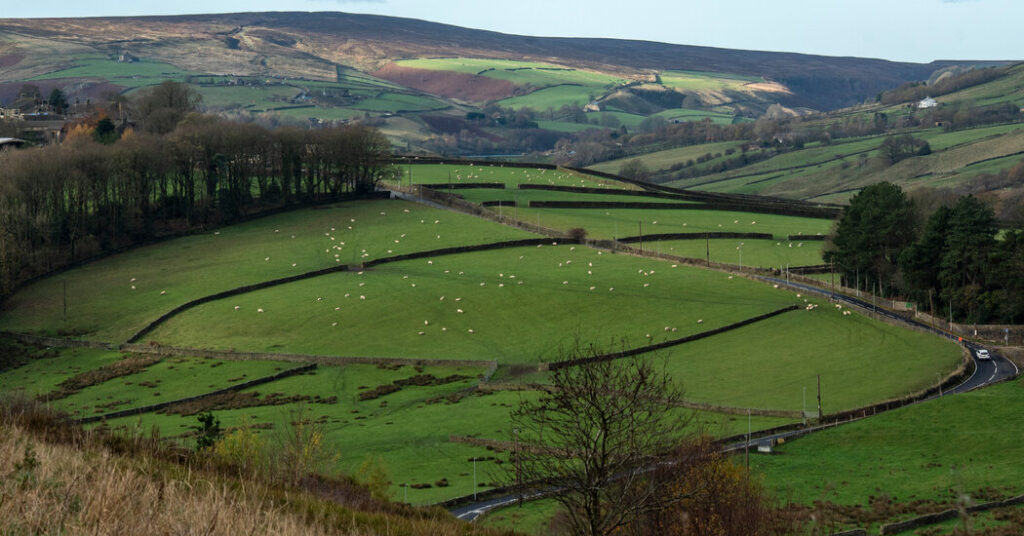
A local couple spent one Saturday stringing bunting from the wooden beams of Haworth’s recently refurbished old schoolhouse building, where Charlotte Brontë, Emily’s older sister and the author of “Jane Eyre,” had her wedding reception in 1854. Down the street, tourists quietly filed through the Brontë home that is now a museum. Outside, the moors stretch as far as the eye can see, rolling hills of dark green and brown divided by bare stone walls.
The heathlands, peat bogs and wetlands are now protected as part of a vast, 3,000-acre reserve. Last month, Condé Nast Traveller magazine called it one of the seven “wonders of the U.K.”
Migration and Backlash
Throughout the area’s history, immigration and religion have been sources of tension.
Patrick Brontë, who emigrated from Ireland, was subjected to abuse for his nationality and accent. Hundreds of thousands of Irish immigrants came to England, particularly after the devastating famine of the 1840s, and many found work in the northern towns of Bradford, Leeds and York. Roman Catholics were viewed with suspicion and, until the Emancipation Act of 1829, were barred from voting or standing for election. Jews had to wait until 1858 to enter Parliament without swearing a Christian oath, after a long political battle.
In Bradford today, a third of residents have South Asian heritage, part of a huge wave of immigration in the 1950s from Britain’s former colonies. As Commonwealth citizens, the new workers had British passports, and many came with their families to work in the textile industry.
The signs in the city are everywhere. Restaurants featuring Pakistani, Indian and Bangladeshi food sit next to the ubiquitous British pubs. The fragrant smells of biryani rice and nehari, a dish made with beef or lamb shanks, tempt hungry visitors.
But parts of the community are hardly integrated. Racial and religious divisions have fueled tension at various points in recent decades. In the early 1970s, there were clashes between workers from different parts of Pakistan, increasing conflict inside the still-operating textile factories.
In 2001, after a wave of rioting, a government report concluded that the city had done a poor job of integrating the large South Asian population. “Different ethnic groups are increasingly segregating themselves from each other and retreating into comfort zones made up of people like themselves,” the report found.
The political impact has been profound. In 2012, after a Labour member of Parliament lost a special election, an audit blamed the loss in part on a Pakistani practice called “biraderi,” a system of influence in which families and friends pledge loyalty.
“The power structure associated with biraderi is highly patriarchal, socially conservative and is regarded by its opponents in Bradford as promoting mediocre, ideology-free stooges to the council,” the report, by the Joseph Rowntree Reform Trust, concluded.
Ms. Shah said that biraderi had made it harder for the community to come together. “If you put people in positions of power, not because of accountability, but because of who they are related to,” she said, “then that doesn’t contribute to the development of a city.”
Nick Ahad, a writer and broadcaster, has lived and worked in Bradford for most of his life. His mother is from nearby Keighley, and his father is from Bangladesh. He pointed out that the diversity of the area had brought benefits as well as challenges.
“The same thing that is perceived as racial tension — actually there’s a lot of richness in the racial makeup of the city,” he said. “So you can go and have the best curry that you will have in the country in Bradford, and there are great fish and chips. You can go to some lovely pubs.”
Still, the city’s history has made it ripe for the anti-immigration message of Reform U.K., which last year announced plans to expel illegal immigrants through “a new U.K. Deportation Command.” It would be called “Operation Restoring Justice.”
Rebirth and Recovery
As in other parts of Britain, youth unemployment has long been an issue.
At one point in 1839, when Emily Brontë was 21, all four adult Brontë children were unemployed and living at home with their father in Haworth, Ms. Barker writes in her biography. In the years that followed, Emily’s brother, Branwell, would get — and lose — a job on the new railway line between Leeds and Manchester, while the sisters would each work stints as governesses, enduring homesickness and sometimes ill-treatment to pay their own way.
In Bradford, jobs have been increasingly tough to find, with recent figures showing that 6.8 percent of the city’s working-age population is unemployed. Young people have struggled even more.
Part of the reason for Bradford’s modern employment problems is a quirk of transportation geography that prevents trains from traveling through the city on their way to or from London. Over the years, train companies avoided the city altogether, routing through nearby Leeds instead.
That has had a marked effect on the city’s economic well-being. Iconic businesses like Harvey Nichols, John Lewis and Liberty, along with flagship stores for Apple, Lego and Nike, are in Leeds, taking jobs and economic energy with them.
In recent years, Bradford’s council and the national government have tried to turn things around.
Some old, decaying buildings have been torn down or adapted. The Wool Exchange building, once the heart of the wool trade, is a Waterstones bookstore. A new food hall, the Darley Street Market, opened in July.
And last year Bradford was named Britain’s “city of culture,” with the government providing money and support for a year of events to highlight its cultural heritage and to inspire tourists to visit.
There are also plans to eventually fix the train stations. Last month, British officials announced a plan worth £45 billion, about $60 billion, to improve the rail system in the northern part of the country. Local officials have said some of the money is earmarked to finally connect Bradford’s two rail lines with a single station.
As part of the yearlong city of culture celebrations, a radio play by Mr. Ahad was performed to a live audience. He said the success of the events had made him optimistic that Bradford could rise above its sometimes troubled history.
“I see the other artists that have decided to stay. I see the artists that have said, ‘We can make work here,’” he said. “You look at Chelsea in New York — the artists come first, the culture comes first. And if you build yourself around culture, then you give yourself a fighting chance.”
Michael D. Shear is the chief U.K. correspondent for The New York Times, covering British politics and culture and diplomacy around the world.
The post What Brontë Country Tells Us About Britain Today appeared first on New York Times.