I traveled to Cuba two decades ago. Fidel Castro was still president. The poverty was palpable. But the level of self-confidence, health care and education was higher than what I’d seen in neighboring countries.
Several older Cubans spoke German to me, having gone on exchanges to East Germany in their youth. When I probed them about their lives, it was clear that many wanted change in a notoriously repressive political system — and equally clear that they didn’t think change was coming any time soon.
That’s different today. Tourism has collapsed, along with much of the country. This could be the year the Cuban regime falls.
A chokehold on Cuba
Cuba, a Communist-led island less than 150 kilometers off the coast of Florida, has been a thorn in the side of the United States for nearly seven decades.
Ever since Fidel Castro led a revolution that brought him to power 67 years ago, many U.S. presidents have tried to bring the government down. During the Cold War, there was a botched invasion. The C.I.A. tried to assassinate Castro at least eight times. There have been countless economic pressure tactics and sanctions.
Now the Trump administration is betting that this is the Cuban communist revolution’s final year. Trump has cut off foreign oil shipments and several sources of foreign income that had kept Cuba’s economy and its government afloat.
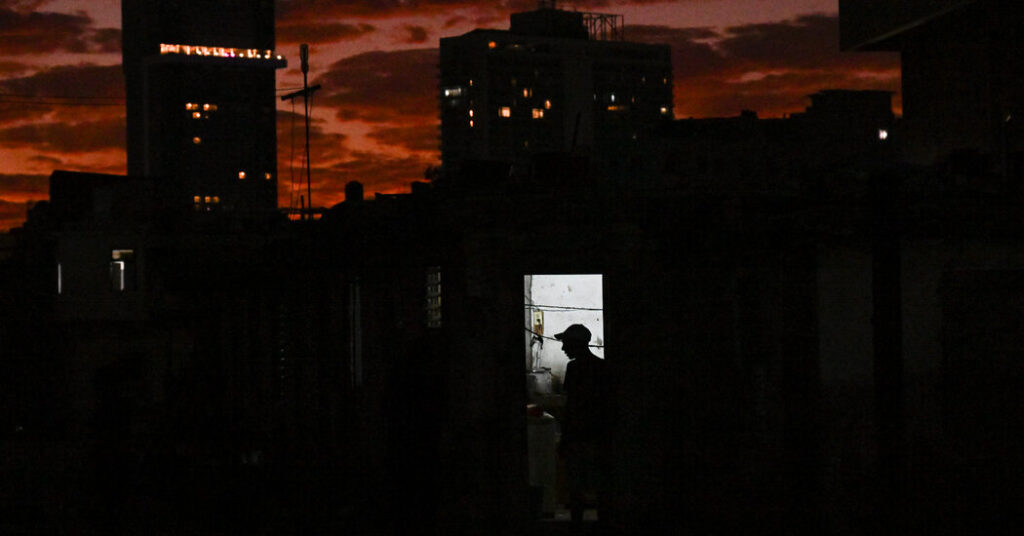
The impact has been stark: rampant inflation, gasoline shortages and lengthy blackouts. Garbage is piling up in the streets.
Predictions of the fall of Cuba’s leadership have been made before, notably after the dissolution of the Soviet Union, which was long the island’s main benefactor. So far they’ve all been wrong.
But this time feels different, writes my colleague Frances Robles, who has covered the island for over three decades.
“The situation in Cuba has become unsustainable,” Frances told me. “It used to be a running joke that no matter how bad it gets, the regime survives. No one is joking now.”
How Cuba has survived
Cuba was in crisis long before Trump became president. There were fuel shortages when I traveled there in the early 2000s; we saw bicycles on the motorway. Many of the colorful, aging Cadillacs, hallmarks of Havana’s cityscape and dinosaur reminders of the pre-revolution era, were mainly stationary.
But even after the support of the Soviet Union ended nearly four decades ago, the Cuban government always muddled through. It found three primary ways to survive.
-
After the left-wing revolutionary Hugo Chávez rose to power in Venezuela in 1999, Venezuela became Cuba’s primary source of oil.
-
Cuba monetized its widely respected doctors. Cuban medical brigades serving around the world became one of the state’s top sources of foreign currency.
-
In the 1990s, the government opened up tourism, Communist-style. State-run resorts partnered with foreign tour operators. Sun-starved Canadians became a pillar of the Cuban economy.
Creaking electricity grids often caused intermittent blackouts in the past. The Covid-19 pandemic crushed tourism. But what makes the current crisis potentially more serious is that the Trump administration has targeted the ways Cuba has survived until now.
The Venezuela squeeze
When Trump returned to the White House last year, he pivoted aggressively to Latin America. The policy is driven by Secretary of State Marco Rubio, the son of Cuban immigrants, who has long dreamed of toppling the island’s Communist government.
Frances told me the critical moment in Cuba’s latest downturn came on Jan. 3, when the Trump administration captured Venezuela’s president, Nicolás Maduro, and took effective control of the country’s oil production. Cuba was already part of the calculation. As my colleagues reported, one central reason for the strike was to deprive the island of oil.
Venezuela had been sending Cuba some 35,000 barrels of oil a day. Trump stopped that and threatened tariffs against any other country shipping oil to Cuba. Mexico, the country’s other main supplier, also stopped shipments.
Besides oil, Trump has also sharply reduced Cuba’s access to hard currency from tourism and the country’s medical missions abroad. Guatemala recently said it would send its Cuban medical brigade home.
Meanwhile, tourism has all but dried up. In February, airlines were informed that there was no jet fuel left in Cuba, causing many of them to end service. In recent weeks, empty planes have flown to Cuba to take tourists home, Frances told me.
In public statements, Cuban officials have denounced the Trump administration for trying to push Cuba toward collapse by cutting off fuel. “Surrender is not an option,” President Miguel Díaz-Canel said. The Cuban government has also signaled a willingness to engage in talks with the U.S.
What comes next?
It’s hard to say how long Cuba can last without imported oil. Some predict the crisis could come to a head within weeks.
“They’re trying to create a condition of extraordinary stress, similar to a war, in Cuba to try to shake loose offers out of the Cuban government,” Ricardo Zúniga, a former Obama administration official who helped lead secret negotiations with Cuba, told Frances. “But the Cubans have no vision for a plan that cuts them out of power.”
And it’s unclear who would lead the country if the government falls. Most opposition leaders are in prison or in exile.
But there now is a sense that “something has to give,” Frances told me.
“A lot of people do think this could be the year the regime ends,” Frances said, “either because of social unrest on the streets, or some kind of negotiated solution that the Cuban government is going to be forced to accept.”
MORE TOP NEWS
-
President Trump, bruised and unpopular, will seek a reset with his State of the Union address.
-
As the war in Ukraine enters a fifth year, Russia’s economy is increasingly under strain, with about half of the country’s federal budget going toward the fight.
-
Meta plans to purchase billions of dollars’ worth of semiconductors from Advanced Micro Devices to develop A.I. technologies and power new data centers.
-
China said it would restrict exports to Japanese companies with ties to the defense industry.
-
A new U.S. tariff went into effect at 10 percent, despite Trump’s pledge to impose a 15 percent rate. A White House spokesman said that the increase was still being worked on.
-
If China invades Taiwan and cuts off its chip exports, it would cripple the U.S. economy. Here’s a deep dive on the looming disaster that Silicon Valley has long ignored.
-
Russia’s domestic security agency is investigating Pavel Durov, the billionaire founder of the app Telegram, on suspicion of aiding and abetting terrorism.
IRAN
-
Trump said that his top general believed a military victory against Iran would be easy. That differs from what the general reportedly told the president in private.
-
As potential strikes loomed, Iran’s Revolutionary Guards conducted military drills and some Iranians packed emergency bags.
EPSTEIN FILES
-
The arrest of Peter Mandelson, the former British ambassador to the U.S., is the latest accelerant on a political scandal rocking the governing Labour Party.
-
Here’s a look at how Jeffrey Epstein ingratiated himself with top executives at Microsoft.
-
My colleague Michael Shear, our chief U.K. correspondent, explains in the video below how the former Prince Andrew’s ties to Epstein led to his downfall.
WHAT ELSE IS HAPPENING
-
The Louvre Museum’s director resigned, less than three months after burglars stole crown jewels from its collection.
-
Novels by Daniel Kehlmann, Olga Ravn and Gabriela Cabezón Cámara are among the 13 titles nominated for this year’s International Booker Prize.
-
Russell Brand, the YouTuber, comedian and actor, pleaded not guilty in London to charges of sexual assault and rape.
-
Top of The World: The most clicked link in your newsletter yesterday was about the debated remodeling of the Tour Montparnasse in Paris.
NUMBER OF THE DAY
10,000
— The number of antennas in a sophisticated new radar system that will soon begin operating in Norway to explore the northern lights. Scientists hope to zoom in on the Earth’s upper atmosphere and provide a detailed understanding of auroras.
MORNING VIDEO
Millions of pieces of luggage are lost or stolen every year at airports around the world. But not at Kansai International Airport near Osaka, Japan. Workers there pride themselves on having never lost a single bag since Kansai opened in 1994.
My colleague River Akira Davis traveled to the airport to understand what sets it apart. She found that the baggage handlers there observe the philosophy of omotenashi — the Japanese concept of selfless and meticulous hospitality. Watch River explain the Japanese culture behind the airport’s success.
AROUND THE WORLD
Outrage and a few laughs over a makeup ban in Syria
When the governor of Latakia Province in Syria banned women who work in government offices and schools from wearing makeup, some saw the move as restricting personal freedom.
A Syrian influencer joked that the ban, combined with power cuts, was part of a conservative plot to get women to cover their hair and faces. “Men should come out in protest, not women,” she said.
Weeks after the order was announced, several women interviewed said the ban was not being enforced. Still, the decision tapped into a fear among some Syrians that with former Islamist rebels now in power in Damascus, the country could tilt in a more conservative direction. Read more.
RECOMMENDATIONS
Store: Should you refrigerate apples? Read an A-to-Z guide on storing fruits and vegetables.
Ponder: Do you find Emerald Fennell’s films like “Wuthering Heights” and “Saltburn” enthralling or enraging? Here’s a case for either take.
Read: These four new works of historical fiction will take you to Berlin, Milan and beyond.
Preserve: Clean and care for your jewelry Fbawith these tips.
RECIPE
Most Slavic countries across Central and Eastern Europe have their own form of beet soup. Barszcz, the Polish variation, is usually served as a clear, burgundy broth with bright flavors. It is sweeter and beefier than Ukrainian or Russian borscht.
WHERE IS THIS?
Where is this road?
TIME TO PLAY
Here are today’s Spelling Bee, Mini Crossword, Wordle and Sudoku. Find all our games here.
You’re done for today. See you tomorrow! — Katrin
We welcome your feedback. Send us your suggestions at [email protected].
Katrin Bennhold is the host of The World, the flagship global newsletter of The New York Times.
The post Trump Squeezes Cuba appeared first on New York Times.