When President Trump addresses Congress on Tuesday, he will have a high-profile chance to issue a call to action on stalled legislation that purports to address his often repeated — and equally often debunked — claims of widespread election fraud.
Though such falsehoods have been a focus of Mr. Trump, he and other MAGA-aligned conservatives have made a particularly energetic push in the past month to urge Republicans in Congress to muscle through a strict new national voter identification bill ahead of the midterm elections.
As they face the potential for major losses in those contests, Republicans are bent on doing everything they can to enact the voting restrictions or, barring that, to spend the coming months hammering Democrats for opposing them, thus seeding doubt among voters about the outcome should Democrats prevail.
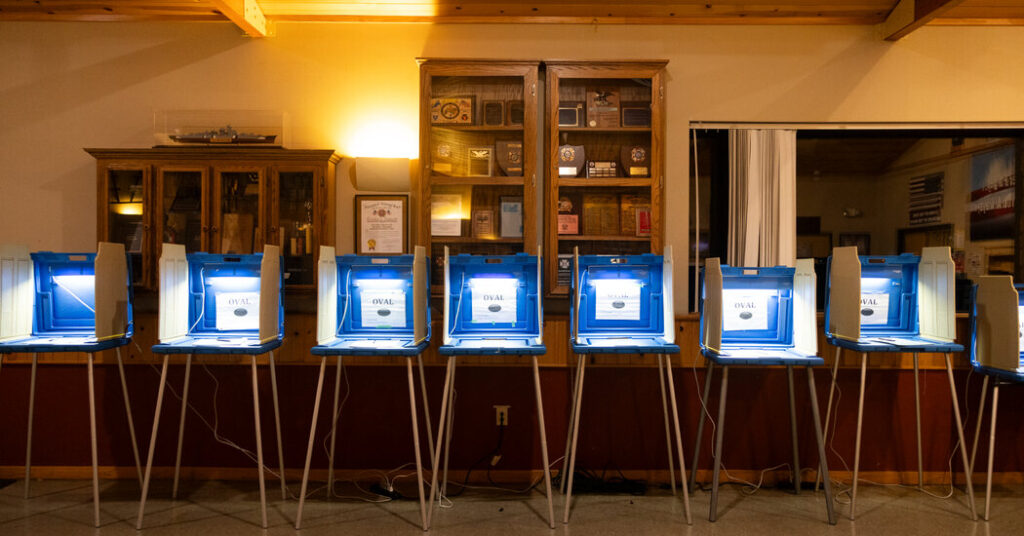
The legislation, known as the SAVE America Act, would require that Americans provide proof of citizenship when registering to vote and would create a nationwide requirement that voters show photo identification to cast a ballot. It would also grant the Department of Homeland Security access to states’ voter rolls.
Though the House passed it this month almost entirely along party lines, the bill has stalled in the Senate, where near-solid Democratic opposition means it has no chance of advancing past the 60-vote filibuster threshold.
But lifted by high-profile allies like the billionaire Elon Musk and the rapper Nicki Minaj, Mr. Trump and a group of hard-line conservatives have been urging Senator John Thune, Republican of South Dakota and the majority leader, to wage a battle royale on the Senate floor. They hope to either force the bill through over Democrats’ objections or, at the very least, spend substantial time making the public case for why it is desperately needed.
That right-wing coalition’s latest focus has been on insisting on a so-called “talking filibuster” in which opponents must occupy the floor continuously if they want to prevent legislation from becoming law.
“We are going to have the Save America Act, one way or the other, after approval by Congress through the very proper use of the Filibuster or, at minimum, by a Talking Filibuster,” Mr. Trump said in a social media post last week.
Mr. Thune has suggested he would consider options for bringing the legislation to the floor and said that Republicans would discuss the use of an old-school filibuster, which has not been required in the Senate in years.
But the senator, who is more of an institutionalist than many right-wing members of his caucus, has also warned that embarking on that tactic would disrupt his party’s ability to move on other legislation in a year when Republicans are eager to demonstrate their commitment to addressing affordability.
Mr. Trump, who has a well-established disdain for the norms and rules of the Senate, has dismissed such concerns as irrelevant. And many of his Republican allies have now begun openly arguing that the only way they can keep control of Congress in November’s midterm elections is if they pass the bill.
Democrats decry the legislation as an overly restrictive measure that would disenfranchise millions of people who lack the necessary documentation and discourage some others from even trying to cast a ballot. Many have pointed in particular to women whose birth certificates or passports do not reflect their married names, arguing that the paperwork required for them to vote would be overly burdensome. They have also expressed concerns about legal immigrants or working-class people who may lack easy access to the documents needed to register.
Mr. Trump has never shifted away from his false claims of widespread voter fraud, a campaign to instill doubts about election security that spurred a mob of his supporters to violently storm the Capitol on Jan. 6, 2021, to overturn his loss in the previous year’s presidential election.
But the president has revived his false assertions ahead of the midterm elections in November, as polls suggest disapproval with his leadership may cost Republicans in critical races. He has focused on groundless accusations that a flood of undocumented immigrants are seeking to vote for Democrats.
Even as his claims have been repeatedly debunked, Mr. Trump continues to repeat falsehoods about widespread illegal voting. During his 2024 campaign, as he was stoking voters’ fears about immigration, he repeatedly and groundlessly charged that Democrats were encouraging immigrants to cross the border illegally to turn them into voters.
House Republicans, always eager to demonstrate their fealty to Mr. Trump, have taken up the cause. Last year, they passed the SAVE Act, a narrower bill that required only proof of citizenship when registering to vote. This year, having pushed through the broader measure, they are also seeking to advance a second, more sweeping bill that bans universal voting by mail and outlaws the counting of ballots after Election Day.
Michael Gold covers Congress for The Times, with a focus on immigration policy and congressional oversight.
The post Trump Leans on Congress to Address His False Claims of Voter Fraud appeared first on New York Times.