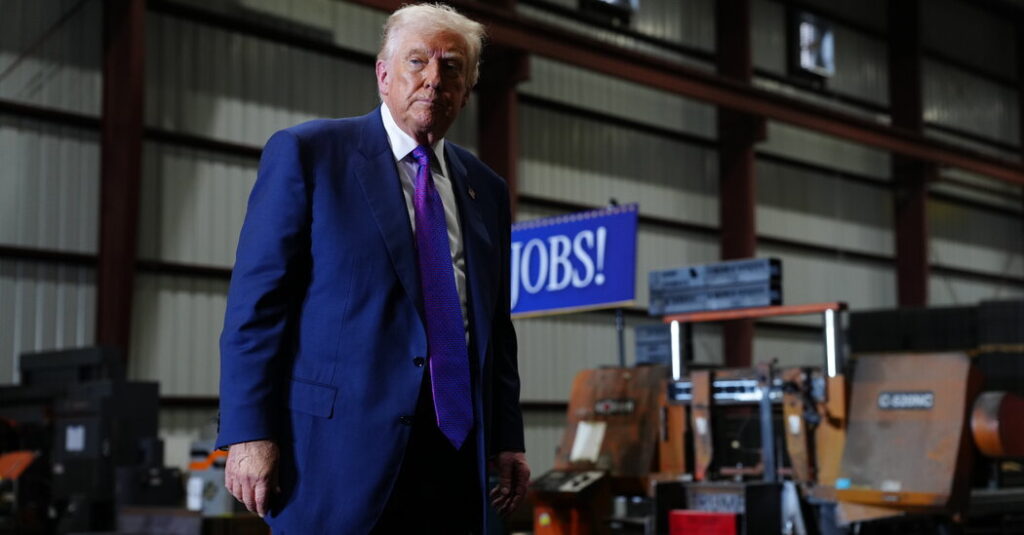
The Trump administration signaled to states this month that it was eyeing changes to the unemployment insurance system, which pays weekly benefits to out-of-work Americans. The move has left some local leaders and labor experts cautious about the future of the program.
While the White House has said little publicly about the full scope of its ambitions, it has suggested its primary focus is on fighting fraud. That coincides with President Trump’s broad, new crackdown against the theft of taxpayer dollars across government, though his actions so far have predominately punished states led by Democrats.
Earlier this month, the Trump administration invited state labor leaders to Washington for a two-day meeting in March “aimed at building momentum for modernizing how we address unemployment,” according to a copy of the letter viewed by The New York Times. The invitation sought states’ help to “implement a new vision” and “reimagine” the program but offered few other details.
The Labor Department has simultaneously ramped up its oversight of unemployment assistance, a federal system that is administered by the states. Last week, the agency singled out California for heightened scrutiny, saying it would dispatch a “strike team” to help uncover any fraud there.
A White House official, who spoke on the condition of anonymity to discuss plans that have not been made public, said the focus of the meeting in March was primarily on improving the collection of economic data but did not further specify the government’s goals. The official said the administration was also considering new ways to verify the identities of people who apply for weekly aid, which would help the Labor Department spot and prevent benefit theft.
The White House added that some of the work was separate from its new antifraud operations in California, a state the administration criticized for mismanagement.
To be sure, California is one of a handful of states with erroneous payment rates higher than the national benchmark, federal data show. The state was also among many that lost substantial sums to fraud during the coronavirus pandemic, when scammers took advantage of generous federal aid and may have absconded with more than $100 billion nationally, some estimates now suggest.
But the ways in which the White House has proceeded have led experts to question Mr. Trump’s motivations, particularly given his history of using allegations of fraud and waste as justification to halt spending that he opposes, including billions for child care and health initiatives in California and other Democratic-led states. Mr. Trump is expected to discuss his general concerns about fraud during his State of the Union address on Tuesday.
Michele Evermore, a senior fellow at the National Academy of Social Insurance, which researches and supports federal assistance, said there “seems to be some good-faith efforts to address fraud” in unemployment benefits dating to Mr. Trump’s first term.
But, she added, “there is an angle that makes this feel more nefarious, particularly the way they talk about California.”
That, Ms. Evermore continued, has left some worried that the new federal inquiry could be an “excuse” for the Trump administration “to target particular communities, rather than to target particular criminals.”
For many policymakers, there is ample room for improvement in unemployment insurance, such as the way the program operates in times of economic strife and which workers it provides with weekly assistance. The system’s greatest strains became acutely evident during the pandemic, when out-of-work Americans sought help in such record numbers that they crashed decades-old computer systems in many states.
The chaos created serious problems, including long waits for checks, while opening the door for identity thieves in the United States and sophisticated syndicates abroad. These criminals stole taxpayer dollars in such staggering amounts that federal officials have worked across multiple administrations to find and prosecute them.
By its last count, the top watchdog for the Labor Department had opened more than 209,000 investigations into unemployment benefit fraud stemming from the pandemic, the agency reported in June. The office issued its latest warning this month, having identified about $1 billion in unspent jobless benefits on unused bank cards issued by states during the pandemic.
Douglas Holtz-Eakin, the president of the American Action Forum, a conservative group, said the developments underscored the many ways in which unemployment insurance still “needs an enormous amount of work” to modernize its benefits and their delivery.
He said the Trump administration could “do some real good,” but he also acknowledged that the president often exhibited a preference for politicizing oversight, particularly by trying to “torture Democratic states.”
Mr. Trump began laying the groundwork to seek broad changes to unemployment insurance at the start of his second term, when he signed an executive order meant to enable the federal government to gather confidential data about Americans who receive weekly benefits from states.
The task fell to the Labor Department, which issued proposed rules in the fall while working with a handful of states on a new, national web portal for the unemployment program. Under a pilot, which is set to begin this year, the system is expected to handle some of the work in select states to process applications for benefits and verify applicants’ identities, according to an official, who spoke on the condition of anonymity to describe the plans.
The actions across the administration spoke to a real problem: a paucity of reliable federal data that had inhibited oversight and a continued lag among some states in upgrading their technology. But the strategy still spurred concern among groups that support the aid.
That is partly because of the Department of Government Efficiency, or DOGE, which claimed last spring that toddlers and dead people were receiving unemployment checks. Experts later disputed those claims. Critics also raised concerns about the privacy and security risks of Mr. Trump’s ambitions. Many immigrant advocates feared that his real goal was to amass information that could aid in mass deportations.
The issue took on new significance in December, after federal prosecutors in Minnesota revealed details about a network of fraud there totaling in the billions of dollars. The development led Mr. Trump to make a renewed push to tighten controls on all federal spending, focusing on states like California, which is led by Gov. Gavin Newsom, one of the president’s top rivals.
“California, under Governor Gavin Newscum, is more corrupt than Minnesota, if that’s possible??? The Fraud Investigation of California has begun,” the president said on social media last month.
California did struggle to stave off fraud in its unemployment insurance program at the start of the pandemic, according to its own auditors. Gareth Lacy, a spokesman for the state’s Employment Development Department, said California had recovered about $6 billion of the roughly $20 billion it had lost to fraud, while putting in place new security tools to protect against future abuse.
But the rate of improvement proved inadequate in the eyes of the Trump administration, which faulted the state this month and promised to send federal officials to monitor its jobless benefits. While the Labor Department cited fraud concerns, it pointed to another metric — the state’s mistaken payment rate, which is about 12 percent — as evidence of mismanagement deserving of higher scrutiny. That figure includes instances when a person who is eligible for aid receives too much or too little.
“Financial issues and potential fraud in California’s unemployment insurance program will be fully examined,” Lori Chavez-DeRemer, the labor secretary, said in a statement last week. “The previous administration turned a blind eye toward failing labor programs: This ends now.”
California is not alone with a high improper payment rate, according to the Labor Department, which dispatched a similar team to Minnesota last year. The problem affects states led by governors of both parties, including Florida, Illinois, Georgia and Kentucky. The federal government cautions that its own data is imprecise and may vary by state, making comparisons difficult.
The Labor Department also appeared to signal privately to California that it planned to conduct its scrutiny more broadly.
In a letter viewed by The Times, Michelle Beebe, the administrator for the agency’s Office of Unemployment Insurance, said this month that states could “expect more engagement” in oversight. A table included with the note indicated there were 14 unspecified states that had met its criteria for “intensive” engagement as of December.
The strike team that Ms. Chavez-DeRemer promised to dispatch appeared to be modeled on a similar initiative during the Biden administration, under which the Labor Department set up “tiger teams” for states looking to upgrade their computers to better defend against fraud.
Andrew Stettner, the senior director of economic security at the National Employment Law Project, said it was hard as a result to gauge the administration’s goals as it now turned to unemployment insurance.
Mr. Stettner, whose group supports those benefits, said the administration’s “fiery-hot press releases” obscured the fact that it is sometimes conducting “routine” oversight of federal programs.
That, he added, threatened to undermine what might be well-intentioned work at the White House.
“The politicization of it makes it less effective,” Mr. Stettner said.
Tony Romm is a reporter covering economic policy and the Trump administration for The Times, based in Washington.
The post Trump Administration Tells States It Aims to ‘Reimagine’ Jobless Benefits appeared first on New York Times.