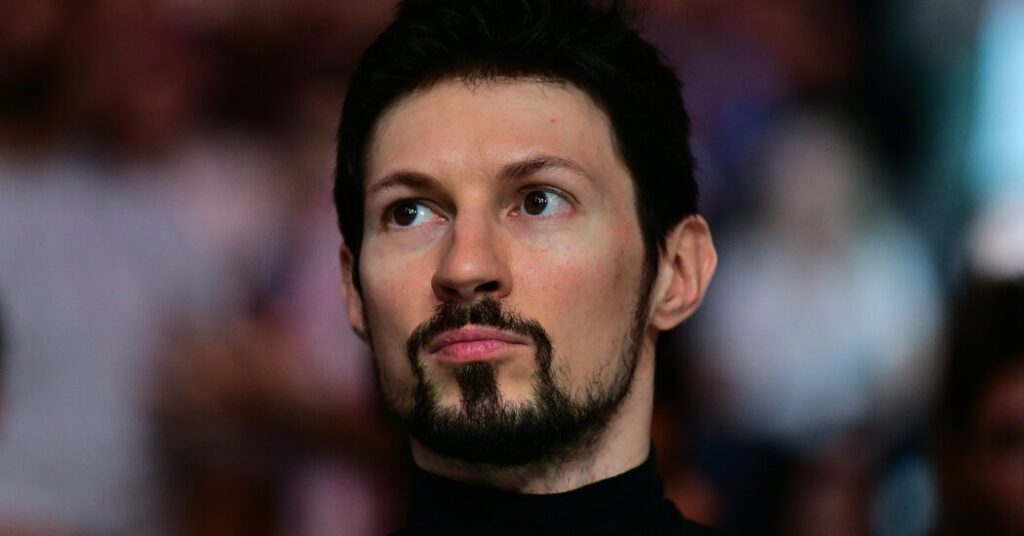
Russia is laying the groundwork for terrorism-related charges against Pavel Durov, the billionaire founder of the app Telegram, in the latest indication that the Kremlin plans to ban the go-to means of communication for millions of Russians.
Two almost identical articles that appeared in Russian newspapers on Tuesday said that the Federal Security Service, or F.S.B., was investigating Mr. Durov on suspicion of aiding and abetting terrorism. Dmitri S. Peskov, the Kremlin spokesman, confirmed that “F.S.B. research” had been used to put together the articles.
The investigation escalates a clash between Russian officials and Mr. Durov, who was born in Russia but lives in the United Arab Emirates. Two weeks ago, the Russian government tightened its incremental throttling of Telegram, accusing the app of failing to prevent its use by terrorists and criminals.
That move was seen as a significant assault on what remained of the free Russian internet. Since the beginning of the war in Ukraine in 2022, the Kremlin has expanded its control over what Russians can see and say online. It is now pushing them to move to a Kremlin-approved “super app” known as MAX.
“Russia is restricting access to Telegram in an attempt to force its citizens to switch to a state-controlled app built for surveillance and political censorship,” Mr. Durov wrote on Telegram on Feb. 10.
Mr. Durov, 41, has also been charged with a range of crimes in France, in connection to illicit activity on the app, including the distribution of child sexual abuse material, drug trafficking and fraud. He faces a potential sentence of up to 10 years in prison.
Telegram, which combines private messaging and public posts, has become a cornerstone of free speech in Russia over the past decade. More than 100 million Russians are estimated to use the app each month for news and commentary, among an estimated billion users globally.
Neither the F.S.B. nor Russian investigators have announced charges against Mr. Durov. The news articles describing the terrorism-related investigation were published in the official Rossiyskaya Gazeta and in Russia’s best-selling tabloid, Komsomolskaya Pravda. The articles laid out the F.S.B.’s view of the threats that the app poses in Russia.
Telegram, the articles said, has “become the main tool” used by Ukraine and by the intelligence agencies of NATO countries against Russia on the battlefield. The articles also accused Telegram of “helping to kill nine Russian generals, organizing school shootings and providing coordination for militants.”
Asked whether the Russian government planned to ban Telegram, Mr. Peskov, the Kremlin spokesman, declined to comment. But he said the security services were “taking the steps they believe are expedient” to deal with potentially harmful content distributed by Telegram.
The move this month to restrict some features on the app drew an outcry from ordinary Russians as well as government ministers, pro-government lawmakers and Russian soldiers who have used the encrypted app to communicate on the battlefield.
Governors and mayors across Russia use Telegram to stay in touch with voters, posting statements, livestreaming events and fielding complaints.
Many Russians view MAX, the state-controlled alternative to Telegram, with suspicion, pointing to its lack of robust encryption.
In an apparent effort to prepare the Russian public for an eventual blocking of Telegram, Russian state television last weekend featured Kremlin-connected figures who pointed out Telegram’s flaws.
On Saturday night flagship news shows, a parade of pro-Kremlin speakers recounted their experience with leaks from private chats on Telegram.
To try to protect the app in Russia, Mr. Durov had cooperated with the government for years. But his stance changed after the Russian invasion of Ukraine. Mr. Durov, who has Ukrainian heritage, has spoken out against the war.
“Durov was engaging with the Russian state and offering compromises for as long as it was important to him,” said Nikolay Kononov, the author of “The Populist,” a critical biography of Mr. Durov. “But the war became a point of no return.”
Russia has demanded that its security services be given keys to Telegram’s encryption system, granting them full access to messages sent on the app. That move crosses a line for Mr. Durov, who has promoted the app as a safe space for communication anywhere in the world, Mr. Kononov said.
Russia unsuccessfully tried to block Telegram from 2018 to 2020, citing concerns about extremist content. Voice calls were blocked last summer.
The latest escalation follows a crackdown on YouTube in Russia last year, as well as bans on Facebook and Instagram put in place at the outset of the war.
Oleg Matsnev contributed reporting.
The post Russia Moves Closer to Banning Telegram App, Saying It Foments Terrorism appeared first on New York Times.