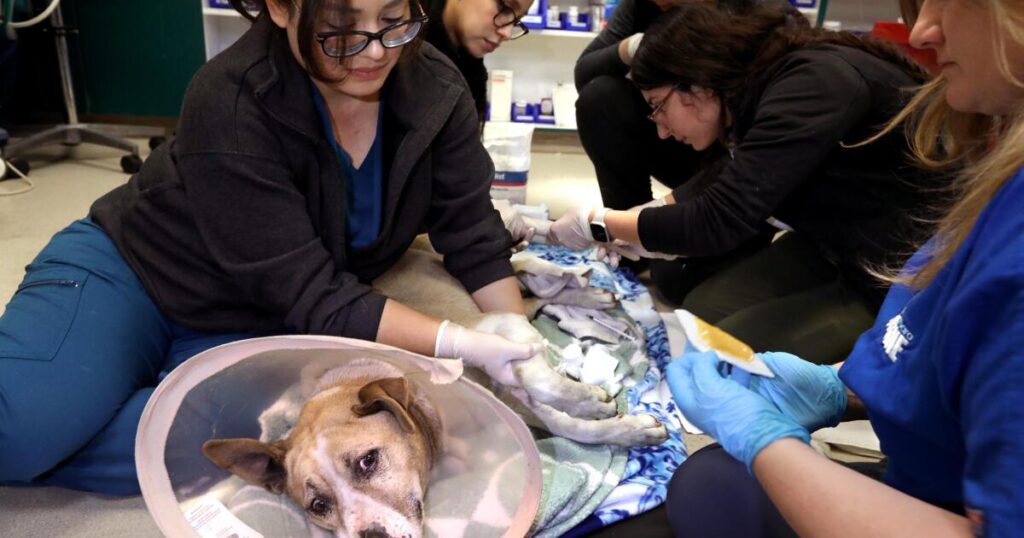
As the Eaton fire consumed an Altadena street, one family loaded their furry loved ones into a truck to evacuate — including Canelo, a dog with white-and-caramel fur.
Then, about three or four houses down, propane tanks exploded. Spooked, Canelo broke out of his collar and ran toward the fire. His humans searched for him as the blaze raged, but came up empty.
The ordeal was all-too-common during the deadly, destructive firestorms that seared Los Angeles County a little more than a year ago. As the disaster unfolded, many families frantically tried to find their pets, or put off evacuating because they didn’t want to leave them behind. Hundreds of animals were ultimately killed, injured or displaced.
Now, a new federal bill with bipartisan support has been introduced to beef up emergency preparedness for pets in the event of natural disasters like wildfires or hurricanes.
The Providing Essential Temporary Shelter Assistance for Emergencies (PETSAFE) Act would expand the allowable use of existing emergency management funds to also cover veterinary supplies or crates to transport pets, as well as fund development of an animal response team or other kinds of training.
States and local governments could apply for the competitive grant funding. The proposed legislation would increase the federal government’s share of the payment from 50% to 90%.
Rep. Judy Chu (D-Monterey Park) was among the lawmakers who introduced the legislation this month. Sen. Adam Schiff (D-Calif.) is spearheading companion legislation in the Senate.
Proponents say the goals of the legislation are to make sure communities are prepared to quickly reunite animals with their owners and to bolster coordination among emergency responders.
“When the Eaton fire tore through my district, so many families were forced into an impossible choice,” Chu said in a statement. “As a result, many families delayed evacuating because they couldn’t bear to leave their pets behind.”
Chu’s office visited an animal shelter in the wake of the Eaton fire and encountered a gray cat with severe burns on its face and all four legs. She was able to pet the cat, gently.
“I think that moment meant a lot to her,” Claire Berry, a spokesperson for Chu’s office, wrote in an email.
In the case of Canelo, Good Samaritans found him and brought him to the Pasadena Humane Society, where veterinary staff tended to his badly burned paws and smoke-irritated eyes. He eventually reunited with his family.
“The house, really, to be honest with you, doesn’t matter to us,” his guardian, Steve Rodriguez, says in a Pasadena Humane video. “We really just wanted to make sure that everybody was all right. I can’t buy another Canelo. I can’t buy another of my mom or my dad.”
As proposed, the bill “improves preparedness and removes unnecessary cost barriers, so states and local governments have the flexibility they need to protect animals, families and first responders during hurricanes and other emergencies,” said Florida GOP Rep. Vern Buchanan, who is co-sponsoring the legislation.
Kevin McManus, a spokesperson for Pasadena Humane, said the nonprofit had responded to disasters in the past, but still needed a lot of equipment during last year’s fires as animals flooded in. The nonprofit cared for more than 3,200 fire-affected pets — including a 200-pound tortoise named Huckleberry — and is still supporting a handful.
One of the organization’s greatest expenses during the fire was specialized veterinary equipment, such as oxygen kennels.
According to McManus, it would probably be harder for rural areas — where animal control might be part of a local police department — to acquire such things. He said this bill would allow agencies to stockpile crates so they don’t have to scramble when disaster strikes.
“Animals will be saved because the equipment is already there in place,” he said.
He said Pasadena Humane was able to assist animals at a Red Cross evacuation center during the Eaton fire. Funding through the bill could potentially allow the city of Pasadena to provide supplies like dog crates directly to the aid group, streamlining the response.
McManus suggested that people’s love for their furry, feathery or scaly companions transcends party lines.
“The things that are dividing us aren’t our love for our pets and wanting to make sure our pets are safe and our pets stay where they should be, which is with their families,” he said.
The post Pets needed help during the L.A. firestorm. A new bill aims to improve preparedness appeared first on Los Angeles Times.