The fate of an air safety bill written in the wake of a deadly midair collision outside Washington last year seemed less certain on Monday, after the Pentagon pulled support from the bill and key House members took to the House floor to vocally object to its passage.
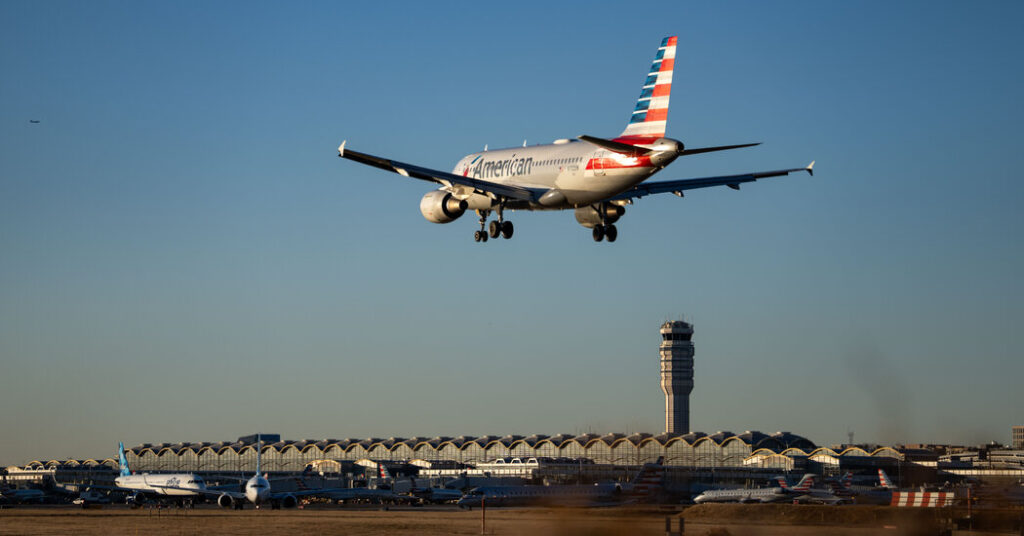
The bipartisan bill, known as the ROTOR Act, is aimed at addressing certain factors that contributed to last year’s midair collision between a commercial jet and a military helicopter at Ronald Reagan National Airport, killing 67. It passed the Senate unanimously in December, just hours after the Pentagon issued an endorsement. Passage in the House had been expected this week, which would send the legislation to the president’s desk for his signature.
But on Monday, a Pentagon spokesman, Sean Parnell, said the bill “would create significant unresolved budgetary burdens and operational security risks affecting national defense activities.” In a statement, he argued that the Senate neglected to include several “mutually discussed updates” to the legislation, but did not specify what they were. Two congressional aides familiar with those negotiations said that the Pentagon never raised such concerns during their discussions since the Senate passed the bill.
“The ROTOR Act includes specific language at the Pentagon’s behest to best protect classified flights,” Senator Ted Cruz, Republican of Texas and the chairman of the Senate Commerce Committee, which oversees aviation, said in a joint statement with Senator Maria Cantwell, of Washington, the panel’s top Democrat. They added, “We appreciate the dialogue with the Pentagon and look forward to the ROTOR Act’s passage so that our skies are made safer immediately.”
Yet the Pentagon’s backtracking appeared to fuel opposition to it among leaders of the House Armed Services and Transportation and Infrastructure Committees, who lobbied against the Senate-passed bill as they introduced it on the House floor.
The legislation “provides an overly prescriptive approach to mandating a specific technology which is still largely under development in a manner that can prove burdensome to some operators,” said Representative Sam Graves, Republican of Missouri and chairman of the transportation committee, as he warned that the bill could create an “operational crisis.”
“The bill before us today is a flawed response to last year’s tragic midair collision at Reagan National,” said Representative Mike Rogers, Republican of Alabama and the chairman of the armed services panel, adding that it would “undermine our national security.”
If passed, the bill would force a safety review of flight routes at all large and midsize airports, limit the conditions under which the military could turn off advanced location broadcasting technology, and require most aircraft to be equipped with advanced location tracking technology by the end of 2031. The House’s G.O.P. leaders announced last week that they would put the ROTOR Act to a vote, just hours after the N.T.S.B. released its final report on the midair collision.
That report determined that had the aircraft involved been equipped with the advanced location tracking technology, known as ADS-B In, the pilots of the helicopter and jet would have had almost a minute of warning that they were on a collision course. The report found that the pilots only realized they were about to crash a little more than a second before impact.
The ROTOR Act has been endorsed by a number of trade unions, Jennifer Homendy, the chair of the National Transportation Safety Board, and a group representing the families of those who were killed in the midair collision.
But opponents of the legislation have rallied around an alternate bill, which Mr. Graves’s and Mr. Rogers’s panels released last Thursday. It considers a broader range of issues related to last year’s midair collision, and the recommendations the N.T.S.B. made to address safety gaps. The backers of that legislation, known as the ALERT Act, have criticized the ROTOR Act as a premature, and incomplete, attempt to improve aviation safety.
“ROTOR responded first, before the N.T.S.B.’s investigation was complete, and as a result, only addresses a few of the N.T.S.B.’s final recommendations,” Representative Rick Larsen of Washington, the top Democrat on the House’s transportation committee, said on the floor, calling the ALERT Act “truly comprehensive.”
The alternate legislation does not have the endorsement of the N.T.S.B. chair or the families of the victims of those killed in the midair collision. Several aviation safety advocates have also criticized it for failing to mandate a date certain by which aircraft would have to incorporate the ADS-B In tracking technology. They have also raised concerns that the limitations on when military aircraft can turn off advanced location broadcasting technology do not go far enough to avoid a repeat of the circumstances surrounding the midair collision.
“Passing the ROTOR Act is the strongest first step we can take to ensuring a safer airspace for the flying public today,” Representative Don Beyer, Democrat of Virginia, said on the House floor. He called for its passage “to mandate that pilots have access to ADS-B In and Out as soon as possible.”
It is not clear whether Mr. Graves’s and Mr. Rogers’s efforts to steer support away from the ROTOR Act will derail the legislation. Two-thirds of House members need to support the legislation for it to pass this week, and several members, including the House aviation subcommittee’s Republican chairman, Representative Troy Nehls of Texas, have publicly declared their support for it.
Speaker Mike Johnson, Republican of Louisiana, also has not signaled that he plans to pull the vote from the floor.
Should the vote fail, it would most likely throw negotiations around the ALERT Act into a higher gear. Lawmakers have been scrambling to address mounting tensions between the military and the Federal Aviation Administration about how aircraft can operate in busy airspace, particularly in areas as congested as the skies surrounding Reagan National.
In the year since the midair collision, the F.A.A. clamped down on clandestine military operations in that airspace, rerouting helicopter routes and drastically limiting what military flights can traverse the airspace above Reagan National without broadcasting their location. Training flights — such as the one involved in the Jan. 29, 2025, collision outside D.C. — were explicitly barred from operating in the area without the location tracking turned on.
But in December, lawmakers passed a defense bill that threatened to loosen those restrictions, leaving it largely to the military to determine — with the transportation secretary’s concurrence — which aircraft could be exempt from the tracking requirements. The ROTOR Act dictates that such requirements cannot be waived for routine flights, nonclassified missions, training flights, or transport of any government officials ranking lower than a cabinet member or the chairman of the Joint Chiefs of Staff.
The tensions between the Pentagon and the F.A.A. are playing out in other areas as well. This month, the two agencies clashed over the use of a high-energy laser, commissioned by the Pentagon but on loan to Customs and Border Protection, to shoot down what turned out to be a metallic balloon near El Paso. The F.A.A. responded by closing the airspace for what initially was supposed to be 10 days, lifting the restrictions hours later under pressure from the White House.
Karoun Demirjian is a breaking news reporter for The Times.
The post Pentagon Pulls Support for Air Safety Bill Written After D.C. Collision appeared first on New York Times.