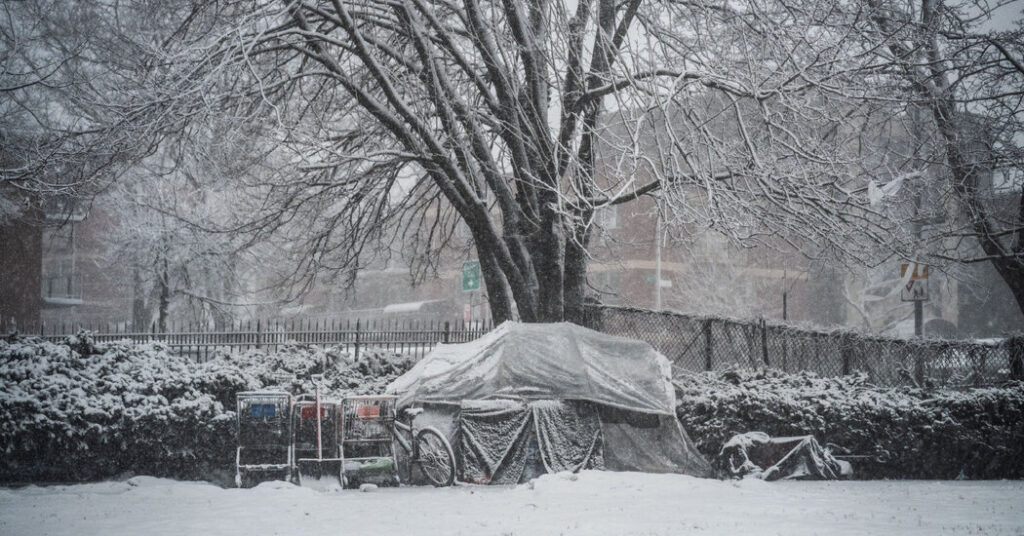
Just weeks after a cold spell left at least 20 New Yorkers dead or dying on New York City’s streets, the city’s homeless population has endured another potentially lethal storm, as a blizzard blanketed the boroughs with nearly two feet of snow and temperatures dropped significantly.
Mayor Zohran Mamdani is again flooding the airwaves and social media with snappy videos of himself in a custom Carhartt jacket, warning New Yorkers to stay safe. He is again holding news conferences at the city’s emergency operations headquarters, surrounded by top aides in outerwear bearing agency emblems. And he is again at the helm of a government operation that, by virtue of its complexity and general unwieldiness, can lend itself to people falling through the cracks.
Yet seven weeks and two major winter storms into his tenure, Mr. Mamdani is effectively getting a second chance, and this time, with a snowstorm that will not be accompanied by weeks of below-freezing weather. On Wednesday, the temperature is supposed to rise into the low 40s.
During a news conference on Monday, Mr. Mamdani said that so far, no outdoor deaths had been reported.
His administration has dispatched hundreds of outreach workers to offer homeless people access to heated environs — on buses, in hospitals, at schools. Learning from the policies it initiated during the last storm, but not at its inception, the city at the start of this blizzard sent out ambulettes to bring warm-weather supplies directly to people living outside and to transport them to shelters, made new emergency shelter beds available and kept overdose prevention centers open overnight, according to a City Hall spokesman.
“We took a hard look at everything that worked and started it from the first day of this blizzard response,” Mr. Mamdani said.
In the interregnum between the first storm and the second, Mr. Mamdani also reinstituted efforts to clear homeless encampments. At least one of the individuals who died during the last storm had been living in a camp site — in his case, off the Long Island Expressway in Queens.
Some homeless New Yorkers were paying heed to the city’s outreach efforts. On Sunday morning, about 60 people were sheltering at a drop-in center in the Hell’s Kitchen neighborhood of Manhattan, many of them sleeping on orange, plastic chairs.
Others encountered crowded facilities with little room to spare. Several homeless people on Sunday told reporters in Queens that they had not had any recent contact with outreach workers.
For Charles Crawford, 50, access to the city’s shelter system proved complicated.
On Sunday, Mr. Crawford tried to stay at two so-called Safe Haven shelters, where the typical curfews are relaxed, and people have more privacy. But the shelters were full, he said in an interview on Monday. Then Mr. Crawford tried to enter a warming bus stationed on Lenox Avenue in Harlem, only to be told there was no room.
“We’re packed, we’re packed right now, no room, no room,” Mr. Crawford recalled the warming bus workers saying.
Then Mr. Crawford sought to access a warming center at the nearby public hospital, which is listed as an option on the city’s informational 311 website. But there, too, he was turned away. On Monday, two hospital workers told a reporter that there was no warming facility on site.
Adam Shrier, a spokesman for New York City Health and Hospitals, said later on Monday that on Sunday night, roughly 30 New Yorkers used Harlem Hospital’s warming center and that the staff turned no one away.
Mr. Crawford said that he went to sleep on a nearby subway platform, but got cold. So he repaired to another.
On Monday morning, he wandered into Pennsylvania Station, but did not stay long, because officials were preventing people from sitting on the floor. By the afternoon, he could be found sitting under scaffolding on 34th Street and Eighth Avenue wrapped in a metallic space blanket. He said he planned to spend the night on a subway platform.
Like other homeless people interviewed in recent days, Mr. Crawford remained reluctant to enter the conventional, congregate city shelter system that he regarded as chaotic and unsafe.
“The shelter people are rough, there are mentally ill people, angry people, you won’t have peace,” agreed Edward Roberts, 64, in an interview on Monday morning at Penn Station.
Mr. Roberts had spent the previous night in the passageway of a nearby store, using cardboard to block the wind. He drank a little, smoked a cigarette, then read a Stephen King novel under a night light until he fell asleep. He went to Penn Station in the morning to warm up, joining dozens of others who had made similar calculations.
Indeed, on Monday morning, when Penn Station, the nation’s busiest rail station, would normally have been thronged with commuters, homeless New Yorkers appeared to outnumber passengers.
Police officers and workers with the Metropolitan Transportation Authority made frequent sweeps of the bathrooms, waking up anyone who may have taken to a stall for a break. In both Penn Station and the adjoining Moynihan Train Hall, where seating is scarce, officers sporadically asked people who were lying down to sit up and people who were sitting to stand up.
Tim Minton, a spokesman for the M.T.A., which runs parts of Penn Station, said those rules were in place to preserve adequate egress and to prevent people from falling victim to crime while asleep. Mr. Minton added that the authority’s leadership had instructed its police department not to eject anyone from the station during the blizzard.
A spokesman for Amtrak, which owns Penn Station and helps operate Moynihan Train Hall, had no immediate comment.
By the afternoon, Moynihan had filled up with commuters waiting on canceled Amtrak trains, and people were being allowed to sit on the floors.
As Juan De La Cruz, the director of emergency relief services at the Coalition for the Homeless, was handing out food on Sunday in Midtown Manhattan, he was startled to hear two homeless men tell him that police officers had taken their sleeping bags and warm winter coats from them while they were sheltering in the subway system.
Mr. De La Cruz and his organization reached out to the Mamdani administration for more clarity, as it was their understanding that the police would not seize homeless people’s belongings during the storm.
Both men were migrants, and Mr. De La Cruz wondered whether a language barrier played a role.
“They shouldn’t be taking any actions that are going to put people at risk or lessen their ability to stay warm or survive the blizzard,” said Dave Giffen, the organization’s executive director.
A spokesman for the mayor had no immediate comment.
Miles G. Cohen contributed reporting.
Dana Rubinstein covers New York City politics and government for The Times.
The post New York City’s Homeless Population Endures Another Dangerous Storm appeared first on New York Times.