I GIVE YOU MY SILENCE, by Mario Vargas Llosa; translated by Adrian Nathan West
Mario Vargas Llosa, who died last April at 89, received the Nobel Prize in Literature in 2010 for his searing fiction about politics, power and social desperation across the Spanish-speaking world and beyond. His final novel, “I Give You My Silence,” is his last word on Peru, his own inscrutable country, whose mysteries he spent a lifetime trying to untangle.
The novel has now been published in English, its precise, largehearted prose wonderfully translated by Adrian Nathan West. It is, in part, a paean to Peru’s homegrown music, especially the vals, a folk rhythm inspired by the European waltz. Peruvians made it a native form every bit as expressive as the Argentine tango, which, like the vals, flourished in the early 20th century. The genre emerged from the narrow, covered, disease-ridden alleyways of Lima’s poorest barrios, some of which date back to colonial times.
By the 1920s, the vals, the more upbeat marinera and other musical inventions had penetrated every class and race of the otherwise incurably divided country; people high and low, Andean and coastal, reveled to the clear sound and aching lyrics of vals songs. (One example: “Hate me please, I beg you/Hate me without mercy, hate me true./If you hate me, I’ll know/There was a time when you loved me.”) The protagonist of “I Give You My Silence,” Toño Azpilcueta, is surely speaking for his creator when he calls the vals Peru’s greatest cultural contribution to the world.
Toño is an impoverished music critic, a prowler of Lima’s clubs and bars, where, with harsh honesty, he reports on the local folk scene. He is a serious man, an ascetic writing without illusions of success, gathering music from obscure corners of the city as Alan Lomax did in the Mississippi Delta, but without government support.
Ignored by intellectuals and the major newspapers, he publishes his essays for a pittance or no money at all in tiny magazines that share his mission to keep the culture they cherish alive. His wife washes and sews clothes to support him and their two daughters. His only admirers are musicians working for little or no pay themselves.
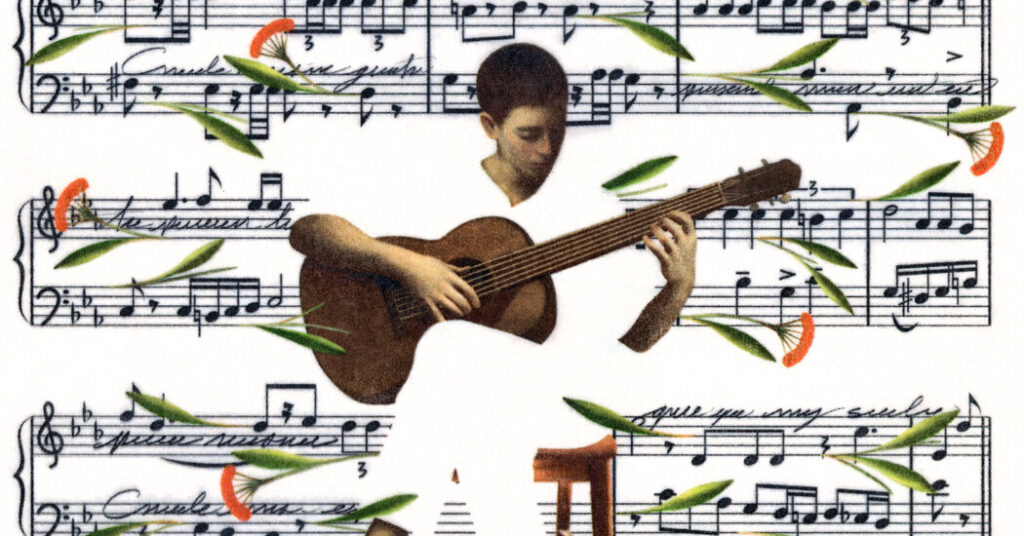
One evening Toño goes to hear an unknown guitarist named Lalo Molfino. Under a single spotlight, Lalo, little more than a boy, takes the stage in the garden of a crumbling mansion packed with invited guests. Skinny and surly, he’s dressed in patent leather shoes without socks and ill-fitting pants that barely reach the middle of his calves. When he begins to play a strange hush envelops the audience.
Lalo makes his guitar “soar and subside” in a way that is completely new to Toño, “he who had heard every professional guitarist in Peru, from the legendary to the insignificant.” It’s as if the familiar notes Lalo plays were invented on the spot, transporting Toño to a place he has spent his entire life searching for yet never fully imagined. “Tears bathed Toño’s face, his soul opened wide with longing,” Vargas Llosa writes, “and he longed to embrace his countrymen, his brothers and sisters, who had witnessed this marvel.”
After the recital Lalo slips away without uttering a word. He goes on tour with a group assembled by a musical impresario from Lima. But he refuses to perform with the other musicians, demanding the stage for himself. He is so supercilious that the tour collapses.
Toño, meanwhile, decides to write a biography of Lalo, to communicate the utopian insight into his country’s soul that the guitarist has inspired. He scratches up enough money to visit Lalo’s birthplace in northwestern Peru. But clues about his life are scarce.
Toño learns that Lalo’s mother, an anonymous denizen of the slums, left him as a newborn in the town’s garbage dump to be eaten by rats. A local priest found the wailing mestizo and brought him up in his rectory. As a young boy, Lalo unearthed a ravaged guitar in the same dump that had briefly been his home. He restored it obsessively, and this scrap of refuse became the conduit for his supernatural sound.
It sounds like a myth, that of David, perhaps, with his soothing harp. But in Vargas Llosa’s hands the myth turns realistic and gritty. Lalo is fragile, scarred, repelled by his own discarded body and incapable of intimacy.
The biography is driven by Toño’s vision of a Peru united by the common language of its music. In fact, a national sensibility did grow up around the vals, a uniquely Peruvian way of behaving and viewing the world known as huachafería. Vargas Llosa’s narrator describes it as “an exaggeration of sentiment, a verbal styling” that can be loosely compared to kitsch or camp.
Huachafería is insolent, bombastic, mawkish, and yet a parody of all these things. “It is irrational and sentimental,” says the narrator. “It sees the world through the lens of emotion and sensation long before reason appears; ideas are dispensable, merely decorative, and often an obstacle to the free flow of feelings. … Huachafería can be brilliant, but it is rarely intelligent.”
In his struggle to drill into the core of his subject, Toño discards dozens of drafts. When the manuscript is finally completed it’s rejected by every publisher, before a poor bookseller brings it out on cheap paper with no publicity or reviews. To Toño’s and his publisher’s astonishment, the first edition sells out.
From here, Vargas Llosa creeps into the darker realms of Toño’s obsessions. He is almost as fragile as Lalo, with a phobia of rats and a manic need to add to his book until it encompasses the entire history of Peru, from before the Spanish conquest to the present. He succumbs to an illusion that has afflicted many ambitious writers: the belief that everything is relevant to their story and even the most peripheral events radiate toward its center, demanding inclusion.
The revised second edition sells out even faster than the first and orders for more copies flood in. Toño’s mania to expand his work grows unabated, and the book’s fate supplies much of the story’s dark pleasure — and suspense.
Vargas Llosa has written with brutality, humor, sarcasm and hardened empathy about Peru and Latin America. With “I Give You My Silence” he adds a moving tenderness. Both erudite and raw, the novel was completed in 2022, when the author knew he had a terminal illness. Like most of his late fiction it is written plainly, yet it is shot through with passages that recall his most passionate work.
During Vargas Llosa’s lifetime, his political beliefs underwent extreme changes, from supporting Castro’s revolutionary Communism to championing traditional European liberalism, which included an adamantine belief in unregulated markets. He might have become president of Peru when he ran in 1990, if not for his visible alliance with his country’s white upper class. But he always believed in the power of a rooted culture, and as a writer, at least, he was anything but a snob.
Vargas Llosa was acutely aware of Peru’s “morbid and masochistic streak,” as his narrator puts it. “I would just as soon the ‘whites’ and ‘Indians,’ as we call them, vanish, swallowed up by a campaign of total miscegenation … to produce the mongrel nation that will reveal Peru’s truest essence,” he writes with typical bluntness.
A fitting farewell from a gifted novelist whose best work was fueled by his own warring emotions and ideas.
I GIVE YOU MY SILENCE | By Mario Vargas Llosa | Translated by Adrian Nathan West | Farrar, Straus & Giroux | 246 pp. | $28
The post Mario Vargas Llosa’s Swan Song Is an Ode to Peruvian Music appeared first on New York Times.