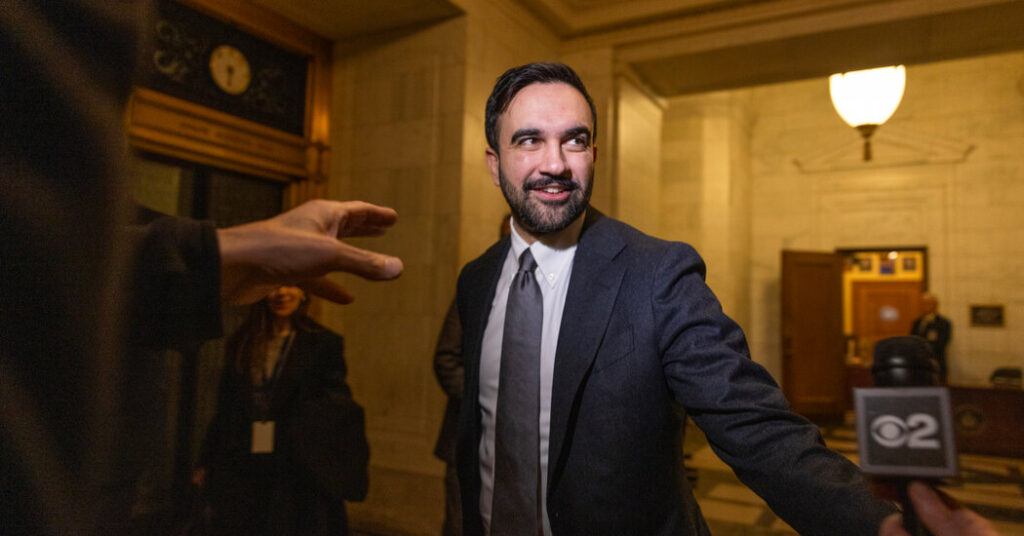
Nearly two months into Zohran Mamdani’s mayoralty in New York City, the business elite and Democratic establishment he knocked aside are beginning to plot a long, if uncertain, climb back to political power.
The organizing push, which was described by 10 people involved in or familiar with it, is still early and disjointed. But it features many rich, powerful and ideologically moderate fixtures of city politics who share a critical view of the mayor’s agenda and the democratic socialist movement he leads.
Some are looking for ways to push back on City Hall’s aggressive posture toward corporations. Some are organizing around concerns over antisemitism that they tie to his criticisms of Israel. Several people pitching their plans to donors have singled out a string of Democratic primaries in June, which pit more moderate Democrats against democratic socialists, as an early testing ground.
In one effort, the longtime Democratic consultant Phil Singer is preparing to run a group that would raise and spend money and serve as a watchdog over Mr. Mamdani’s mayoralty, according to two people familiar with it. Mr. Singer’s firm worked on a $30 million super PAC for former Gov. Andrew M. Cuomo’s unsuccessful mayoral run last year.
Another group of close Cuomo allies, including Steven M. Cohen, who ran the former governor’s super PAC, convened a meeting in early February to discuss longer-term approaches to curbing the left’s influence, like reviving the super PAC or setting up a public policy organization, according to people familiar with the group’s thinking.
The Partnership for New York City, an influential pro-business group, announced last week that it would augment its typical lobbying work with a “more overtly political” strategy than it had in the past, using millions of dollars that executives had put into its political arm to target politicians it deemed antisemitic.
In a separate effort still in its very early stages, a group of operatives working for tech companies, including Uber and DoorDash, have solicited proposals from consultants to push back against an anticipated wave of regulations coming their way from the Mamdani administration. Among the consulting firms the delivery apps have spoken to are Tusk Strategies, Pythia Public Affairs and Stu Loeser & Company, according to seven people familiar with the meetings.
One idea floated by Tusk Strategies involved creating a nonprofit that would coordinate messaging and political advocacy in the delivery app industry, according to two of the people.
And Scott M. Stringer, a former city comptroller and mayoral candidate, has been privately pitching political operatives, pollsters and other public officials on starting his own group to provide a political home and support network for younger moderate candidates to counterbalance the Democratic Socialists of America’s momentum.
“The mayor has made it clear that his view of politics does not stop at his election,” Mr. Stringer said in an interview, citing Mr. Mamdani’s endorsements of democratic socialists for state and local office. “If he can do it. We can do it.”
The scattershot efforts reflect the unfamiliar place that many of the city’s wealthy and well-connected power players find themselves in. For generations, they have been used to having easy entree into — if not influence over — mayors of the nation’s largest city.
Now, after spending extravagantly to try to defeat Mr. Mamdani at the ballot box last year, they find themselves in the wilderness, unsure how to approach the administration of a democratic socialist who owes them nothing and routinely positions his administration as a corrective to the excesses of the wealthy and powerful.
These early efforts could make Mr. Mamdani’s life more difficult, potentially eroding his authority as every perceived misstep is exploited to heighten division among Democrats. But a more active opposition would also give Mr. Mamdani something that has been missing since he took office on Jan. 1: an ideological foe for his passionate political base to rally around.
In last year’s Democratic primary, Mr. Mamdani’s team successfully mobilized opposition to Mr. Cuomo and his wealthy backers. But since his election, Mr. Mamdani has been more cautious about choosing his enemies.
He has aligned himself with Gov. Kathy Hochul, the politically centrist governor who might otherwise be a useful opponent, because she controls much of his budget and legislative agenda. He has established a surprisingly amicable relationship with President Trump. And although the speaker of the City Council, Julie Menin, has been critical of parts of his job performance, he has yet to engage her in a public feud.
The mayor’s team appears to realize the potential usefulness of wealthy New Yorkers once again mobilizing against his agenda. When asked about those efforts, Mr. Mamdani’s communications director, Anna Bahr, quickly drew a parallel to his successful campaign.
In November, voters rejected “a brazen attempt to buy City Hall for the rich and powerful,” she said. “Now the billionaire class is conspiring to try again. We welcome it.”
Ms. Bahr, who recently worked for Senator Bernie Sanders of Vermont, said the campaign opposing the mayor “only clarifies what this fight is about: Whether this city belongs to the oligarchy or to working people.”
Many of those involved in the early pushback efforts against the mayor indicated that they were aware that some New Yorkers would frown on anything too closely tied to the super wealthy, or even to Mr. Cuomo, who lost both the Democratic primary and the general election.
There are different emerging strategies. Some are focused on hobbling Mr. Mamdani’s administration itself, arguing that his success or failure will have the biggest effect on the fate of the left more broadly.
Mr. Cohen led a meeting that included John Cordo, a major Albany lobbyist, and Sarah Danzig, the top strategist for Fix the City, Mr. Cuomo’s super PAC. Paul Francis and Serena Torrey Roosevelt, who worked directly for Mr. Cuomo’s mayoral campaign, also took part.
Ms. Danzig said that their group “would like to see the new mayor successful” but wanted to find ways “to support the Main Street faction of the Democratic Party in New York.”
Their group is one of a handful that is so far charting a longer-term approach because they believe that Mr. Mamdani’s victory made clear that more moderate Democrats lacked the kind of voter engagement infrastructure that socialists have built.
In an interview, Mr. Stringer, 65, said he was worried that the brand of liberalism he had long identified with — pro-civil rights and progressive, but also pro-Israel and business friendly — was at risk of dying out without “a tactical political awakening.” Though he has emerged as an early public critic of Mr. Mamdani, he insisted he was not trying to build a platform for himself.
“The next generation needs a platform that is more than the extremes,” he said. “If people of my generation do not invest in that young leadership, than what was the point of all this.”
He hopes to launch his group in the coming weeks.
Mr. Stringer added: “What people have to realize in politics in New York City, the pendulum doesn’t swing every eight years anymore. It swings every year.”
Still, some well-connected political figures said they had reasons to be skeptical about how successful any of the groups might be, particularly given the track record of many of those involved in trying to stop Mr. Mamdani.
“There was a lot of I’m going to huff and puff and blow your house down,” said David Greenfield, a former city councilman who is now chief executive of the Met Council, a nonprofit. “And it hasn’t really materialized.”
Sally Goldenberg is a Times reporter covering New York City politics and government.
The post Mamdani’s Vanquished Foes Are Plotting a Comeback, if Not Revenge appeared first on New York Times.