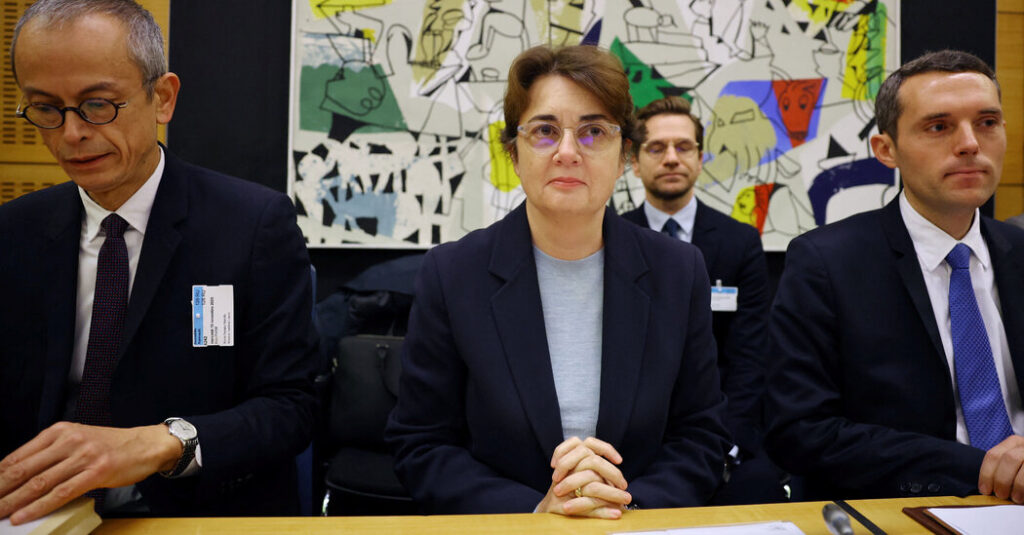
Laurence des Cars, the first female president of the Louvre Museum, resigned on Tuesday, less than three months after an audacious theft raised thorny questions about security at one of the world’s most famous museums.
Ms. des Cars submitted her resignation to the French president, Emmanuel Macron, who had appointed her in 2021 and championed her plans for an ambitious refurbishment of the museum, known as “Louvre — New Renaissance.”
The president’s office said in a statement that Mr. Macron had accepted Ms. des Cars’s resignation “as an act of responsibility at a time when the world’s largest museum needs both stability and a strong new impetus to successfully complete major security and modernization projects.”
Ms. des Cars’s resignation came a day before she was scheduled to testify before the French Parliament about the security lapses that led to the theft of a collection of jewels, which were valued at more than $100 million.
Her departure leaves the “New Renaissance” project in flux. Mr. Macron views the endeavor as one of his signature cultural legacies, but it has aroused widespread criticism both because of its expense and because of the proposed changes to the layout of the Louvre.
The heist was only one of a series of misfortunes that befell the Louvre under Ms. des Cars’s watch, which included water damage to antique books, the forced closing of a gallery because of structural weaknesses and a cascade of strikes by museum workers. Each setback chipped away at Ms. des Cars’s reputation and her political backing.
Ms. des Cars, 59, offered to resign in the immediate aftermath of the theft, but her offer was rejected by France’s culture minister, Rachida Dati, who is effectively her boss. But Ms. Dati later appointed a senior civil servant, Philippe Jost, to work alongside Ms. des Cars to overhaul the management of the Louvre in what was seen as a humiliating verdict on her leadership.
In an interview with The New York Times a month after the theft, Ms. des Cars acknowledged the reputational damage that the burglary had done. “It is a wound that I will certainly carry all my life,” she said.
But Ms. des Cars defended her record at the Louvre, pointing out that she had long called attention to weaknesses in the museum’s security. She said she had worked to marshal government support to renovate the glorious but dangerously dilapidated palace, parts of which date back to 1190.
Just weeks after the heist, the discovery of structural weakness in beams forced the closure of a marquee gallery that housed Greek ceramics.
“When you take charge of this museum, you know very well that it is a political, diplomatic and cultural symbol and that it is constantly subject to very intense controversies,” said Ms. des Cars, a specialist in 19th-century art who had led the Musée d’Orsay before taking over the Louvre.
“I knew that from the start,” she said. “I didn’t know that I would, of course, have the current crisis to manage, but one learns a lot.”
Mark Landler is the Paris bureau chief of The Times, covering France, as well as American foreign policy in Europe and the Middle East. He has been a journalist for more than three decades.
The post Louvre Director Resigns, Months After Burglars Stole Crown Jewels appeared first on New York Times.