Richard J. Lazarus is the Charles Stebbins Fairchild professor of law at Harvard Law School.
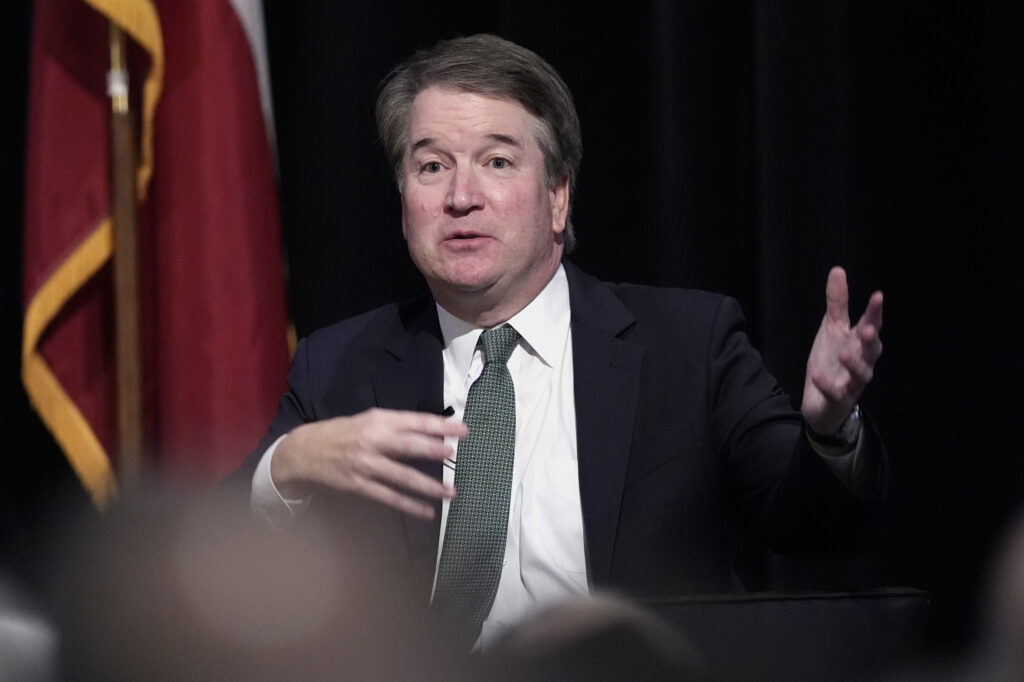
Justice Brett M. Kavanaugh has an extraordinary opportunity in the aftermath of the Supreme Court ruling on Friday, from which he dissented, striking down President Donald Trump’s claim of sweeping authority to impose tariffs on imports.
After the decision, Trump singled out Kavanaugh as a “genius.” The president described the justices in the majority, including those he had appointed to the court, as “fools and lapdogs,” “a disgrace to our nation,” “unpatriotic and disloyal to our Constitution,” “swayed by foreign interests” and “slimeballs,” and even “an embarrassment to their families.”
Trump’s unprecedented criticism of the court and individual justices merits a firm response. Kavanaugh should consider seizing this historic moment by issuing a formal statement supporting the court, the integrity of his colleagues and the legitimacy of the court’s rulings, even those with which he disagrees.
Kavanaugh plainly disagreed with the court’s 6-3 ruling. But his dissenting opinion lacks any hint that he believes that the colleagues with whom he opposed regarding a complex question of law acted in a lawless, incompetent, corrupt or shameful way. That is no doubt why the justice ended his dissent with the traditional: “I respectfully dissent.” In extreme instances of disagreement, justices have omitted “respectfully.” But not here. Indeed, Kavanaugh included those words for emphasis earlier in his opinion.
Like all his colleagues, Kavanaugh understands the court can be damaged when the nation’s leaders condemn it for rulings they disfavor and that this damage is much greater when those leaders unfairly single out justices for highly vicious attacks. That is why Chief Justice John G. Roberts Jr. properly rebuked Sen. Minority Leader Charles E. Schumer (D-New York) in 2020 for insinuating that Justice Neil M. Gorsuch and Kavanaugh would face retaliation if they ruled against abortion rights. As Roberts quickly and publicly responded, “Justices know that criticism comes with the territory, but threatening statements of this sort from the highest levels of government are not only inappropriate, they are dangerous.”
The president’s attack on the justices was no less incendiary in tone than the comments of a grandstanding member of Congress. The former wields enormous authority and sway over millions of Americans. The latter has little to none of either.
The best response would be a statement signed by all nine justices. The statement need not name or refer directly to Trump. It would simply state that whatever their disagreements in individual cases, the justices believe in the integrity of their shared institution and the individual justices, and decry the corrosive and potentially dangerous effects of personal attacks and implicit threats.
In April 2023, the justices responded with such a statement to increasing attacks on the ethics of justices. In declining to testify before a Senate Judiciary Committee hearing, Roberts attached to his letter a formal “Statement on Ethics Principles and Practices” signed by all nine court members. The statement’s purpose in addressing ethical issues raised was to “provide new clarity to the bar and to the public” and “to dispel some common misconceptions.”
However, because Kavanaugh was singled out by Trump as a “genius,” he is positioned to write an effective statement on his own. People who are publicly attacked often respond by silence rather than risk giving more airtime to the attacks themselves. But if those who might be viewed, rightly or wrongly, as supporters of the attacks emphasize that the attacks are misdirected, their response is far more powerful.
This is, after all, how schoolteachers are instructed to deflate the ability of some students to bully others. It is not enough for the victims to complain. Such complaints can perversely encourage even more bullying by confirming the victim’s vulnerability. It is when those in the bully’s presumed community make clear their objection and distance themselves that the bully is rendered powerless. This is no less true for the president’s bully pulpit.
Kavanaugh can meet his moment in history by affirming that his overriding allegiance lies with his colleagues on the court and in their shared mission to work together to promote the rule of law.
The post Kavanaugh’s moment to defend the court appeared first on Washington Post.