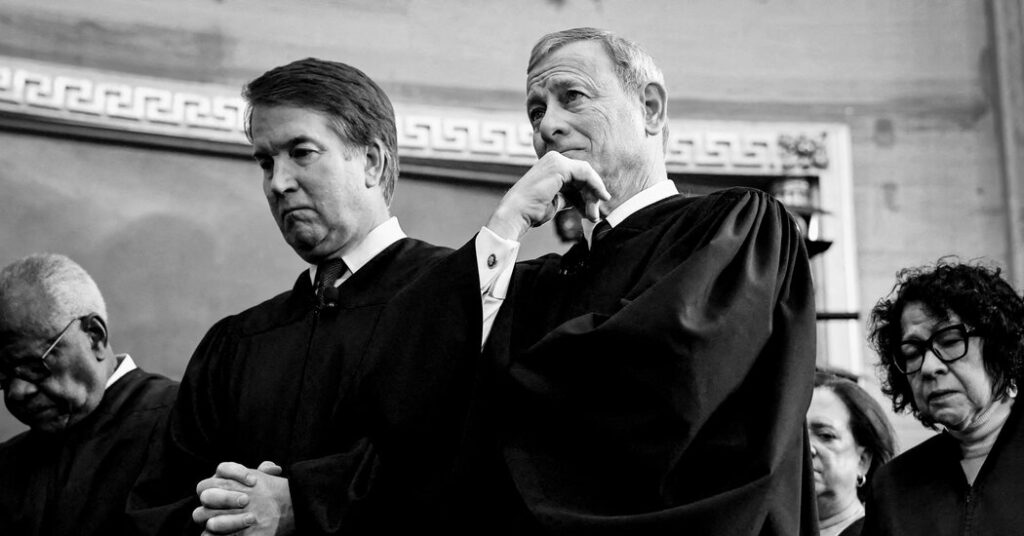
Chief Justice John Roberts doesn’t waste words.
His majority opinion in last week’s tariff ruling was, characteristically, a model of succinctness. In a mere 21 pages (Justice Neil Gorsuch’s concurring opinion, by contrast, clocked in at 46 pages, and Justice Brett Kavanaugh’s dissent at 63), he explained why, as a matter of statutory interpretation and the constitutional separation of powers, President Trump lacked the authority he had claimed, under the International Emergency Economic Powers Act, to impose a hodgepodge of tariffs on countries all over the world.
There was, however, one exception to the opinion’s conciseness: a meaty paragraph describing the roller-coaster course of Mr. Trump’s tariff regime. Here, with citations to seven separate executive orders omitted for the sake of readability, is the chief justice’s account:
Since imposing each set of tariffs, the president has issued several increases, reductions and other modifications. One month after imposing the 10 percent drug trafficking tariffs on Chinese goods, he increased the rate to 20 percent. One month later, he removed a statutory exemption for Chinese goods under $800. Less than a week after imposing the reciprocal tariffs, the president increased the rate on Chinese goods from 34 percent to 84 percent. The very next day, he increased the rate further still, to 125 percent. This brought the total effective tariff rate on most Chinese goods to 145 percent. The president has also shifted sets of goods into and out of the reciprocal tariff framework ([e.g.] exempting from reciprocal tariffs beef, fruits, coffee, tea, spices and some fertilizers). And he has issued a variety of other adjustments ([e.g.] extending “the suspension of heightened reciprocal tariffs” on Chinese imports).
For all the attention the decision in this case, Learning Resources v. Trump, has received, this paragraph has gone largely unremarked. I understand why; it’s unnecessary to the opinion’s argument. If, as a matter of law, the tariffs are invalid, it doesn’t matter whether they were imposed sensibly or capriciously. The paragraph is, in a word, gratuitous, something that can rarely be said about a passage in a Roberts opinion. So what is it doing there?
The answer, I think, is that the chief justice is sending a message, not necessarily or not only to Mr. Trump but to the waiting world. Something along the lines of: “People, this is what we’re dealing with.” The point being not that “some fertilizers” are now exempt from reciprocal tariffs, but that a reckless president is sowing chaos in America and around the globe.
We don’t need to know Chief Justice Roberts’s innermost thoughts about Mr. Trump — whatever they were before the president, in reaction to the tariff decision, described him and his majority as “fools” and “lap dogs” swayed “by foreign interests” — to discern his exasperation.
For the past year, the Trump administration has trolled the Supreme Court, sending up one emergency application after another to demand temporary relief from adverse lower-court rulings. The administration frequently got what it wanted: a stay of the ruling while an appeal proceeded. Powerful dissenting opinions from the three liberal justices, Sonia Sotomayor, Elena Kagan and Ketanji Brown Jackson, made sure the public knew that these orders, while making no law, had the real-world effect of enabling the president to carry out his agenda, including slashing the federal work force and gutting lifesaving foreign assistance programs. Chief Justice Roberts was usually in the majority on these unsigned and generally unexplained orders; obviously he thought the stays were called for. But he probably isn’t happy with the drip-drip-drip of public perception — reflected in polls and social media chatter — that the court was handing the president a blank check.
Something different happened in late December when the justices denied the administration’s request for a stay of a district-court decision barring its use of the National Guard in Illinois. The order was unsigned, with Justices Gorsuch, Clarence Thomas and Samuel Alito dissenting. The three-page order essentially made new law by narrowly defining the circumstances under which a president could federalize a state’s National Guard.
This was a very big deal. The president promptly acceded to the order, removing the federalized Guard from Los Angeles and Portland, Ore., as well as Chicago. Yet the court’s action, coming on the day before Christmas Eve, received far less attention than the tariff case. In discussions about the court today, few people even seem to remember it. It is as if the view of the court as the administration’s lackey was so entrenched that evidence to the contrary was too discordant to be fully absorbed.
The tariff decision was the first of the court’s rulings, after full briefing and oral argument, on the merits of one of the second Trump administration’s cases. A decision on the administration’s effort to fire a member of the Federal Reserve’s Board of Governors may be next. In that case, the administration claims sufficient cause to dismiss a Fed governor, Lisa Cook, based on assertions it claims she made in mortgage agreements. During oral argument, Chief Justice Roberts seemed to recoil from the overwrought tone of Solicitor General D. John Sauer’s argument, which began with, “Deceit or gross negligence by a financial regulator in financial transactions is cause for removal,” even though there has been no judicial finding that Ms. Cook engaged in either.
“You began by talking about deceit,” Chief Justice Roberts said to Mr. Sauer. “Does what you said after that apply in the case of an inadvertent mistake contradicted by other documents in the record?” Mr. Sauer’s answer, “We would say yes,” hung unsatisfactorily in the air as the argument proceeded for the next two hours.
It’s worth remembering that Chief Justice Roberts is the head of the entire judicial branch. It is in that capacity that his vexation with Mr. Trump verges on acute concern. The president has denounced judges who have ruled against him, including by calling for a Federal District Court judge’s impeachment. Mr. Trump has helped create an atmosphere in which judges appropriately fear for their personal safety and that of their families. Many people expected the chief justice to address this issue directly in his year-end report in December, but he did not. In two decades as the nation’s top jurist, he has at times spoken directly in defense of the judiciary, as in his 2024 report. But these occasions have been infrequent, as if the only messages this notably self-possessed and buttoned-down man cares to send are those his opinions deliver.
Noted.
Linda Greenhouse, the recipient of a 1998 Pulitzer Prize, reported on the Supreme Court for The Times from 1978 to 2008.
The Times is committed to publishing a diversity of letters to the editor. We’d like to hear what you think about this or any of our articles. Here are some tips. And here’s our email: [email protected].
Follow the New York Times Opinion section on Facebook, Instagram, TikTok, Bluesky, WhatsApp and Threads.
The post John Roberts Sent Trump a Message appeared first on New York Times.