“A Knight of the Seven Kingdoms,” HBO’s miniature “Game of Thrones” spinoff about a new-minted knight at a crowded tourney, is a welcome change from the grim and ponderous aspects of George R.R. Martin’s extended universe — more Renaissance Faire than medieval dungeon, with brighter colors and livelier spirits than the grueling “House of the Dragon.” And watching its basically heroic protagonist head for his semi-happy ending, I had an unexpected thought: My 10-year-old would really like this show.
Unfortunately for our family’s viewing options, it’s still a “Game of Thrones” spinoff, which means it features gore and profanity and frontal male nudity and the most savage scenes of tourney combat I’ve had the distinct displeasure to encounter. So I won’t be adding it to the queue for any of our betwixt-childhood-and-adulthood kids.
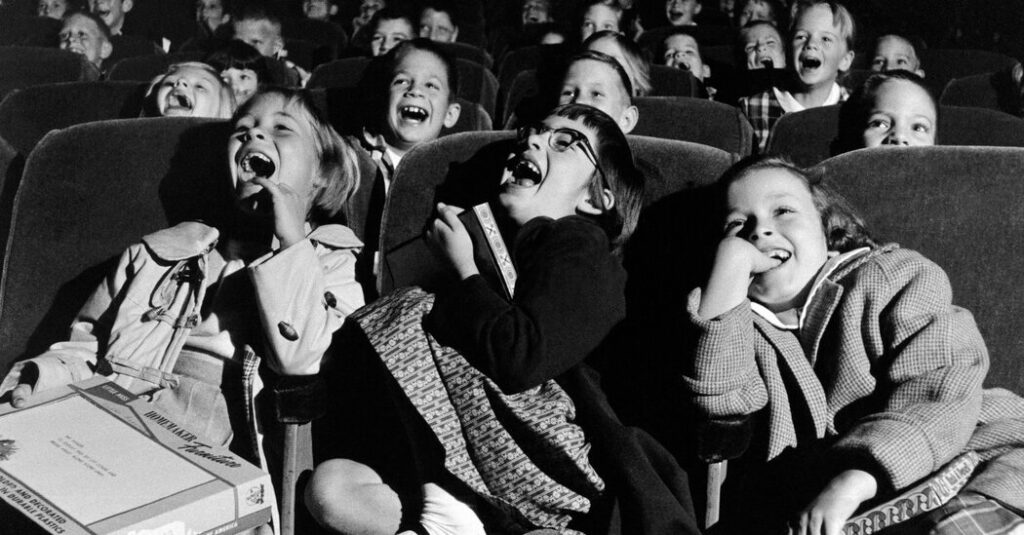
But with “A Knight of the Seven Kingdoms,” unlike some other HBO productions where the adult content just is the content, it’s relatively easy to imagine a version that’s fit for youthful eyes. Or at least a version that has just that one scene where you’d fast-forward while otherwise keeping things PG-13. So I’ll use the show’s failure to be a youth-friendly production as an excuse to express frustration at the dearth of popular art that falls in that zone — telling grown-up stories in a fashion suited to the ages between, say, 10 and 16.
Of course it isn’t hard to find popular art pitched directly to younger teenagers: The bookstore shelves groan with Y.A. fantasy and the entire superhero-industrial complex is explicitly geared to 13-year-old sensibilities. We aren’t living under some tyranny of R-rated movies — far from it — and so parental complaints about inappropriate material in prestige television might be greeted with an eye roll: We purged sex from the multiplex, the box office is dominated by comic book movies, what more do you want?
What I want is emphatically not more Y.A. culture or “tween” books or Marvel sequels. Rather I want more adult culture that’s accessible to early teenagers, that presents grown-up themes without being explicit about everything, that feels like a bridge connecting childhood and adulthood rather than a young-adult detour or a jarringly coarse acceleration.
It’s true that growing up always involves encountering stories that are more explicit than your parents would prefer — the R-rated movies at a friend’s sleepover, the sunbaked paperbacks found in summer rental cottages, the internet equivalents that I shudder to imagine. Part of being a parent is hoping that one’s kids will make a transition to adulthood that’s more gradual and decorous than one’s own experience; part of being a teenager is testing the limits of that conceit.
But with that conceded, I would still like to see more cultural bridges that don’t jump kids directly from the Marvel matinee to prime-time HBO. Especially because — at least from what I can observe — some of today’s young people seem loath to make that kind of leap, which is part how you end up with a culture of “Disney adults” and 30-something Harry Potter fans.
In our household we’ve found a couple of bridges. One is offered by the PG-13 movies of the 1980s and 1990s, which are more adult-themed than most of today’s superhero extravaganzas, but with spikes of indecency (well suited for the fast-forward button) rather than consistent coarseness, and with periods of innuendo whose full implications a 12-year-old might miss. I’m thinking here of movies as diverse as “Titanic” and “Ghostbusters” and “Forrest Gump” and “Ferris Bueller’s Day Off,” all of which include scenes and dialogue that wouldn’t pass muster with the National Legion of Decency while still maintaining a certain decorum and constraint.
Our older kids, in keeping with their own generational tendencies, regard some of the ’80s and ’90s movies that I remember fondly as a bit traumatic or grotesque. (A recent encounter with Jack Nicholson’s Joker in the Tim Burton “Batman” did not go especially well, so I’m not sure we’ll be escalating to “Batman Returns.”) They often prefer the alternative bridge to adulthood offered by the cinema of the 1950s and early 1960s, especially anything starring Cary Grant — a cinematic realm in which the adult themes are palpable but subtle and sophistication is the order of the day.
Take a movie like “North by Northwest,” a favorite in our house. It’s not a film for prudes, in the sense that sexual possibilities between Cary Grant and Eva Marie Saint are taken for granted from their first encounter. But as a kid or teenager you can watch the movie and appreciate it at varying levels of maturity — letting the sexual implications go over your head, turning away from them while you wait for the spy antics to resume, or appreciating having a doorway into the adult world that doesn’t feel the need to show you everything immediately.
That approach to sex at the movies makes an interesting contrast with the bodice-ripping version of “Wuthering Heights” now in theaters, which has been framed by its director, Emerald Fennell, as an attempt to channel her own experience encountering the Emily Brontë novel as a teenager. For Fennell that means not just giving us masturbation on the moors but also sexualizing every inch of the story, every cracked egg and kneaded loaf of dough, just as a hormonal teenage mind might do.
But that’s not what the Brontë novel offered to her teenage-reader self. It told a story in which sexuality is a potent force but not a pornographic one, in which extremity is everywhere but obscenity is not, and there are undercurrents and implications that the younger reader can grasp in part and the adult reader more completely.
“Wuthering Heights” the novel initiates, in other words, where “Wuthering Heights” the movie browbeats. And that feeling of initiation is what neither explicit R-rated entertainments nor the Y.A. fiction/superhero complex can really offer: a sense of encountering a world that’s fully adult but that makes allowances for innocence and inexperience, and that can be grasped provisionally with the promise of a greater understanding later on.
Breviary
Hanna Notte on what Russia hasn’t gained from Trump.
Jesse Singal on the scandal of pediatric gender medicine.
Daisy Hay on Edmund Burke and Charlies James Fox.
Titus Techera on the religious art of Robert Duvall.
Giancarlo Sopo on what makes a conservative movie.
The post In Search of Grown-Up Movies for Kids appeared first on New York Times.