Like many Texas women who spent their girlhood summers along a certain stretch of the Guadalupe River, Carla Smyrl cries these days when she talks about Camp Mystic.
“My whole life has been influenced by this place,” Ms. Smyrl said over a cup of tea in Dallas. “Once a Mystic girl, always a Mystic girl.”
Starting in 1976, she spent nine years as a camper and five as a counselor at the all-girls retreat, sent her three daughters to camp, and then worked for more than a decade as Mystic’s liaison to families in Austin, where she lives.
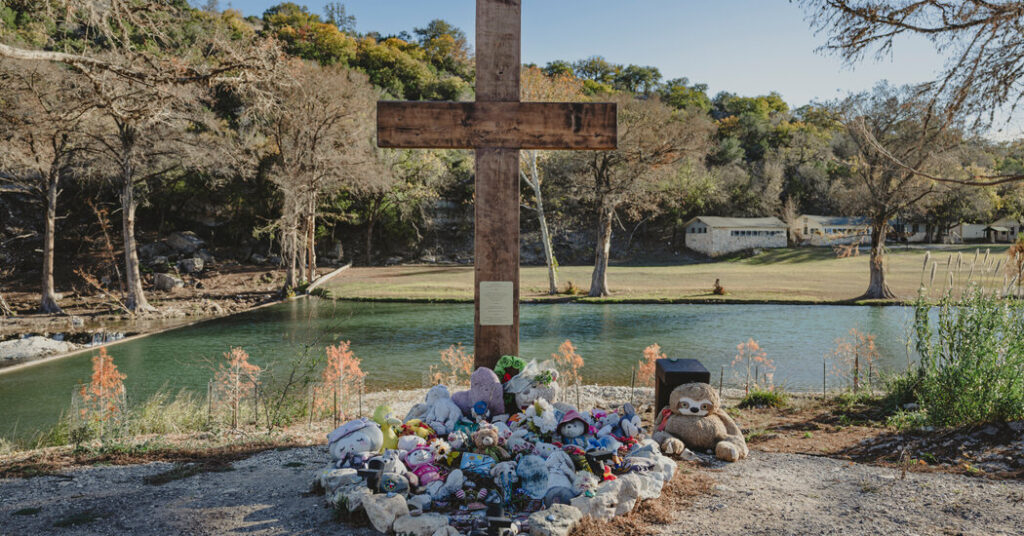
On July 4, 27 campers and counselors died in heavy flooding, along with the camp’s longtime executive director.
The disaster was shattering to Mystic’s thousands of alumnae, even if they hadn’t set foot there for decades. For many, the flood was a moment to draw on a tight network of lifelong relationships that has long been a core part of the Mystic mystique. Within the first hours and days, there were text chains, prayer services, old photos shared on private Facebook pages, and teary alumnae gatherings, including one at the George W. Bush Presidential Center in Dallas. (Laura Bush is a former Mystic counselor.)
It was a reminder that in Texas, camp is not just a way to while away the sticky hours of a Southern summer, but the foundation of an invisible network of status and power.
Going to Mystic places you in a “social web,” as one former counselor, Laura Beth Calvert, put it, that leads to the right college, the right sorority, the right husband, the right private preschool for your children, and then right back to Mystic.
But more than seven months after the flood, that social web is beginning to fray. In September, the camp’s longtime owners, the Eastland family, announced they would partly reopen this summer, a move vocally opposed by most of the parents of the victims, who have united under the name Heaven’s 27. Soon after, multiple Heaven’s 27 families filed lawsuits against the Eastlands, claiming gross negligence in both long-term emergency planning and in their actions on July 4.
Mystic is now facing mounting pressure from elsewhere in the state. On Monday, Lt. Gov. Dan Patrick sent a blistering letter asking the Texas Department of State Health Services not to issue a new license to the camp, noting that he would not be comfortable sending his grandchildren there. (A lawyer for the camp said that it was in compliance with all safety laws, and that Mr. Patrick had rendered a political verdict before a state investigation had begun its work.)
The camp’s leaders seem aware of the conflicting forces bearing down on them. “We’re just day by day trying to consider what is respectful to our bereaved families and to all those that Mystic means a lot to,” Britt Eastland, one of the camp’s leaders, said in an interview at the camp in December.
Publicly, the victims’ families have received overwhelming sympathy from the wider Mystic community. But Ms. Smyrl is among what appears to be a quiet majority of parents and alumnae who support the camp’s reopening, and see the Eastlands as equal victims of an unforeseeable natural disaster for which no one could have prepared.
For them, the anger of the Heaven’s 27 families is beginning to wear thin.
“When they say 27, it really struck some of us that it was 28,” Ms. Smyrl said, referring to the death of Dick Eastland, the camp’s patriarch. “There’s some tension there: Are you loyal to the 27, versus the desire to send your daughter back.”
As Ms. Smyrl talked, a polished young woman at the next table leaned over and apologized for interrupting. She, too, was a Mystic girl, and she wanted to thank Ms. Smyrl for saying something positive about the camp, and the Eastland family. Like many women who support Mystic, she did not want to be named because of how sensitive the subject had become in her circles. But she signed her own daughter up for the camp’s waiting list when she was 6 weeks old, she told Ms. Smyrl.
“There’s nothing like a Mystic girl,” Ms. Smyrl said after the woman left. “And you can spot them a mile away.”
‘I Can’t Change My Memories’
Carrie Hanna was a Mystic girl, too.
Her first summer at camp, she was so homesick that she sent a letter to her parents with wet spots circled on the page, reading, “These are my tears.” But within a few days, she loved it all: canoeing, dancing, tumbling, synchronized swimming, vespers by the river on Sundays. She spent 14 summers there as a camper and a counselor.
Back home in Dallas, even if her mother didn’t know her camp friends’ families personally, a Mystic pedigree meant a girl was welcome to spend the night at her house. Many of her camp friends became her college friends at the University of Texas, then her sorority sisters, then her bridesmaids.
“Anywhere I’ve gone, it feels like all roads lead to Mystic,” she said in an interview at her home this fall, one of multiple conversations in Dallas over several months..
Ms. Hanna grew up in University Park, which along with its neighbor Highland Park is a wealthy enclave known as the Park Cities that forms the city’s main pipeline to Camp Mystic. Resisting annexation from Dallas in the 1940s, the well-manicured neighborhoods have their own school district, the city’s first country club and a Spanish-style outdoor shopping center with tenants including Chanel and Cartier. (Highland Park’s apparent first Black homeowner made the local paper in 2003.) The median income in both neighborhoods is more than $250,000.
Before Ms. Hanna married her husband, Doug, she half-jokingly told him that if they had girls, they had to go to Camp Mystic.
They had three. Ms. Hanna put her oldest daughter, Harper, now 10, on the waiting list soon after she came home from the hospital. Last summer was Harper’s third, and the first for her younger sister, Hadley, 8.
Hadley was nervous before camp, just as her mother had been. She didn’t want to be away from her mom for a month, the length of a full term at Mystic. But Ms. Hanna calmed her, and volunteered to ride along with her on one of the buses the camp charters from Dallas, Houston and Austin.
“I reassured her that she’d be OK and safe and happy,” Ms. Hanna said. “Those were some of my last words.”
The girls had been at camp only for a few days when the river surged on July 4. Harper waded safely to the recreation hall in the chaos, and was later evacuated by helicopter. Hadley was one of 11 girls who died in the structure called Twins, a pair of adjoining cabins.
Ms. Hanna had considered the Eastlands her friends. Now, she found herself disenchanted and, at times, angry. Months after her daughter had died in the family’s care, she had heard nothing from Edward Eastland, Dick’s son, who had tried to rescue girls from Hadley’s cabin. “It’s almost shameful,” she said. “He was the last person to see my child alive.”
The Eastland family said that Edward’s wife, Mary Liz, had been in touch with Ms. Hanna multiple times, and that Edward “has made himself available” to meet at the camp with any of the Heaven’s 27 parents.
(In November, the Hannas and many of the other Heaven’s 27 families sued the camp and members of the Eastland family.)
Outside Ms. Hanna’s home last fall, fences and trees in the neighborhood were still wrapped in wide memorial ribbons, and yards displayed signs reading “Praying for Mystic.” Halloween was a few days away, and Harper wanted to wear one of Hadley’s old costumes. Thanksgiving was coming, then Christmas. Her youngest daughter, Hunter, was home sick for the day, though Ms. Hanna wasn’t sure if it was a bug or another example of the loss rippling through the family.
“We are four people with four ways of grieving,” she said. Even the dog, an elderly mutt named Royal, was anxious lately.
Leaving her house was hard, in part because everywhere she went in her neighborhood people knew who she was. Six of the seven girls from Dallas who died at Camp Mystic lived in the Park Cities. Once, when she and the mother of another girl who died made a plan to meet for dinner, they chose a restaurant a few miles north, in hopes that they wouldn’t run into anyone who recognized them. (They still bumped into a former sorority sister of Ms. Hanna’s.)
At soccer games and at church, Ms. Hanna had to comfort and reassure acquaintances who approached her to offer sympathy. She had fallen off many of the text chains of local mothers organizing school fund-raisers and sharing bits of gossip and light gripes. Sometimes she wanted to be treated normally, she said, but then when normal things came up in conversation, all she could think was that she’d give anything to be annoyed by something like a dance-class schedule snafu.
“I don’t know how to be my old self,” she said. “I’m not my old self.”
Ms. Hanna still has some of her own Mystic memorabilia, including a paddle from when she rowed in the end-of-term “war canoe” race. In a program from a vespers service in 1999, she is listed as presenting a message on perseverance.
“What do I do with this?” she wondered. “I can’t change my memories.”
She was still struggling to untangle her own years of happy memories and relationships from the way her Mystic story ended. Hadley had not yet had time to send a letter home when she died.
Ms. Hanna was desperate for any slivers of information on her daughter’s brief experience. What activities had she signed up for? Was she happy? She tried for months to reach one of Hadley’s counselors, but that conversation ended up yielding few details. The scraps she dug up became part of her understanding of her daughter. On the website for the foundation she started in Hadley’s memory, she wrote that Hadley “had found a special home at Mystic, where she was a proud member of the Tonk tribe and an avid fisherwoman.”
After everything she had been through, Ms. Hanna still mourned the fact that none of her girls would ever spend another summer at the camp. “I think that’s what’s made me the most sad,” she said, “knowing what all three of them won’t have.”
A Camp Rebuilding
Five months after the flood churned mud and debris through the cabins along the river, blowing out windows and buckling walls, Camp Mystic had been scrubbed and tidied, if not fully repaired.
On a sunny afternoon in December, the grounds were clear and fresh green ribbons were wrapped around trees and porch columns, including at Hadley Hanna’s cabin. Plastic bins of unclaimed water bottles and swimsuits, some labeled with the names of campers who died, were stacked neatly in the recreation hall, where dozens of girls had huddled during the storm on an interior balcony as the water rose. Outside Bubble Inn, where 15 of the campers and teenage counselors who died had been staying, someone had placed a row of small white crosses for each girl, and one for Dick Eastland, whose body was found in his truck with several of the girls.
Cypress Lake, the camp’s nearby second location, sits at a higher elevation and sustained no serious damage in the flood. It will reopen to campers this summer, with a modified schedule of six shorter sessions to accommodate more girls.
Britt Eastland, one of Dick’s sons, had spent the day overseeing the installation of a new flood-warning system at Cypress Lake. Four towers along Cypress Creek were calibrated to blast an alarm if water levels rose to a certain point. That would activate lights along the pathway of a new evacuation route up to the dining hall.
Other plans had stalled. The Eastlands’ announcement in September that they planned to erect a memorial on the grounds in honor of the girls who died met with swift backlash from the Heaven’s 27 families, who said they had not been consulted on the plan and wanted to focus all efforts on recovering Cile Steward, the one camper whose body still has not been found.
Mr. Eastland called the memorial a “work in progress” in December. “If we do it right, we’re working with our families that lost girls,” he said. “They gotta be a part of it.”
Almost 900 girls have signed up for camp this summer, Mr. Eastland and his wife, Catie, who run the Cypress Lake campus, said in early February, a few weeks after registration closed. That was enough to fill all six sessions, but less than full capacity. The Eastlands did not respond to questions about how many slots remain unfilled.
For many of the Mystic families who support the Eastlands, sending their girls back to camp is a matter of healing.
Liberty Lindley got to know the Eastlands and a circle of local Mystic alumnae when her family moved near the camp to her husband’s hometown, Kerrville. She has a picture of her identical twin daughters, Evie and Vivi, wearing matching Camp Mystic T-shirts as babies.
When Vivi died in treatment for leukemia in 2024, the Eastlands and the women from Mystic supported Ms. Lindley.
“These are kind, generous, rooted women,” she said. “There’s a glow about the Mystic girls.”
She sent Evie to Mystic as she had always planned. Last year, the girl, who was then 9, was in a cabin called Wiggle Inn, where campers survived with the aid of a security guard who helped them clamber onto camping mattresses that floated as the water rose.
The Eastland family’s critics, and the lawsuits that have been filed against them, depict the camp as woefully underprepared for a rare but predictable crisis. The night’s evacuation was improvised, and the camp’s one-page safety plan called only for counselors to shelter in place in a flood. One suit says that camp leadership dismissed counselors’ early pleas for help, and then “made a hopeless ‘rescue’ effort from its self-created disaster” only when it was too late.
Ms. Lindley has not questioned whether the Eastlands bear any responsibility for the deaths at the camp.
“That has been its whole own grief, to watch people that you care about and love so much, and a place you love so much, be villainized,” she said. “They’re victims of this, too.”
The camp and the Eastland family are nearly inextricable entities, to both supporters and critics. Camp Mystic has been in the family since the 1930s, and three generations were living on the camp’s grounds last summer. Nearly every alumna has a personal story about the family.
So it was galling to some supporters when some of the Heaven’s 27 family members and their allies wore small enamel pins reading “Don’t Be a Dick,” including around a signing of the camp safety laws at the Texas governor’s mansion in September.
Some Eastland loyalists wear a different accessory, a green cloth bracelet that says “Love Like Dick Eastland.”
Ms. Lindley and other families begged the Eastlands directly to open the gates again.
She has signed Evie back up for camp this summer, the camp’s 100th year.
“We know it’s safe,” she said. “I can’t think of many families that I trust more than the Eastlands with my daughter.”
No Looking Back
In Dallas, Ms. Hanna’s closest friends from her Mystic days came to Hadley’s funeral, and supported her in her grief. In February, some were among the attendees at a country club mahjong fund-raiser for the foundation the Hannas had started in Hadley’s name. But in the wider camp community, she could feel allegiances shifting.
Some women were talking about the importance of returning to camp for the surviving girls. “Shutting down Camp Mystic is not the answer,” read one public Facebook post by a self-described Mystic mom and alumna that was liked and shared more than 700 times. “Shaming and ruining the Eastlands is not the answer.”
While debates raged online and registration opened for the summer, the question of whether to send girls back to the camp became a verboten topic in person in the Park Cities.
“Discussing Mystic is worse than discussing politics, if you’re at a dinner party,” said Blair Isom, a Mystic alumna in Dallas whose daughter was at the Cypress Lake campus on July 4. “It feels taboo.”
Ms. Hanna tried to insulate herself. She ignored a “nasty text” from an old college friend who accused her of “ruining” the camp industry in Texas. But the divide will get harder to ignore when the summer begins, she said. She will notice certain girls gone from the neighborhood during camp sessions, or see social media posts from friends she suspects have signed up their girls to go back to Mystic.
“That will be the end of that friendship,” she said. “I won’t look back.”
Winter was difficult. The family had to put down Royal, their old shaggy dog, a few days into the new year. It struck Ms. Hanna that she had a final weekend to prepare for his death and shower him with love — something that she didn’t have with her daughter.
Hadley’s ashes had been at home for months, in a small urn shaped like a butterfly. When the Hannas went to New York before Christmas, Ms. Hanna took the container to a neighbors’ house, struck with a fear that the house would burn down and the ashes would burn. Her husband tried to reassure her. “They’re already ashes,” he said.
Feb. 13 would have been Hadley’s 9th birthday. That morning, the family buried the urn at a cemetery near home.
A few hours later, they gathered for a party at a small park across the street from the Methodist church where the Hanna girls had attended preschool. Ms. Hanna had handed the logistics to an event planner who was known locally for elaborate weddings, but had thrown a similar party for one of the other Dallas girls who died at Mystic. The plan was to raise money for Hadley’s foundation, with funds going to causes like scholarships and game warden canine units like those that searched for missing girls after the flood.
The crowd at the park included teachers, fellow dance moms and a handful of Mystic girls. One longtime friend of Ms. Hanna’s, Ali Treaster, a Mystic alumna whose daughters were not at the camp on July 4, looked uncomfortable when asked whether she planned to send them back. “We haven’t made a decision,” she said, although the registration deadline was weeks ago. “It’s hard on all sides.”
It was the day before Valentine’s Day, and children and their mothers were dressed in pink and red, hearts and spangles. Balloons wafted in the breeze, and Hadley’s sisters and their friends ran in clusters from the selfie station to the cotton candy machine to the glitter tattoo stand. A D.J. played “Girls Just Want to Have Fun.” It was a birthday party, and it wasn’t. The air was getting warmer in Texas, and summer was just around the corner.
Ruth Graham is a national reporter, based in Dallas, covering religion, faith and values for The Times.
The post Generations of ‘Mystic Girls,’ Divided by a Deadly Texas Flood appeared first on New York Times.