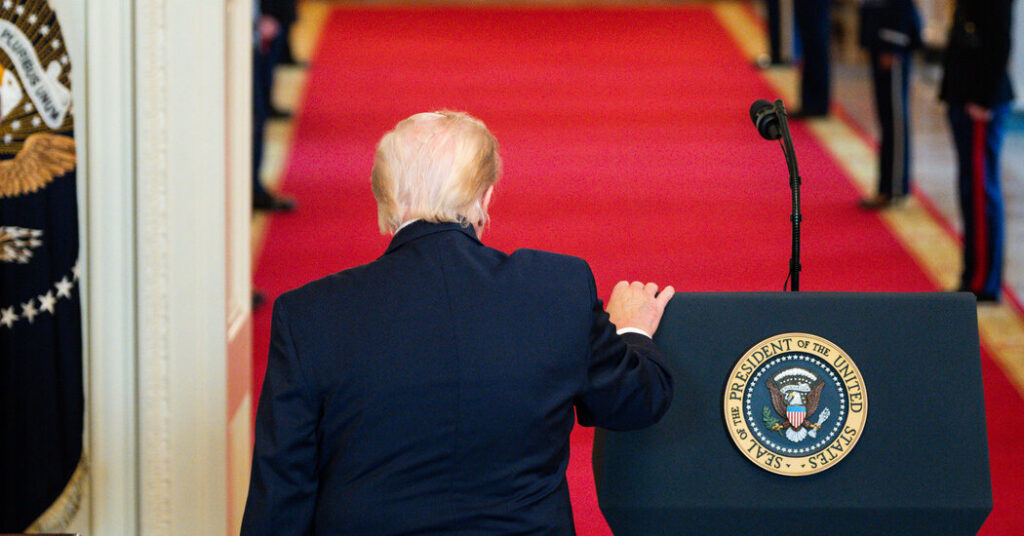
Tomorrow, President Trump is scheduled to deliver his State of the Union address, a speech expected to be his most watched before the midterm elections. Let’s be real: Most people already have firm views about this president. Another speech is unlikely to change the attitudes of voters who have been hearing from him for years (though you never know what he might say!).
And even if Trump stays on script, any carefully calibrated message on Tuesday may not remain his focus for long.
But when it comes to the midterm elections, the speech may be politically significant in other ways. Namely, many Republican candidates will feel compelled to defend whatever vision Trump lays out, or go through contortions to distance themselves. And to what extent does his message reflect — or ignore — voters’ biggest concerns?
Here are a few of my midterm-focused questions:
How, and how much, does Trump talk about tariffs?
As my colleague Shane Goldmacher and I wrote last week, Trump’s tariffs have been deeply unpopular, one of his worst-polling issues. But instead of accepting the Supreme Court ruling on Friday that his sweeping tariffs exceeded his authority, he pivoted to pushing a new global tariff.
Plenty of Republicans would prefer not to talk about, much less champion, the administration’s tariff policy — though Democrats, seeing another opening to blame Trump for high prices, are trying to ensure that Republicans won’t have a choice.
That could get harder for Republican candidates to pull off if Trump leans into defending his approach on Tuesday (it will also be fascinating to watch Trump’s body language toward the Supreme Court justices he recently disparaged, who could be sitting just feet away from him).
Democrats, for their part, see the issue as powerful enough to potentially put key races in states like Iowa into play. Two years ago, Trump won the state by 13 percentage points, but Iowa has been especially hard hit by his trade policies.
“No one has felt the squeeze of the reckless economic policies coming out of DC more than Iowa farmers,” Rob Sand, the Iowa state auditor and a Democratic candidate for governor, wrote on social media. “Iowa growers, producers, and hardworking families don’t need more chaos or higher prices from Washington.”
Voters are worried about the cost of living. Can Trump show he sympathizes?
Some Republicans think they have a good, or at least improving, story to tell on the economy.
That’s what Democrats thought in the last presidential election, too.
Then voters made clear that they didn’t care about the various positive economic indicators that President Biden’s White House pointed to. They cared about their pocketbooks, and their pocketbooks were in pain.
Today, 65 percent of Americans disapprove of Trump’s handling of inflation, according to a new ABC News/Washington Post/Ipsos poll, and 57 percent disapprove of his handling of the economy.
Trump will almost certainly highlight what he sees as his administration’s accomplishments on the issue. But can the president — who recently declared that “I’ve won affordability” — show that he also cares about the many Americans who are still struggling?
What’s his tone on immigration?
Immigration has historically been a strong issue for Republicans. But Americans, including growing numbers of Republicans, have turned sharply against the hard-line and in some cases deadly immigration enforcement tactics of federal agents.
Republicans want to be seen as the party of law and order. When federal agents are killing Americans in the streets of Minneapolis, detaining school children and otherwise stoking scenes of chaos, that argument, some strategists have told me, gets more challenging to make.
Trump himself has said that his administration could use a “softer touch.” How does he frame immigration issues on Tuesday night? Can he refocus the public on his border security efforts, which have been more popular? Does he make any effort to appeal to Hispanic voters who supported him in 2024 but have pulled away from Republicans amid the administration’s far-reaching immigration crackdown?
Will the speech be ‘America First’?
Trump’s speech arrives at a moment of global turmoil and uncertainty.
A wave of violence in Mexico left some American tourists stranded this weekend. Russia continues to attack Ukraine. And are we on the brink of war with Iran?
Trump’s foreign interventions — like the toppling of Venezuela’s leader — have divided his party, leaving some worried that he is abandoning his “America First” principles, while others applaud what they see as his strength.
How much time does he devote to discussing foreign affairs, versus the pocketbook issues that feel urgent in many voters’ daily lives? And if he does intend to plunge into another conflict in the Middle East, does he use this major platform to make a case for intervention to the American people?
In 2024, many voters felt that the Biden administration was more focused on problems abroad than events at home. How does Trump navigate that tension now?
How do Democrats respond?
For all of Trump’s political challenges, polls show that the public doesn’t have much faith in the Democrats, either.
Against that backdrop, the newly elected Gov. Abigail Spanberger of Virginia will step forward to offer her party’s response. Spanberger, a moderate former congresswoman and an ex-C.I.A. officer, handily won her race last fall with a sharp focus on affordability. Her remarks will offer an early snapshot of how Democrats are messaging against Republicans at the beginning of a midterm election year, and what alternative they are trying to offer.
Historically, of course, delivering the State of the Union response can be a thankless job, with the public largely only remembering the flubs (remember Marco Rubio and his infamous water break?).
Sometimes, the goal is to simply make it through unscathed.
Trump’s vision of capitalism
Stakes in private companies. Handshake deals with chief executives. Since President Trump returned to the White House, my colleague Ben Casselman writes, his economic policy has gotten the government involved in the private sector in ways that past presidents would never have considered.
quote of the day
“He can make sure A.I. serves us, not the other way around.”
That’s a quote from a new political ad urging northern New Jersey residents to tell their House representative, Josh Gottheimer, to oppose a bill that would block states from creating protections against A.I. scams.
The ad was paid for by a super PAC operation backed by the A.I. start-up Anthropic, which generally supports tougher safeguards for the technology it is developing. The ad blitz is part of an escalating political war over A.I., my colleague Cecilia Kang writes, as states and the federal government squabble over regulations.
ONE LAST THING
What’s next for anti-Trump Republicans?
Members of the Republican Party’s long-sidelined “Never Trump” faction are contemplating whether they have any path back to relevance once the president leaves office, my colleague Tim Balk writes.
Does the most promising route involve joining forces with parts of the staunchly anti-Trump Democratic Party? Should they simply wait for Trump’s power to fade over time? Some of these Republican figures expressed hope at a recent gathering that they would draw more support to their cause after the midterm elections.
Others, on the other hand, worried that it might be hopeless.
Taylor Robinson, Ama Sarpomaa, Tara Terranova and Hannah Fidelman contributed reporting.
Katie Glueck is a Times national political reporter.
The post Five Big Political Questions About Trump’s State of the Union Speech appeared first on New York Times.