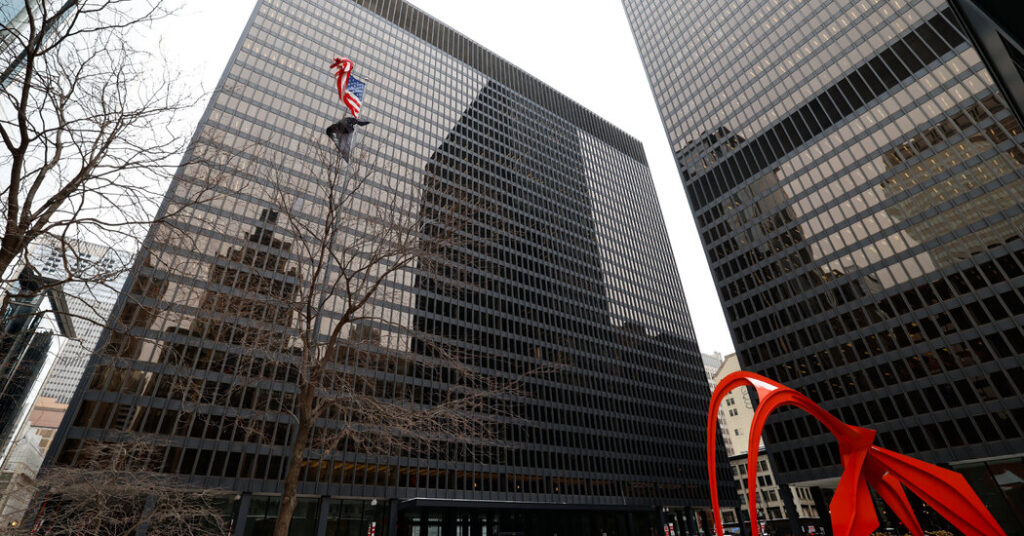
For years, the judicial branch has complained that when it comes to hundreds of federal courthouses, the executive branch is a bad landlord, letting storied buildings fall into disrepair.
On Tuesday, a leader of the judiciary’s administrative body told Congress that the condition of courthouses has gotten so bad that lawmakers should intervene and give the nation’s judges control over their own spaces.
The matter “has reached a crisis point after decades of inadequate management and oversight,” Judge Robert J. Conrad, the secretary of the courts’ policymaking body, wrote in a letter to lawmakers. The letter proposed draft legislation to establish a new “Judiciary Buildings Service” that would take over courthouses and other judicial facilities from the General Services Administration, the executive branch agency responsible for their custody and management.
The judiciary currently pays G.S.A. $1.3 billion each year for rent and other services. That money comes out of its congressionally appropriated budget, forming a substantial part of the roughly $10 billion it receives annually.
Problems with G.S.A.’s oversight of courthouses go back decades, said Judith Resnik, a Yale Law School professor and the co-author of a book on judicial symbols and courthouses. She called the agency’s performance “a failure of stewardship.”
Marianne Copenhaver, a G.S.A. spokeswoman, disputed the courts’ account. “We disagree with the characterization that the federal courthouse portfolio is in ‘crisis’ due to mismanagement,” she said in a statement. The judiciary should continue to focus “on the rule of law,” she added, “while G.S.A. continues to focus on the federal real estate portfolio.”
Trump Administration: Live Updates
Updated
- The guest list for Trump’s speech includes Epstein victims, Olympians and Erika Kirk.
- A top Democrat on the Senate Homeland Security panel opens an inquiry into Binance’s Iran transactions.
- The House rejects an air safety bill after the Pentagon abruptly pulled its support.
During a 2014 congressional hearing, federal judges complained about blocked fire exits, unnecessary landscaping, leaking water and electrical outages.
Since then, they say that matters have only gotten worse. Judicial facilities are now in need of more than $8.3 billion in “critical repairs,” according to materials released by the courts to accompany the request. In some cases, the problems are dire, Judge Conrad wrote.
A century-old courthouse in Asheville, N.C. is plagued by mold and a dilapidated heating system that causes “headaches, nosebleeds and sore throats during proceedings.”
In Chicago, six floors of the Everett McKinley Dirksen United States Courthouse were damaged by a water leak in October 2024. More than a year later, “construction has not begun,” the submission to Congress said. In another courthouse, according to the judicial administrative group, judges were trapped in a malfunctioning elevator for hours.
Eighteen “critical courthouse security improvement projects” are in limbo, according to a white paper that accompanied the proposal.
Under President Trump, G.S.A. has cut 23 percent of its work force and discussed selling hundreds of federal properties. The latter effort was associated with Elon Musk’s government overhaul operation known as the Department of Government Efficiency. A list of dozens of properties identified as part of “right-sizing the federal real estate portfolio” included four courthouses. The list still appears on G.S.A.’s website.
If Congress decides to adopt the courts’ proposal, the transition in management from G.S.A. would be gradual, beginning in no more than 10 of the 94 federal judicial districts, the courts proposed. In a statement, Judge Conrad characterized the change as “constructive realignment, not separation,” because it would allow G.S.A. to focus on its primary responsibilities with the executive branch and let the judiciary pay repair bills out of its own budget.
The post Federal Judiciary Asks Congress to Give Over Control of Courthouses appeared first on New York Times.