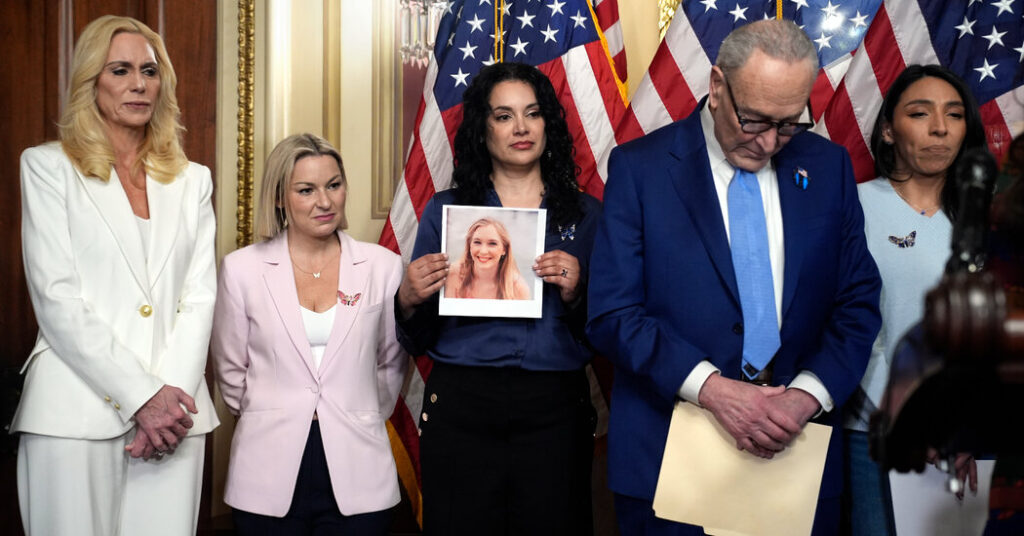
Over a dozen lawmakers are bringing survivors of Jeffrey Epstein’s abuse to President Trump’s State of the Union address on Tuesday night, a statement against the administration’s handling of documents related to the convicted sex offender.
Lawmakers for many years have invited guests to the annual speech as a way of sending pointed messages to the president. A number of Democrats have said they will boycott the speech and attend a rally on the National Mall near the Capitol.
But many members of Congress who believe that the latest release of documents fell short of a full accounting are extending invitations to Mr. Epstein’s victims, who have been demanding the full release of files.
Senator Chuck Schumer of New York, the Democratic minority leader, is bringing Dani Bensky, a survivor who met Mr. Epstein when she was 17.
“Trump says he’s going to give a long speech tonight, but there’s one thing he refuses to talk about — the Epstein files,” Mr. Schumer said at a news conference on Tuesday held by Democratic lawmakers and Epstein survivors.
Ms. Bensky called on the administration to release all files related to Mr. Epstein, accusing Mr. Trump and the Justice Department of continuing to “cover up and protect perpetrators.” Mr. Trump has denied any wrongdoing in connection to Mr. Epstein. The Justice Department has said many pages were redacted or withheld because of various legal privileges.
“As we prepare to attend the State of the Union, survivors and this country have so many questions that need to be answered,” Ms. Bensky said. “The first one is: Where are the rest of the files? The truth must come out. Why are there no investigations when there are plenty of people in these files to investigate?”
The Justice Department in January released three million more pages of documents related to Mr. Epstein, shedding light on his relationships with prominent figures, including Elon Musk, Bill Gates and Howard Lutnick, now the commerce secretary.
The reckoning over the files has also spread internationally. The British police last week arrested Andrew Mountbatten-Windsor, a son of Queen Elizabeth II who was formerly known as Prince Andrew, after reports suggested that he might have shared confidential information with Mr. Epstein while serving as a British trade envoy. Mr. Mountbatten-Windsor was released after around 11 hours in custody.
Other Democratic lawmakers bringing Epstein survivors to the address include Representative Hakeem Jeffries of New York, the House minority leader, who invited Marina Lacerda; Representative Robert Garcia of California, who invited Annie Farmer; and Representative James R. Walkinshaw of Virginia, who invited Jess Michaels.
Mr. Walkinshaw called the address an opportunity “on the world stage” to call attention to Mr. Epstein’s abuse and the importance of holding perpetrators accountable.
“The wall of privilege is only beginning to crack, and we will not stop until there is real justice and accountability,” he said in a statement.
The delayed rollout of the latest tranche of Epstein files was met with fierce backlash by Democratic lawmakers and survivors after victims’ names were improperly disclosed, for which Attorney General Pam Bondi blamed “various factors, including technical or human error.” During a House Judiciary Committee hearing on Feb. 11, she refused to apologize to survivors who were seated in the room.
“The world saw her turn her back on the survivors rather than apologize for the pain that her Department of Justice has caused them,” Representative Pramila Jayapal of Washington said of Ms. Bondi at the Tuesday news conference. “Today, the world will see Donald Trump have to face these survivors right there in the House gallery.”
Marijke Chartouni, an Epstein victim who will attend the address as Ms. Jayapal’s guest, said her presence would serve as a reminder that “survivors will not remain silent through this continued institutional failure.”
Ashley Ahn covers breaking news for The Times from New York.
The post Epstein Victims to Attend Trump’s State of the Union as Guests of Lawmakers appeared first on New York Times.