D.C.’s top legal officer argued Tuesday that a disapproval resolution Congress passed to block the city from opting out of President Donald Trump’s tax cut is invalid in part because federal lawmakers missed a deadline — a defiant response to the congressional action that puts the city in uncharted territory.
The argument from D.C. Attorney General Brian Schwalb (D), laid out in a legal opinion, could set up a clash with Congress over a D.C. home rule issue that has never been tested in D.C. courts.
Congress voted earlier this month to swat down D.C. legislation that divorced the city’s local tax code from Trump’s One Big Beautiful Bill. Republicans celebrated the move as a way to put more money back in Washingtonians’ pockets through various tax deductions — but D.C. officials warned it could cost the city millions and upend tax season while it is already well underway, raising concerns from the city’s chief financial officer.
When Congress objects to a D.C. law, disapproval resolutions have the effect of rendering it null and void. But Schwalb (D) argues in his opinion that Congress missed a critical 30-day deadline and also failed to make the resolution apply retroactively, given the 2025 tax season already began. As a result, Schwalb says, the disapproval has no effect on the city’s tax laws, and D.C. tax filers should proceed without any disruption or change to the rules.
Schwalb wrote that while Congress retains the authority to repeal city laws, “in our view, Congress did not do so here.” The disapproval, he said, merely “operates as an expression of Congress’s unfavorable opinion of [D.C.’s tax policy] but not as a repeal.”
As the federal district, D.C. has little leverage going up against the federal government or Congress, which under the Constitution has full authority over the city and its laws. But Schwalb seized in part on a provision of the 1973 D.C. Home Rule Act, which created the city’s modern local government, to make a case that Congress acted outside legal boundaries.
Congress has 30 legislative days under the Home Rule Act to review or disapprove D.C. legislation before it becomes law. In this case, the city points out Congress acted on day 31 and Trump signed the measure about a week later — too late, Schwalb says.
Because it is historically rare for Congress to pass a disapproval resolution — only five have succeeded in D.C.’s half-century history of home rule — there is no precedent for a situation in which the city legally objects to a disapproval resolution.
But the timing dispute has come up before. Congress and the city have tended to count the 30 legislative review days differently, or 60 days in cases of criminal justice bills. In 2023, as the Senate teed up a final vote on a disapproval resolution to block D.C.’s major police reform package, Schwalb issued a legal opinion that stood by the city’s counting method under the Home Rule Act, arguing the Senate vote would be too late for the disapproval to be valid.
President Joe Biden ultimately vetoed that disapproval, rendering the timing dispute moot. Now, at a time when tension between the city and Congress continues to escalate, the city could be picking a fight depending on whether or how Congress responds.
Spokesmen for Senate Majority Leader John Thune (R-South Dakota) and House Speaker Mike Johnson (R-Louisiana) did not immediately respond to requests for comment.
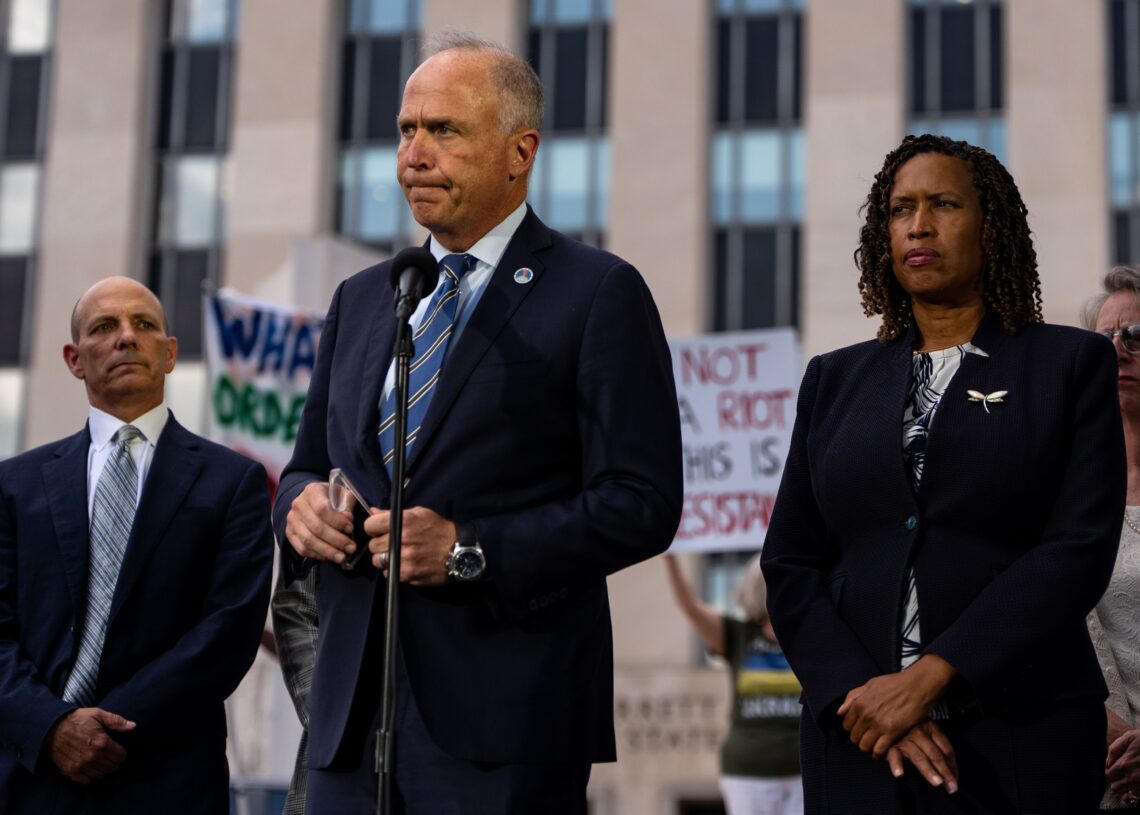
D.C. Council Chairman Phil Mendelson (D) said that Schwalb’s opinion was simply “a plain reading of the law” and that the District had to stand by it as a matter of home rule.
“We the government have to have certainty. Are our laws effective after 30 days? Or effective after we know Congress isn’t gonna step in?” he said. “I don’t relish a fight, but do we get to stand by our laws or do we get to be bullied?”
Congress has tended to count the 30 days in the review period differently from D.C. The city begins counting the day that its representatives physically deliver a piece of legislation to Congress for review, as they are still required to do. But Congress doesn’t start its clock until the day the second chamber publishes a notice to members that the legislation is ready for their review. In this case, there was a one-week difference in those two events.
The D.C. Council had voted in November to decouple its local tax code from Trump’s One Big Beautiful Bill, which included tax deductions such as no tax on tips, overtime wages or personal auto loan interest, along with other beneficial deductions for seniors and businesses. Federal tax returns would not be affected by the D.C. bill.
The council’s move came as the city was facing major economic strain, amid mass federal job cuts, and a tough budget season ahead, seeing it as a way to boost revenue by about $600 million through 2029. Lawmakers voted to set aside about $239 million of the roughly $600 million to expand the earned income tax credit and fund a local child tax credit, which would make D.C. the first city to supplement the federal child tax credit.
The disapproval resolution, however, was intended to undo all of those policy choices. Republicans argue the $600 million in revenue is better left in the pockets of residents and businesses. “The D.C. Council decided to benefit from these people instead of helping them. They decided they deserve these people’s money more than the people do,” Sen. Rick Scott (R-Florida), the sponsor of the disapproval measure, said on the Senate floor. “This isn’t right.”
Trump signed the disapproval resolution into law last week, prompting D.C. Chief Financial Officer Glen Lee to seek legal guidance from the attorney general about how to proceed.
Lee, the District’s taxman, had previously warned Congress he may have to suspend tax filing season for D.C. for months because his office would have to update tax forms, provide guidance to third-party tax preparers such as TurboTax and H&R Block and potentially ask thousands of D.C. residents who have already submitted tax returns to refile them under a different set of rules.
Delaying tax collections, he had warned, could also disrupt the city’s cash flow by hundreds of millions of dollars. The prospect of all of those hurdles became the top focus for D.C. Mayor Muriel E. Bowser (D) and other D.C. officials who lobbied Congress not to proceed with the disapproval resolution.
But in his legal review, Schwalb points not only to the timing rules in the Home Rule Act, but also to separate federal and D.C. laws that he argues also protect D.C.’s tax policies from being repealed in the middle of tax season.
He notes that the D.C. Council passed both an emergency version of the tax policy, called the D.C. Income and Franchise Tax Conformity and Revision act, and a temporary version that both applied to the 2025 tax year beginning on Jan. 1 of that year. Federal and D.C. laws say that, if a law that levies penalties or liabilities on residents expires or is repealed, that doesn’t mean the liabilities expire, unless lawmakers explicitly say so, Schwalb notes. For example, if a criminal sentencing law expires in the middle of the year, a defendant could still be sentenced under the law as it was when the crime was committed.
In this case, tax liabilities are at issue. Even if Congress did repeal D.C.’s tax act, Schwalb argues, under these laws, all D.C. residents would still be subject to the D.C. tax rules that were in effect on Jan. 1, 2025, and D.C.’s tax season would not need to be disrupted as officials originally feared.
Bowser declined to comment on the opinion through a spokesman, referring questions to Lee.
Eric Balliet, a spokesman for Lee, said lawyers in the CFO’s office were still reviewing Schwalb’s opinion. He said that there was not yet a timeline for when there would be further guidance to taxpayers but that for now, the District’s tax filing season remains open and the Office of Tax and Revenue is continuing to process returns.
Mendelson said the effects on tax season remain about as “clear as mud.” He said that, ideally, the District’s issuing of this legal opinion is “the end of it.”
“The disapproval went through without regard to over 50,000 taxpayers who have filed their taxes,” he said. “And this is all thrown into turmoil.”
The post D.C. attorney general says Congress missed deadline, failed to block tax policy appeared first on Washington Post.