Drug lords have been killed or captured, and cartels have splintered or collapsed, only to see more violent ones replace them and the illicit trade expand.
So, in nearly 60 years of the war on drugs, what has actually worked?
On Sunday, the Mexican military killed Nemesio Oseguera Cervantes, known as El Mencho, the leader of one of the world’s largest drug cartels.
It is called the Jalisco Cartel, and its reach can be felt in nearly every corner of the globe. It is more of a conglomerate than a single entity, composed of dozens of groups spread across Mexico that do everything from growing the avocados used in Americans’ guacamole to smuggling migrants into the United States and, of course, trafficking drugs.
As Mexican and U.S. officials wait to see what lies ahead for the cartel — whether a successor is quickly appointed or it devolves into infighting over who assumes the leadership — one thing appears likely: El Mencho’s death alone is not the end of the group.
The group’s full name, the Jalisco New Generation Cartel, underscores its ambition and how deeply rooted it is in Mexico. Eradicating it requires a more patient, long-term approach than killing or capturing one man, analysts say.
“They created a new generation of doing things differently,” said Carlos Pérez Ricart, an expert at the Center for Economic Research and Teaching, a Mexican research group. “They employed a mode of violence that was very calculated and instrumental. It was narco-terrorism.”
Mr. Pérez, like other analysts, said that each new generation of cartel members tends to be more violent than its predecessors, as a way to assert authority. With every new generation, what was once unthinkable becomes the new norm.
The gratuity of the violence — rivals are beheaded, their bodies displayed in public parks — is the point, they said. It becomes the new standard, a gruesome way of outdoing rivals.
“Today’s leaders have a much lower life expectancy,” Mr. Pérez said. “Their education is also lower and their attachment to the territory they work in is now almost zero.” One result is an especially ruthless detachment from the suffering of the local population.
Mexico is now fighting what may turn out to be one of the bloodiest and consequential wars against the cartels in its history, analysts say.
Since 2024, the Mexican government has been bogged down in the north, fighting the Sinaloa Cartel. Now, the government has opened up a second front, against the Jalisco New Generation Cartel, based in western Mexico but with branches throughout. The two Mexican cartels, archrivals, are arguably the world’s most powerful drug organizations.
Perhaps the most comparable battle against drug trafficking was during President Felipe Calderón’s presidency, which ended in 2012. But back then, the government was mostly taking on a single cartel, Los Zetas, and that fight was concentrated in northern Mexico.
The histories of the cartels offer important reminders of how resilient they can be, even when the government makes major strides against them.
The Sinaloa Cartel, after all, did not go away after its chief, Joaquín Guzmán Loera, the notorious drug lord known as El Chapo, was captured and extradited to the United States.
And the Jalisco Cartel itself was born from the ruins of another drug group, the Milenio Cartel, which disintegrated into infighting after its leadership was captured and killed.
By 2009, Mr. Oseguera, the Jalisco leader killed on Sunday, had emerged on top — in part because if his willingness to embrace spectacular levels of violence to defeat his enemies.
Rather than simply going after kingpins like Mr. Oseguera, the authorities need to take a holistic approach to dismantle these groups more completely, analysts say.
The Mexican government has to use a combination of force on the ground and smart investigative work to defeat the Jalisco Cartel, former diplomats say. It is a model similar to the one Colombia adopted beginning in the 1990s.
Midlevel commanders need to be targeted, since they provide critical links between the top leadership and the cartel’s boots on the ground, analysts and diplomats say.
And when it comes to the Jalisco Cartel, its sprawling business empire and hidden financial network must also be unwound, they note. That investigative capability, however, is still being built up by Mexico’s government.
That is where the United States may be most useful, experts say. On Sunday, the Mexican military credited U.S. officials with sharing vital intelligence that allowed its troops to capture and kill Mr. Oseguera.
“We have the best technical intelligence, and local partners in Mexico and Colombia have the best human, on-the-ground intelligence,” said Todd Robinson, a former assistant secretary of state for international narcotics and law enforcement at the State Department.
“And if you have that and a government that is willing to fight corruption, you can get positive results,” he said.
Colombia’s initial success battling the cartels in the 1990s offers a good lesson for Mexico, former U.S. diplomats who have worked on both countries say.
Back then, the Colombian government deployed its security forces to capture and kill high-ranking cartel members, while also increasing its investigative capacities to unravel the groups’ hidden financial infrastructure. It also strengthened the judicial system to end impunity.
After Colombia largely brought down the country’s kingpins in that decade, the United States helped the government there expand its authority across the country.
For every dollar the U.S. spent, Colombia spent three, Mr. Robinson said. It was part of an effort to eradicate coca crops and bring schools, roads and other economic incentives to remote communities where the government had dislodged drug trafficking groups.
But the government was not able to expand its authority to all parts of the country. In the vacuum, guerrilla groups took over cocaine production and trafficking. Cocaine production exploded across the country about a decade ago, analysts say.
The Mexican government needs to immediately start working across municipalities and states to dislodge the Jalisco Cartel and start exerting authority, Mr. Robinson said. But historically, Mexico’s federal governments have been reluctant to work with political rivals, creating a patchy security response that provides safe havens in which cartels can operate.
“Mexico is not traditionally good at that,” Mr. Robinson said. “The ruling party tends to support the governor or mayor that are part of their party, and leave those mayors who are from the opposition alone to fend for themselves against the cartels.”
In contrast, the Jalisco Cartel works closely with dozens of smaller criminal groups to exert its muscle across the country and challenge the government’s authority.
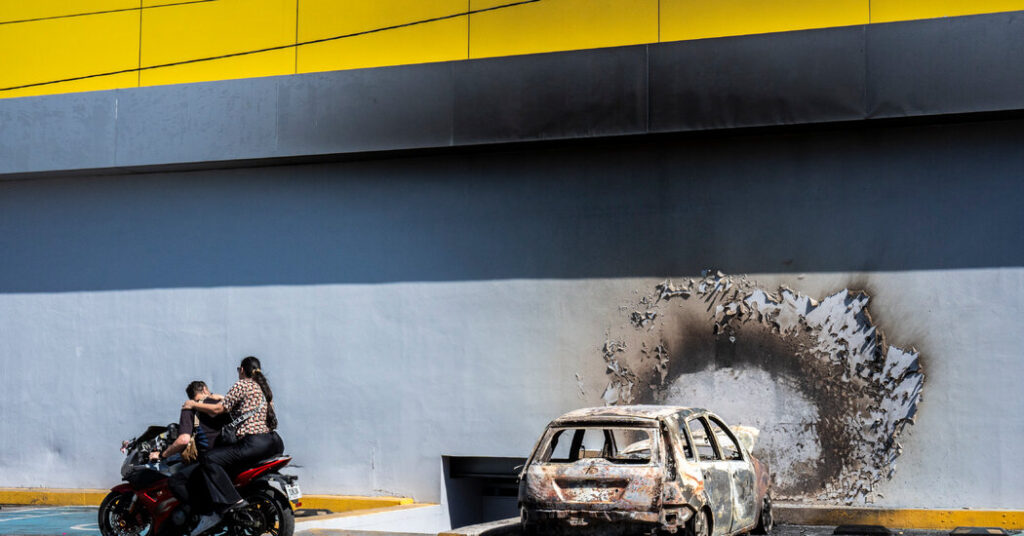
On Sunday, the cartel was able to showcase its strength and territorial reach when it set fires to banks and storefronts and blocked roads and highways in some 13 states across Mexico. In many states, the Mexican government failed to respond.
Annie Correal contributed reporting from Mexico City.
Maria Abi-Habib is an investigative correspondent reporting on Latin America and is based in Mexico City.
The post After Six Decades of the War on Drugs, What Works? appeared first on New York Times.