Once again, a French jeweler has come to the rescue of contemporary dance. Dance Reflections, a festival sponsored by Van Cleef & Arpels, returned to New York for the second time to pump some life into the city’s dance offerings.
A performance blitz, the festival showcases works mainly by European artists. France is omnipresent. Last weekend, the Lyon Opera Ballet presented a double bill at New York City Center, while (La)Horde and National Ballet of Marseille unveiled “Age of Content” at the Brooklyn Academy of Music. That’s just the start: Dance Reflections, with different acts and at various venues, continues through March 21.
Lyon Opera Ballet — a contemporary company with a history of presenting modern classics and pushing new choreographic voices — paired Merce Cunningham’s “Biped” (1999), a momentous experiment with motion capture, and the United States premiere of Christos Papadopoulos’s “Mycelium.” (The group’s director, Cédric Andrieux, was a member of Cunningham’s company.)
Together, the works made for a long night; individually, there were other problems. “Biped” is a transcendent dance, but this “Biped” sunk the heart. Despite the bones of Cunningham’s choreography — and bones they were, splintery and breakable — Lyon’s interpretation showed the dancers clearly out of their depth.
In most circumstances, “Biped” is not a work to miss. Dancers appear and disappear behind a transparent scrim on which Shelley Eshkar and Paul Kaiser’s projections of virtual figures and lines and circles float by. Aaron Copp’s haunting lighting, Suzanne Gallo’s shining costumes that transform from sleek to flowing and Gavin Bryars’s score coexist beautifully.
Cunningham’s choreographic phrases, with long balances, turning promenades and jumps with seemingly no preparation, are body-mind challenges for any dancer. It wasn’t just that there were wobbles in Lyon Opera Ballet’s performance — that’s normal — but full-bodied tilts were generally identifiable only by slight and strange side cocks of the head, while unison and canon seemed murkily interchangeable. It was airless. The memory of its original dancers were the ghosts in the room.
“Mycelium,” a trance-like dance by Papadopoulos named after a part of a fungus, was dismaying for other reasons. An hourlong exercise in flocking — the performers, dressed in black, eventually came together to traverse the stage like birds — it began with a solitary dancer who seemed to be gliding across the stage. Lighting obscured his feet, but his mode of transportation turned out to be more pedestrian: a toe-to-toe, heel-to-heel sort of shuffle.
While Coti K.’s score often mimicked the natural world, gradually more dancers appeared until there were 20 moving as a pack, their hips swaying softly from side to side while their twisting shoulders propelled their arms, loose and hanging, to swish back and forth like disembodied appendages. These micro movements on repeat allowed for the dancers to chart an internal rhythm, as the group swallowed the stage like an oil spill spreading over the ocean. The repetition was an obvious tool, and it didn’t build to a hypnotic whole.
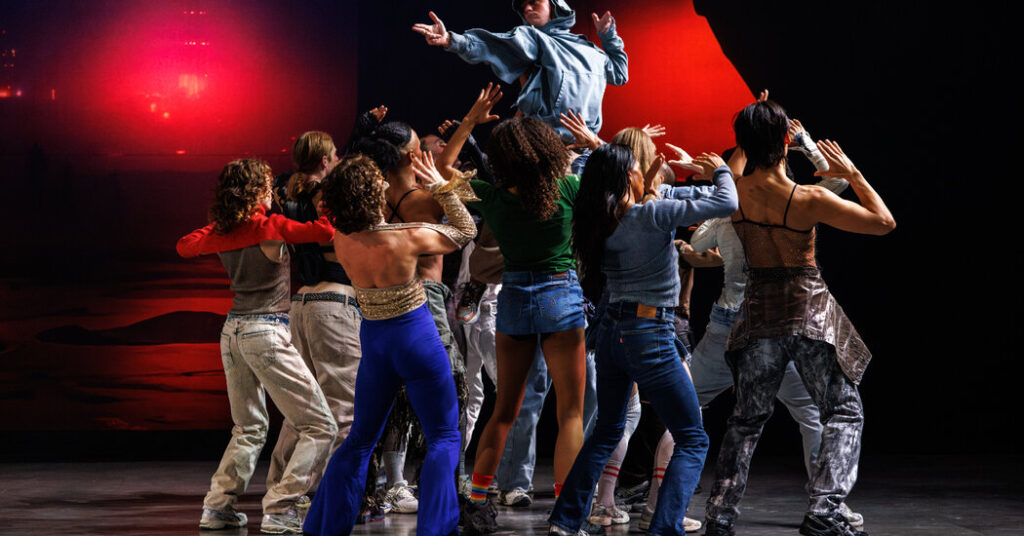
In Brooklyn, National Ballet of Marseille and the collective that leads it, (La)Horde (Marine Brutti, Jonathan Debrouwer and Arthur Harel), brought their evening-length “Age of Content,” a look at avatars and real bodies. (La)Horde crafted choreography using imagery from video games — Grand Theft Auto was a key inspiration — that transformed dancers into avatars that walked stiffly, stuttered in place and changed paths with uncanny resilience.
Julien Peissel’s set design, conceived with (La)Horde, featured a staircase with a balcony. Curtains at the back of the stage opened to a view of a cliff taken out of science fiction and, in a nod to Grand Theft Auto, a car.
This was a rare case of money well spent: The automobile was see-through, like a greenhouse. As the work began, its headlights, like eyes, glistened in the darkness. Fog rolled in. A dancer dressed in a white tracksuit adorned with glitter — her hood pulled up and long braids dangling — draped her body upside down on the hood. Her legs opened and closed like windshield wipers. (Costumes are by Salomé Poloudenny, with hairstyling by Charlie Le Mindu.)
As cars go, this one had a personality, a mix between Herbie, the sensitive Volkswagen Beetle, and Christine, a possessed Plymouth Fury. It also served as a stage within the stage. After that first dancer was joined by others, dressed the same and with nylon stretched over their faces, fights broke out on and around the vehicle.
Scenes mimicked video games, making the line between avatar and human hazy; as the work progressed, two dancers, as avatars, seemed to control the scene, while the others, having changed into streetwear, became more of themselves.
There were sections that slowed the momentum — as well as an overabundance of humping — but the finale of “Age of Content” was a thrill. Combining movement from TikTok dances with the minimalist structure of the postmodern choreographer Lucinda Childs (with whom the choreographers have worked) brought two dance forms together. In a previous visit to New York, (La)Horde showed this section under a different title, and while that performance was exuberant, this was better. It had context concerning the differences between real and virtual bodies.
Set to Philip Glass’s “The Grid,” the choreography had dancers walking evenly against the curtained back of the stage. One broke from the group to let loose until, eventually, they all joined in, flitting in and out of the footwork and images that normally invade our social media. Smiles, a little maniacal, were pasted onto their faces.
During the Sunday afternoon performance, people across New York were inside their homes, wisely waiting for the sky to turn blizzard white. But for those of us at BAM, this high-octane delivery pulled us away from screens and planted us firmly into our bodies. It was the best timing.
Gia Kourlas is the dance critic for The Times. She writes reviews, essays and feature articles and works on a range of stories.
The post A French Dance Invasion Returns With Bumps but a Thrilling Ride appeared first on New York Times.