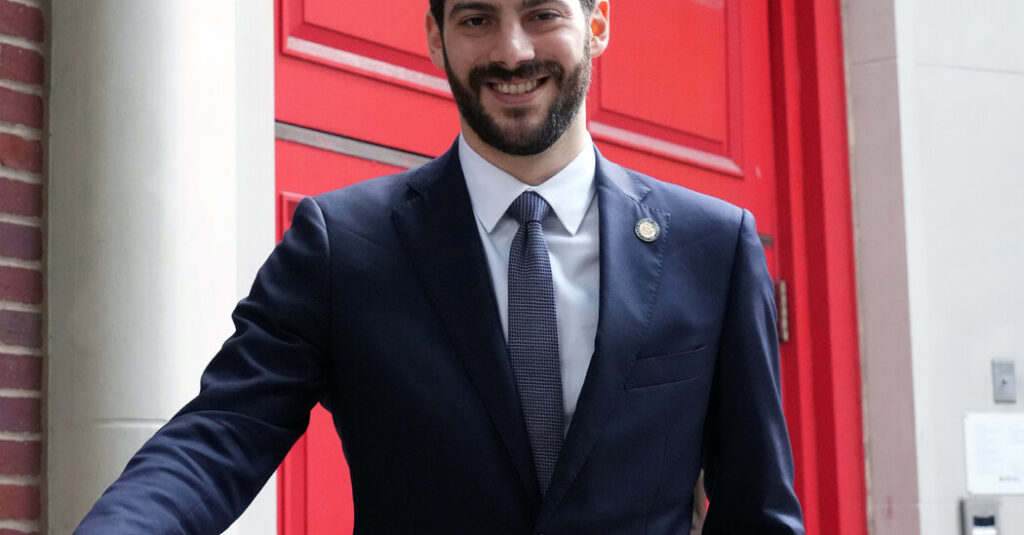
If I were a voter in New York’s 12th Congressional District, a recent attack ad against the candidate Alex Bores might make me think twice about considering him. Bores, a 35-year-old member of the New York Assembly, is a reliably progressive candidate in the coming Democratic primary to succeed the liberal stalwart Jerry Nadler, who is retiring. But the spot, paid for by a political action committee called Think Big, points out something seemingly sinister in Bores’s past: A former data scientist, he led a government team at the tech giant Palantir until 2019, while the company was working with Immigration and Customs Enforcement. “ICE is powered by Bores’s tech,” says the ad, as anxious electronic music plays and images of paramilitaries in the street flash onscreen.
The people behind Think Big know that A.I., ICE and Palantir are all very unpopular with New York City Democrats. So they probably don’t want you to know that the PAC is part of a dark-money network funded by Donald Trump megadonors seeking unfettered A.I. development.
Think Big is an affiliate of Leading the Future, a super PAC that has raised over $100 million from figures including a Palantir co-founder, Joe Lonsdale; the venture capitalist Marc Andreessen; and OpenAI’s president, Greg Brockman. Their goal is to take down politicians who want to put guardrails around A.I., and they’re happy to exploit public suspicion of the technology to do it. Bores is their first target. The PAC has already spent $1 million to try to make an example of him.
That’s because Bores, who says he resigned from Palantir over its work with ICE, has made regulating A.I. a centerpiece of his campaign. “I think Congress is just missing the boat right now, the same way we missed it on social media,” he told me. “Some combination of not having people that actually understand it, not having people that are willing to stand up to mistruths and the power of the industry, has just led to a place where we have no protection as Americans.”
There are several interesting candidates in the campaign for the 12th District, including Assemblyman Micah Lasher, a solid Upper West Side liberal endorsed by Nadler, and George Conway, the Trumpworld insider turned resistance celebrity. (There’s also Jack Schlossberg, an influencer whose primary qualification is that he’s John F. Kennedy’s grandson.) But only Bores gives voters the opportunity to defeat the tech oligarchs unleashing tsunamis of cash to buy political submission. No one else in the race has better enemies.
As a New York assemblyman, Bores sponsored the 2025 Responsible Artificial Intelligence Safety and Education, or RAISE, Act. Similar to a California law, the act requires large A.I. developers to take steps to prevent “critical harm,” to report safety incidents and to publish their safety and security protocols. Though some of Bores’s proposals were watered down in negotiations with Gov. Kathy Hochul of New York, the RAISE Act is still perhaps the most stringent A.I. law in the country.
Bores hopes, in Congress, to spearhead A.I. legislation at the federal level, including child safety measures, a national data privacy law and laws to protect consumers from electricity price hikes caused by data centers. “People have this feeling A.I. is happening to them,” said Bores. He wants to make voters feel that they have a say in how the technology is deployed. “We need to start building the muscle of actually passing bills in this space, because what’s happening around us could change very, very quickly,” he said.
Though leaders in the industry have lined up against him, he’s raised hundreds of thousands of dollars from rank-and-file A.I. employees, who are well placed to see A.I.’s potential dangers.
Right now, the politics of A.I. are scrambled and don’t break down along neat partisan lines. Trump, of course, is a major recipient of A.I. money and, consequently, a huge A.I. booster; he recently signed an executive order seeking to invalidate state A.I. regulations like the RAISE Act. But there are plenty of A.I. skeptics in the Republican Party, including Gov. Ron DeSantis of Florida, and some leading Democrats are A.I. enthusiasts, particularly Gov. Josh Shapiro of Pennsylvania.
The public, meanwhile, is broadly uneasy about A.I. In a recent YouGov/Economist poll, 58 percent of Americans — and 53 percent of Republicans — said they distrust it. Almost two-thirds of respondents expect A.I. to decrease the number of available jobs, and a plurality think it will negatively affect the economy. Communities in both blue and red states are mobilizing against new data centers, which, in addition to driving up electricity costs, can deplete water tables.
A.I. feels, to many of us, creepy and invasive — a sense that’s only exacerbated by the antihumanist pronouncements of its creators. “I suspect that in a couple of years on almost any topic, the most interesting, maybe the most empathetic conversation that you could have will be with an A.I.,” Sam Altman, a co-founder of Open AI, said last year. More recently, he said it was “unfair” to harp on A.I.’s environmental cost because “it also takes a lot of energy to train a human.”
There’s a huge political opportunity for the party that can stand up for human beings in the face of this alienating, machine-worshiping ethos. For Democrats to seize it, they need both the fortitude to make foes of some of the world’s richest men and the expertise to know how these technologies can be constrained. If Leading the Future fears a candidate, those of us desperate for a different future should consider it an endorsement.
The Times is committed to publishing a diversity of letters to the editor. We’d like to hear what you think about this or any of our articles. Here are some tips. And here’s our email: [email protected].
Follow the New York Times Opinion section on Facebook, Instagram, TikTok, Bluesky, WhatsApp and Threads.
The post A Congressional Candidate Feared by the Tech Oligarchs appeared first on New York Times.