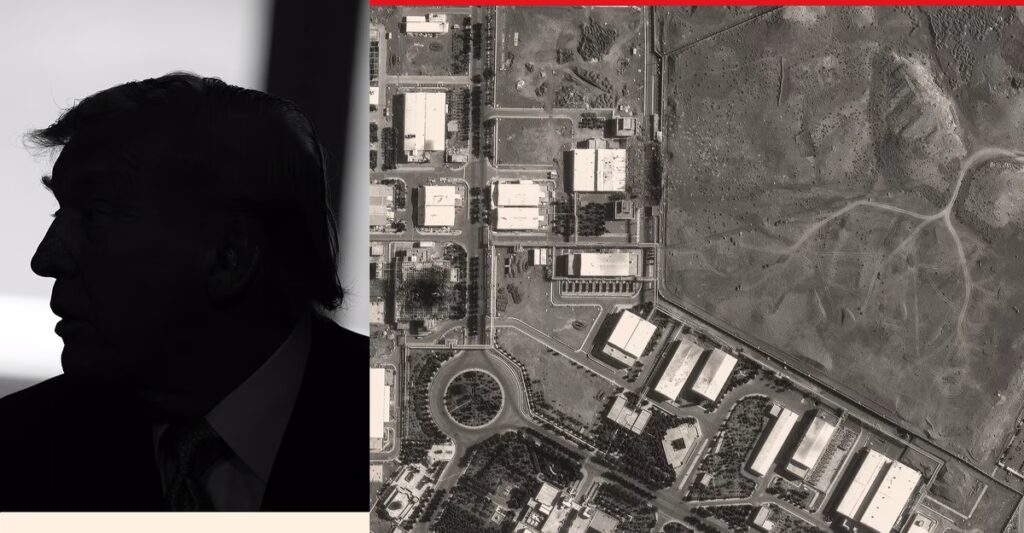
Donald Trump has assembled the largest U.S. force in the Middle East since the invasion of Iraq in early 2003, including two carrier strike groups and a formidable array of fifth-generation fighters. By one account, this agglomeration represents 40 to 50 percent of all deployable U.S. airpower in the world.
War may be imminent. But the buildup masks a deep strategic confusion. The United States does not need a comprehensive deal with Iran now, and may be better off without one for the time being. Nor is a war necessary. The clock is not ticking on America. Washington has time to exert pressure and leverage to give the Iranian people a chance to bring about change—while still getting a good nuclear deal in the future.
Trump and Israeli Prime Minister Benjamin Netanyahu have been clear that Iran cannot be allowed to obtain a nuclear weapon. U.S. envoy Steve Witkoff told Fox News on Saturday that Iran is “probably a week away from having industrial-grade bomb-making material. And that’s really dangerous. So they can’t have that.”
The U.S. and Israel have set out maximalist demands: Iran must give up any ability to enrich uranium (even with the sorts of limits and inspections that were agreed upon in the 2015 nuclear deal), dismantle its nuclear infrastructure, and accept curbs on its missile program and regional proxies.
But their argument rests on a startling omission. It makes no reference to the events of June 2025, when the U.S. and Israel struck Iranian military and nuclear targets in 12 days of aerial bombardment. But these events did happen. And they matter.
The strikes may not have “obliterated” Iran’s nuclear program, as Trump said they did at the time, but they did inflict enormous damage and appear to have set the program back years. The summer’s campaign also reset expectations about what the United States and Israel are willing to do. Iran now knows that efforts to rebuild its program could trigger additional strikes. And yet, the administration speaks as though no time has been gained and the window to stop Iran from building a bomb is rapidly closing.
[Read: The problem with Trump’s cease-fire]
The strategic context has also shifted in another crucial respect. The Iranian regime is weaker today than at any point since it came to power, in 1979. It faces sustained domestic unrest, severe economic strain, and a crisis of legitimacy. Iran’s supreme leader turns 87 in April, and a succession crisis looms. This is not a moment of regime strength; it is one of fragility.
That fragility should shape American strategy. Washington should seek to sustain pressure and allow these vulnerabilities to develop. Instead, it is offering a deal or war.
The United States does not need a comprehensive deal with Iran now. In fact, such an agreement could be counterproductive. The more ambitious the nuclear concessions demanded of Iran, the greater the economic relief required to secure them. A comprehensive nuclear deal that requires Iran to abandon enrichment entirely would almost certainly involve sweeping sanctions relief. That would unlock tens of billions of dollars, reopen global markets, and offer the regime a path out of isolation. Paradoxically, it could provide a lifeline just as internal pressures are mounting. A “zero enrichment” deal could have the unintended effect of prolonging the very system it seeks to constrain.
The United States could instead accept a stronger version of the 2015 nuclear agreement (with no time limit, no stockpiles, and a lower level of enrichment) in exchange for much more modest sanctions relief and economic opportunities than would be in play if Iran agreed to zero enrichment. This more circumscribed agreement would keep the pressure on the regime. And the truth is that last June’s strikes created space for such an approach by imposing real costs on Iran’s program and significantly extending the timeline for any nuclear breakout. However, there is no urgency for such a deal. The administration can bide its time if it would prefer to give the regime no sanctions relief at all at this moment, or if it believes that it cannot accept any enrichment.
Of course it is very possible that Trump and Netanyahu are not in any way serious about a deal. The whole push might be a pretext to deliver a devastating military blow to a regime teetering on the brink of collapse.
Americans can reasonably hope that the Iranian regime falls. Iran’s security forces have killed thousands of protesters in recent months in what was likely a world-historic wave of repression. The country sponsors Hezbollah and Hamas. It has plotted to kill senior American officials, including Trump. And it has sown terror at home and abroad for decades. Still, applying economic and diplomatic pressure is very different from launching a war to topple the regime.
The United States and Israel might well defeat Iran quickly and decisively, because last year’s war left the Islamic Republic’s forces and command structure depleted. But an escalation into open-ended regional conflict is also possible. A cornered Iranian regime could conclude that the only way to prevent continued attacks is to inflict significant casualties on American forces and those of allied Gulf states. The country’s power structure could prove more resilient than expected, aided by its willingness to kill large numbers of civilians who dare to challenge it. A major war in the Middle East, lasting weeks or months, would badly damage U.S. readiness and capabilities in the Indo-Pacific, deplete American munitions stockpiles, and leave Americans to deal with the consequences for years to come.
[Read: What would war with Iran look like?]
The Wall Street Journal recently reported that Trump might launch a limited strike as a means of coercing Iran into making concessions. But if that gambit fails, the operation could morph into a war for regime change. This just underscores how ill-defined the objective is. Suppose American air strikes succeeded in decapitating Iran’s leadership. The administration has articulated no plan for what would happen next. Such a war would lack congressional authorization, and American voters have repeatedly rejected open-ended regime-change campaigns. The administration has not set forth a clear legal or strategic rationale for such a war, either domestically or internationally. The president spoke at one point about helping protesters, but if he were serious about this, he might consider reversing the cuts he made to foreign assistance that once supported Iranian civil society and human-rights groups.
The United States now faces a choice, but it is not the one most often presented between a sweeping deal and a major war. It is a choice between recognizing the leverage created by recent events and discarding it. The June 2025 strikes altered the strategic landscape. They damaged Iran’s nuclear program, further weakened its regime, and bought time. Any policy that ignores those gains risks squandering them.
Before the United States takes the next step, whether toward a deal or war, it should answer a basic question: What exactly has changed since June that justifies a more extreme course of action now? Until that question is addressed, the case for urgency, and for war, does not add up.
The post Trump’s Iran Policy Does Not Add Up appeared first on The Atlantic.