President Donald Trump on Monday spotlighted victims of crimes by undocumented immigrants with an official proclamation, returning on the eve of his State of the Union address to an issue that most animates his base even as broader public support for his approach erodes.
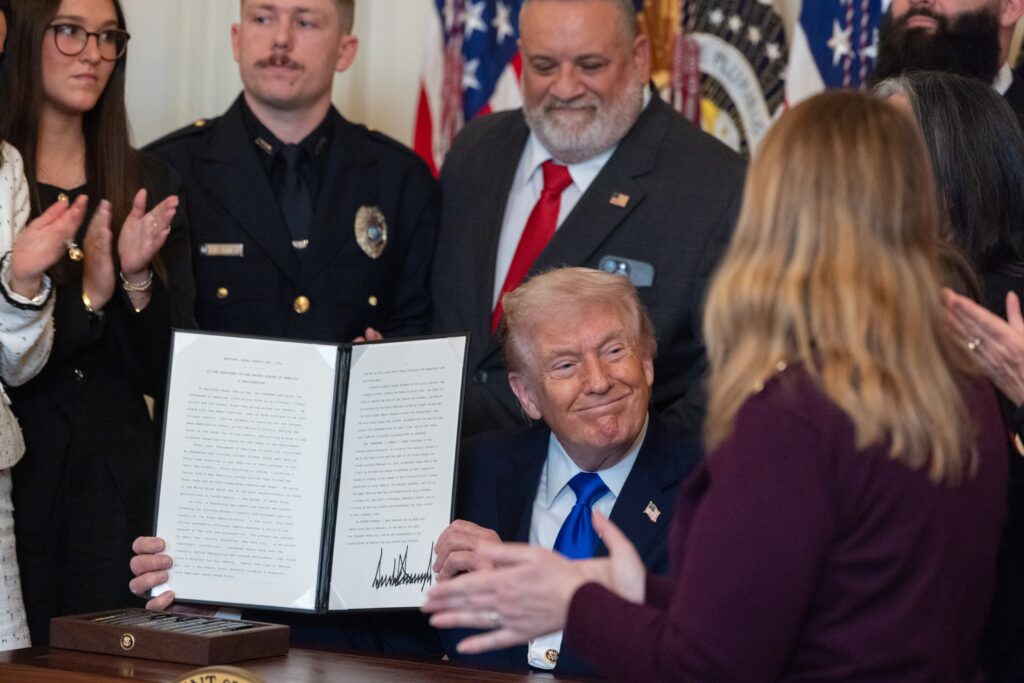
In a somber vigil, Trump declared Feb. 22 “Angel Family Day,” inviting a half-dozen people to the microphone in the East Room of the White House to detail the impact of violent attacks. Many credited Trump for his immigration policies before a candle was lit, dozens of victims’ names were read, and “Amazing Grace” was sung.
Trump several times repeated the falsehood that he won the 2020 election and claimed that had he remained in office, his policies would have prevented the deaths of attendees’ loved ones.
“We did great in that election. If that election wasn’t rigged, every single one of the people in this room right now would not be here,” he said, even though several of the killings occurred before he was elected in 2016 or during his first term in office. “You’d be home with your son or daughter, family. We had a strong border. You know, we solved it.”
The event sought to refocus the immigration debate on crime as public support for Trump’s approach softens, despite research showing that immigrants do not commit violent crimes at higher rates than U.S. citizens and that violent offenders account for a small share of deportation arrests.
Support for Trump’s approach to deportations has fallen in recent months, a new Washington Post-ABC News-Ipsos poll found, even as the share of those who support federal efforts to deport the nation’s roughly 14 million undocumented immigrants has held roughly steady over the past year. Half of Americans say undocumented people should be deported, but 58 percent say Trump has gone too far — an eight-point increase since the fall. His approval rating on the issue of immigration has also steadily eroded, falling to 40 percent in the latest poll, down 10 points from a year ago.
Trump was largely dismissive of polls during his remarks Monday as he reaffirmed his commitment to aggressive immigration enforcement. He did not mention the recent high-profile killings of two U.S. citizens in Minnesota by federal personnel carrying out this campaign.
“Polls are tough. You know when you get a fake poll?” he said. “I get them today. I see one today that I’m at 40 percent. Forty percent? I’m not at 40 percent. I’m at much higher than that.”
The event in the East Room was filled with families, sitting in a semicircle around the podium. Two screens with the text “Signing of the National Angel Family Day Proclamation” faced an audience that included officials such as Homeland Security Secretary Kristi L. Noem and border czar Tom Homan. The date was chosen to honor Laken Riley, a nursing student killed by an undocumented immigrant in Georgia on Feb. 22, 2024.
Allyson Phillips, Riley’s mother, on Monday said she appreciated Trump’s support and said his private comforting may be surprising to those who only know his public persona.
“You have fought a fight that most people would not want to have to fight,” she said. “President Trump, you are doing a thankless job that most people just wouldn’t do. And I just can’t thank you enough.”
Officer Ethan Curreri recounted having arrested the man who killed Riley for committing an earlier crime, only to see him released.
“I did my job. I put him in custody. The system failed,” he said. “No detainer, no accountability, no deportation. And an innocent American life was taken.”
Addressing Riley’s family, he said, “Your loss should have never happened.”
Some of the family members also rebuffed the attention placed on immigrants whose families are riven by deportations.
“I’m sick and tired of hearing these Democratic politicians stand up on these podiums and say how sorry they are for seeing these criminal illegal aliens being ripped apart from their families,” said Jody Jones, whose brother, Rocky Jones, was shot and killed by a migrant in 2018. “What about us? What about the American family? What about us? We mean something, too. And this man here understands it.”
While Trump has often painted all undocumented immigrants with a broad brush in his deportation campaign, there is not evidence that they commit crimes at a higher rate than U.S. citizens. A 2024 study funded by the Justice Department’s National Institute of Justice found that undocumented immigrants are arrested at less than half the rate of native-born U.S. citizens for violent and drug crimes, and at less than a quarter of the rate of native-born citizens for property crimes.
Communities with high concentrations of first-generation immigrants experienced less violent crime than other communities in similar economic shape, according to sociologist Robert J. Sampson’s Project on Human Development in Chicago Neighborhoods, which studied crime trends among neighborhoods in the city in the 1990s and 2000s.
Even so, crimes committed by undocumented immigrants have commanded public attention, and Trump has continued to place them at the center of his immigration agenda. He began his second term by signing the Laken Riley Act, which requires the detention of any migrant who allegedly commits a theft or burglary, and he posted signs on the White House lawn of undocumented immigrants accused of committing violent crimes.
Immigration and Customs Enforcement has said it is focusing enforcement operations on immigrants who commit violent crimes. In practice, however, those individuals have consistently represented a small percentage of the overall arrests of undocumented people as the administration has sought to meet the president’s mass deportation goals, according to a Post analysis of ICE data from January 2025 to June 2025. The examination found that the administration is increasingly targeting unauthorized migrants with no criminal record.
Trump on Monday did not unveil any new policies, but he had several digressions, including one in which he remarked about how assassins often target important presidents.
“You know, you read about all these crazy shooters. But they only go after consequential presidents, they don’t go after non-consequential presidents,” he said. He mentioned Abraham Lincoln (“some big one”) and John F. Kennedy (“he was consequential; there was a glamour”).
“So maybe I want to be a little bit less consequential,” he said. “Can we hold it back a little bit, please?”
Later he remarked of the victims’ families, “I’ll never forget them.”
“I don’t know how long I’ll be around. I’ve got a lot of people gunning for me, don’t I?” he added. “But I will not forget them.”
He also said he has accumulated more power in this term and added he may have more to unveil on Tuesday night.
“It’s going to be a long speech,” he said. “Because we have so much to talk about.”
Arelis R. Hernández contributed to this report.
The post Trump again centers crime in immigration debate with White House vigil appeared first on Washington Post.