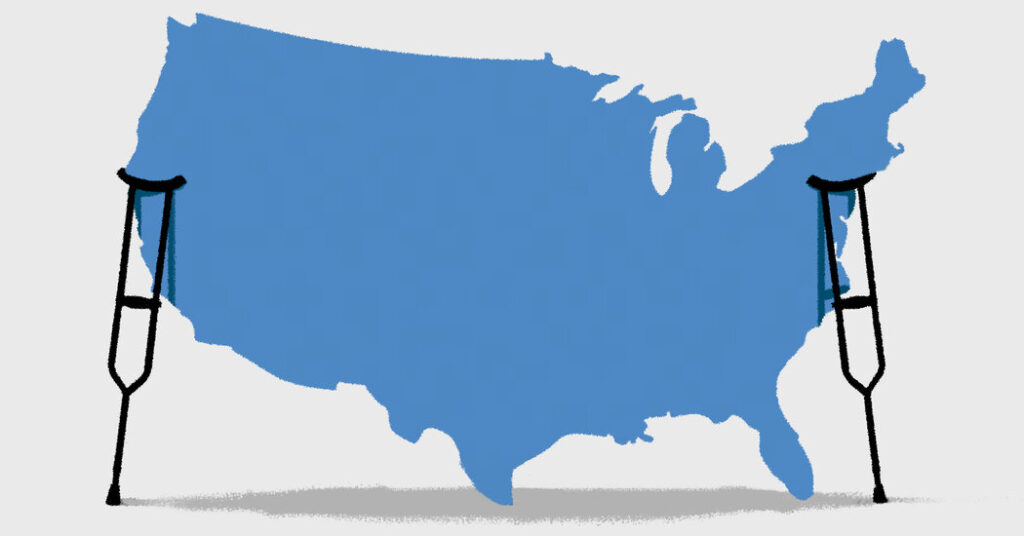
I have read extensively and written occasionally about treatments from which our ailing country might benefit. Perhaps we should fashion a sweeping new national service program. Maybe establish open primaries and ranked-choice voting in more states.
Here’s something smaller, easier, doable tonight. You want a healthier America? Watch “The Pitt.”
It’s the medical drama, streaming on Max, that won a bunch of Emmy Awards last year and has an intriguing real-time conceit, with each of a season’s 15 episodes representing a consecutive hour in one day at an overwhelmed Pittsburgh emergency room.
The second season is almost halfway done and feels even more relevant than the first. It’s also more open about its desire to be a mirror for a nation in need of help. To that end, this season takes place on America’s birthday, the Fourth of July. No subtlety there. In fact, my one major quibble is how blunt the show’s messaging can be.
But that doesn’t make “The Pitt” any less important. It’s an empathy exam. It’s a civics lesson. Above all, it’s a study of people under intense pressure — as they are when a pulse is fading, or when a nation is fraying — and the importance of muddling through and making things better, no matter the odds, no matter the obstacles.
I’m hardly the first observer to recognize its interest in being both American microcosm and American parable, nor is this the first time I myself have recognized that. I wrote last year that the show’s depiction of a drained, imperfect enterprise that gets by on last-minute fixes rather than permanent solutions felt awfully familiar.
But the current season seems even more intent on setting that enterprise straight. Details follow, as do spoilers. Skip to the next section of this newsletter if you want to avoid them.
“The Pitt” implores us not to rush to judgment and not to assume the worst. A 9-year-old is brought into the emergency room by her father’s girlfriend with a gashed chin from a hard fall. An examination reveals extensive bruising beyond that injury, as well as blood in her urine. Members of the medical team attending to the girl suspect abuse, and they clearly suspect Dad. Where is he, anyway? Then he shows up and, in short order, tests come back: His daughter has a disorder that explains her symptoms.
Legally, he’s in the clear. But morally? In his upset, he treats his girlfriend miserably, and that’s apparently a pattern. He’s no monster and no saint. But he inhabits a world that hastens to tuck people into one category or the other.
Time and again, “The Pitt” stresses the point, at once obvious and necessary, that we never really know what’s going on inside someone; a patient’s long undetected tumor is a metaphor for so much more. The show also illustrates the cost of our overconfidence that we grasped the truth at the outset.
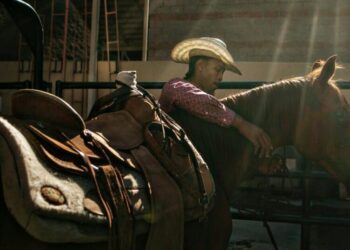
It makes an argument for diversity that’s smart and true, looking beyond the usual dividing lines — race, religion, gender — to less politically charged differences. A brand-new doctor who grew up on a farm in rural America draws on a sensibility that peers lack. A medical student suggests a way to lessen an uninsured patient’s financial distress that her co-workers didn’t think of. It occurred to her not because she’s Asian American but because she grew up in a family with limited means and daunting medical bills, so she was schooled in impediments and options.
Prison guards arrive with a convict who has been brutally assaulted and needs more skilled medical attention than he can get behind bars. He’s also malnourished, presumably because of an inadequate prison diet, so some of the emergency room staff contrive to keep him past the point when he could be discharged.
The show’s main character, Dr. Robby, played by Noah Wyle, pushes back.
Wait, wait — Dr. Robby is supposed to be one of the good guys. He’s a caregiver, a healer. Does his compassion end where incarceration begins? No. It’s not that. It’s this: Any bed in which the convict lingers is a bed that someone who needs more immediate attention won’t get. When resources are finite, choices must be made. That’s not cruelty. That’s reality. And that, too, is something many Americans must accept.
There’s a war in America between erudition and improvisation, science and superstition, head and heart. “The Pitt” might be expected to come down unconditionally on the side of expertise. But it doesn’t, not exactly. While it routinely and rightly exalts medicine’s wondrous advances, it also suggests that experts can be hidebound, timid. And it understands that the wiring of people and of societies demands room for both proper procedure and imagination. To the consternation of a colleague, Dr. Robby repeatedly asks the younger physicians around him what their guts say. He’s negotiating a truce between information and intuition.
He’s a fascinating mess. In this season’s opening minutes, he rides into work on a motorcycle. He’s not wearing a helmet. He later lies about that, because he obviously knows the risks of such recklessness — he’s steeped in the bloody ravages of it. He’s the lodestar and conscience of the emergency room, capable of such wisdom and grace, and he behaves like this?
“The Pitt” has no illusions about how defiant people can be. How self-destructive. How irrational. That’s also in our wiring, and ”The Pitt” amounts to a plea that we humbly bear that in mind as we try — which we must — to put ourselves on a better track. It’s the most patriotic show on television.
Forward this newsletter to friends …
… and they can sign up for themselves here. It’s published every Monday.
For the Love of Sentences
Per usual, there has been some excellent political writing over the past week, but it’s going to have to wait to find mention here. This is one of my occasional newsletters that, in the interest of our mental health, declares this section a politics-free zone.
In The Athletic, Matt Slater explained that every curling stone used in the Winter Olympics for the past two decades has been quarried in the uninhabited Scottish island of Ailsa Craig: “To quote the Scottish Geology Trust, Ailsa Craig’s microgranite has ‘no crustal contamination’ and, as an added bonus, it contains the ‘comparatively rare alkaline ferromagnesian minerals riebeckitic arfvedsonite, hedenbergite-acmite and aenigmatite.’ If you take nothing else from this piece, store those away for your next game of Scrabble.” (Thanks to Judy Howard of Seattle for nominating this.)
In The Washington Post, Barry Svrluga provided context for Mikaela Shiffrin’s gold medal performance in the slalom: “Five of Shiffrin’s World Cup victories this season have been by more than 1.2 seconds. In ski racing that’s enough time for dinosaurs to die off and be replaced by mammals.” (John Holtz, Medford Lakes, N.J.)
In The Wall Street Journal, Georgi Kantchev and Laine Higgins profiled the Norwegian cross-country skier Johannes Hoesflot Klaebo, whose dominance in the sport is attributed to his way of sprinting, known as the Klaebo stride: “While the technique is now taught in ski schools across Scandinavia, few can replicate it without calling an ambulance.” They added: “Cross-country skiers talk about expending energy in terms of burning matches. The Klaebo stride is more like lighting the whole box at once.” (Bill Hamill, Richmond, Va.)
Also in The Journal, Jason Gay reflected on the shockingly disappointing performance of the American figure skater Ilia Malinin (a.k.a. the “Quad God”). “When it unravels like that, the whole spectacle starts to feel pretty cruel,” he wrote. “The anticipation and exuberance that bounced around in the arena moments ago gets sucked out of the concrete and cold dread rushes in. The crowd goes numb, near silent. You can almost hear the blades on the ice, glumly slashing through the final motions of a night expected to end so differently.” (Ellen Langille, Mount Dora, Fla.)
In The Ringer, Katie Baker registered her own reactions to Malinin’s tumbles — and to the generous hug he subsequently gave to Mikhail Shaidorov, who won the gold that he’d dreamed of. “From where I sat, there were two winners on TV,” she wrote. “One of them was the gold medalist. The other was the guy only a few minutes removed from one of the worst moments of his life, actively giving an opponent his very best.” She added: “It was like a spell broke and the world saw the truth: Even a Quad God is only human. What a broken and beautiful thing to be.” (Michael Kelly, Cincinnati)
In The Times, Bruce Handy puzzled over the Olympic sport of ski ballet, also known as acroski: “Even in figure skating and gymnastics, the marriage of athleticism and choreography can sometimes feel forced. Add skis, poles and snow suits, and the effect is more the hippos in tutus from ‘Fantasia’ than it is Simone Biles or Michelle Kwan.” (Barbara Buswell, Oakland, CA)
Also in The Times, Tim Balk appraised a flamboyantly decrepit mansion in Brooklyn whose dilapidation was a neighborhood spectacle and curiosity: “It is a temple of profligate neglect, the sort of structure that seems capable of giving you a splinter just because you looked at it.” (Phil Pullella, Rome, and Steve Elliott, Las Vegas, among others)
And Rory Satran heralded a trend in tresses: the return of the side part. “A revolution is afoot — or rather, ahead,” she wrote. (Valerie Macaray-Brickey, Fullerton, Calif.)
In The St. Paul Pioneer Press, Mark Glende explored the intersection of Catholicism, Lent and the Friday Fish Fry. “As a child, I understood Lent primarily as the season when hamburgers became illegal on Fridays and guilt became recreational,” he wrote. In Wisconsin, he added, “Friday Fish Fry is less a meal and more a constitutional right.” And at a Friday Fish Fry in Minnesota: “Even Lutherans show up. Quietly. Respectfully. Possibly with Tupperware. No one asks questions. We are ecumenical when batter is involved.” (Julie Quinn Kiernan, St. Paul, Minn.)
Finally, in her newsletter, Joanne Carducci, a.k.a. JoJoFromJerz, surveyed a chromatically monotonous landscape: “February in New Jersey is a color more than a month. It’s the shade of wet concrete and exhausted sky, sidewalks crusted with old salt, lawns still pressed flat beneath winter’s palm.” (Kate Kavanagh, Concord, Mass.)
To nominate favorite bits of recent writing from The Times or other publications to be mentioned in “For the Love of Sentences,” please email me here and include your name and place of residence.
Bonus Regan Picture!
I’m fascinated by how dogs sleep. By the range of places — a soft lawn, a hard sidewalk, a proper dog bed, a bathroom floor — in which they’re able to doze off. By the Kama Sutra of sleeping positions they find comfortable. But most of all by how quickly they tumble into slumber and how deep that slumber seems to be. I marvel at Regan’s stillness as she lies beside me. At her unfettered peace. How I envy it, too.
On a Personal Note
Something remarkable happened the other morning: I spent roughly 75 minutes having breakfast at a restaurant in a group of five people (including me) with busy lives and many acquaintances, and not once did one of us take out a smartphone to check for emails, to send a text message, to consult Google or simply to gaze at that infernal, ensorcelling screen.
Nobody had a phone lying face up or face down on the table. Nobody had one visibly within reach. It was as if we’d traveled back in time to a less addled past. It was splendid.
It wasn’t perfect; perfect would be my not noticing this smartphone liberation, because it had become the norm. But I do think there’s a positive change happening (and God knows we need to note and hold on to anything good amid all the bad). I think that the widely chronicled, desperately needed movement to limit schoolchildren’s time on social media and their umbilical attachment to their smartphones has become part of — and has motivated — a broader reckoning with our digital addictions.
And with our digital rudeness.
Sometime over the past decade, it became customary, during a meal, for various people at the table to take out and fiddle with their phones. Smack in the middle of conversation. Smack in the middle of mastication. It became customary for someone to take a call or respond at length to an email. It became customary for me to do that, as ashamed as I am to admit it; that damned phone was this constant itch in my pocket, this devilish whisper in my ear, an insistent yank on my thoughts.
How did I justify that? How did any of us? We were careful to chew with our mouths closed, to put our napkins in our laps. But we had our phones beside our forks.
Now I don’t. I notice the same difference in many of the people around me. At some point the cultural conversation about what we were doing to ourselves reached a volume that got through to us. At some point, the realization of how inconsiderate we were being to everyone around us sank in.
The other night, I walked into a dinner party and realized, as soon as I was through the door, that my phone was still plugged into my car dashboard. And that if I didn’t retrieve it, I might be without it for more than three hours. The horror!
I left it there. Forgot about it entirely. And I was able to do that in part because my five dinner companions never reached for or used their phones. That wasn’t some pact. It was just how the evening played out.
I hope it’s the new etiquette. And I apologize for my terrible manners — for my disrespectfulness — in the past.
The post The Television Show Every American Should Watch appeared first on New York Times.