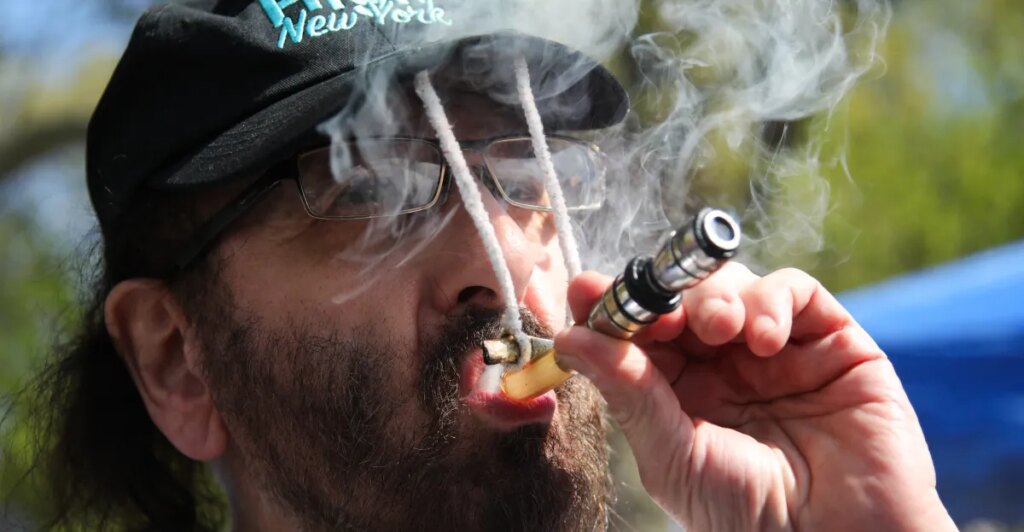
On March 2, the justices will hear their second major Second Amendment case of the Supreme Court’s current term. United States v. Hemani asks whether Congress may make it a crime for an “unlawful user” of marijuana to possess a gun.
If you are a lawyer trying to guess how the Court will rule in this case, good luck with that. The Court’s Second Amendment precedents are as unsalvageable as they are confusing. At least in theory, they require judges to ask whether a modern-day gun law is sufficiently similar to gun laws from more than 200 years ago. But the rules appear to shift depending on whether a majority of the justices actually think a particular gun law is a good idea.
That said, there is a sensible way that the Court could resolve the Hemani case without having to wade into this historical morass. Again, the federal law at issue in Hemani bars gun possession by an “unlawful user” of “any controlled substance” such as marijuana. But what does it mean to be an unlawful user of marijuana?
If someone takes a bong hit in college, decides that they don’t like weed, and never gets high again, are they forever barred from owning a gun? What about a person who shares a joint with her cousins every year on Thanksgiving, but otherwise doesn’t smoke? And if this law doesn’t permanently bar one-time marijuana users from having a gun, when does the bar end? If someone takes a single puff at a party in February, do they get their gun rights back in March? In November? And what about people who use marijuana more than occasionally? If someone takes a weed gummy a couple times a month to help them sleep, are they barred from owning a gun? What about someone who hits a vape pen on every other Saturday?
Federal appeals courts, as defendant Ali Hemani’s lawyers argue in his brief, have struggled to answer these questions, reaching divergent answers. That’s a serious constitutional problem, because the Supreme Court has long held that the government violates due process when it takes away “someone’s life, liberty, or property under a criminal law so vague that it fails to give ordinary people fair notice of the conduct it punishes.”
The Supreme Court, in other words, can strike down the vague law in Hemani without having to dive into the impossible-to-answer question of whether this law violates the Court’s unfathomable Second Amendment precedents.
The Supreme Court’s Second Amendment precedents are as perplexing as they are incompetently drafted
The Second Amendment provides that “a well regulated militia, being necessary to the security of a free state, the right of the people to keep and bear arms, shall not be infringed.”
And, until fairly recently, the Court took the first 13 words of this amendment seriously. As the Court said in United States v. Miller (1939), the “obvious purpose” of this amendment is to “render possible the effectiveness” of militias, it must be “interpreted and applied with that end in view.”
But the Court abandoned this textualist approach to the Second Amendment in District of Columbia v. Heller (2008), which held that the “central component” of the right to bear arms is a personal right to have a gun for “self-defense.”
Fourteen years later, in New York State Rifle & Pistol Association v. Bruen (2022), the Court’s Republican majority announced a new legal framework that applies only in Second Amendment cases and does not resemble any other framework in constitutional law.
At least on its face, Bruen requires a government lawyer defending a gun law to “demonstrate that the regulation is consistent with this Nation’s historical tradition of firearm regulation.” To do so, the lawyer must show that the gun law they are defending is sufficiently similar to “analogous regulations” that existed when the Constitution was framed.
But the Court has struggled to explain how similar a modern law must be to an old one to survive. And a couple of its post-Bruen actions raise doubts about whether the Court is applying Bruen in good faith.
First, in United States v. Rahimi(2024), eight justices upheld a federal law barring gun possession by people subject to a domestic-violence restraining order. That’s a sensible law.
But Bruen held that modern-day gun laws are particularly suspect when they address “a general societal problem that has persisted since the 18th century.” While violence among romantic partners certainly existed in the 1700s, there were no laws disarming domestic abusers. Indeed, no state made it a crime for someone to beat their spouse until the Alabama Supreme Court did so in 1871.
A strict application of Bruen, in other words, would likely have required the Court to strike down the law at issue in Rahimi. All but one of the justices who joined the Bruen decision balked at that terrible result. But that suggests they were unable to accept the consequences of their decision in Bruen.
Then, in January, the Supreme Court heard oral arguments in Wolford v. Lopez, a challenge to a Hawaii law prohibiting gun owners from carrying weapons into private businesses without the owner’s permission. There are many historical examples of similar laws from the 18th century, including a New Jersey law barring people from bringing a gun onto another person’s land “unless he has license or permission in writing from the owner,” and similar laws in Pennsylvania and New York.
But the Republican justices signaled at oral argument that they are going to strike down Hawaii’s law anyway.
So it appears that the historical research demanded by Bruen doesn’t actually determine how the Court decides Second Amendment cases. Instead, the justices appear to decide these cases based on whether they think the challenged law is a good idea.
If there is a principled framework to be found in Bruen, moreover, actual judges are struggling to find it. In a concurring opinion in Rahimi, Justice Ketanji Brown Jackson quoted a dozen judicial opinions complaining, in the words of one of Trump’s judicial appointees, that Bruen’s “inconsistent and amorphous standard” simply does not work.
So, if the justices apply the Bruen framework to the law at issue in Hemani, it’s anyone’s guess how the Court will decide the case. My best guess is that they will probably uphold it, because the Trump administration filed a brief asking them to do so, and that’s a pretty good sign that Republicans believe that marijuana users should be prohibited from owning guns.
But I have little confidence in that guess because all Second Amendment cases after Bruen are a law-free zone, seemingly decided on the justices’ personal preferences.
Hemani’s vagueness argument offers the justices a more sensible way to resolve this case
Rather than trying to resolve Hemani within Bruen’s opaque framework, the justices could avoid the Bruen thicket by striking down the “unlawful user” law on vagueness grounds. One sign the law is too vague: Federal appellate judges cannot agree on a definition of “unlawful user” of marijuana.
The US Court of Appeals for the Third Circuit, for example, ruled that a person who used drugs once and possessed a gun six hours later could not be convicted — holding that “use of drugs with some regularity is required to support a conviction” under the “unlawful user” provision.
The Sixth Circuit, meanwhile, requires prosecutors to show that a defendant’s drug use is “sufficiently consistent, ‘prolonged,’ and close in time to his gun possession to put him on notice that he qualified as an unlawful user of drugs.”
The Eighth Circuit, by contrast, holds that prosecutors do not need to present “evidence of use over an extended period.” Instead, it’s enough to show that the defendant used drugs “during the period of time” that they also possessed a gun.
The Trump administration argues that the words “unlawful user” should be read to apply to “habitual drug users.” This appears to be an attempt to fit the law within the Bruen framework, because there were early American laws criminalizing “habitual drunkards.”
So there’s a strong argument the law is unconstitutionally vague. If the Court disposes of Hemani on these grounds, it will at least save them from having to apply the arbitrary legal test laid out in Bruen.
The post The Supreme Court will decide if marijuana users may be barred from owning guns appeared first on Vox.