This is an edition of The Atlantic Daily, a newsletter that guides you through the biggest stories of the day, helps you discover new ideas, and recommends the best in culture. Sign up for it here.
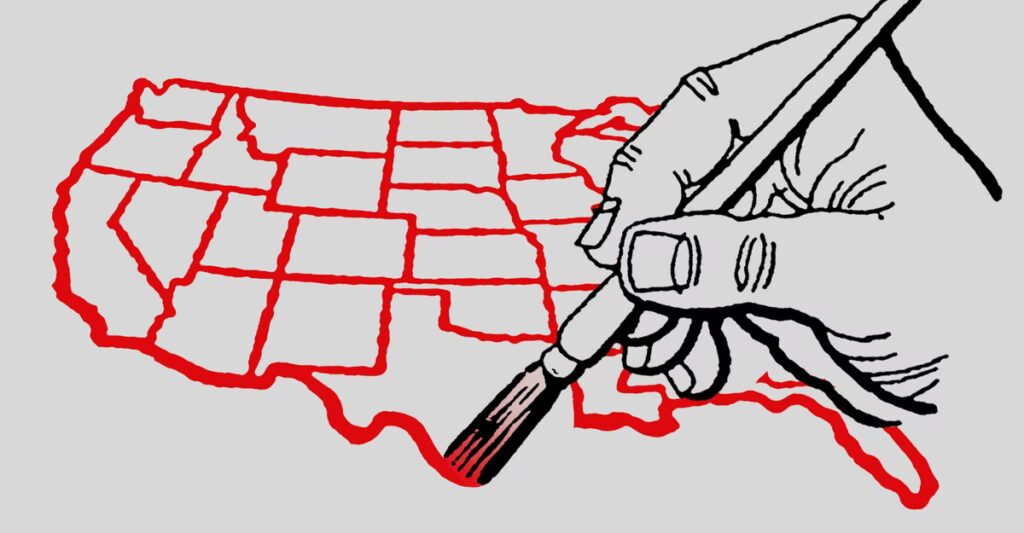
Partisan gerrymandering—the practice of drawing districts in a way that is designed to aid one party and hurt the other—is one of the more pernicious phenomena in American politics today. It’s fundamentally antidemocratic because it’s designed to circumvent or at least dampen the will of voters. For the same reason, it’s very difficult to overcome through democratic means: You can’t exactly vote out the people in power if they’ve drawn districts designed to stop you from doing so. And legal remedies are scant. The U.S. Supreme Court has concluded that although partisan gerrymandering is distasteful, the federal courts have no role in stopping it. Some states have specific constitutional protections against gerrymandering, but many do not.
But partisan gerrymandering does have one ultimate weakness—a foe that doesn’t always win, but whose victories are especially satisfying. That foe is gerrymandering itself. If you have never heard of a dummymander, this is probably a good time to learn the word. Dummymander is the term that the political scientists Bernard Grofman and Thomas L. Brunell coined for what happens when a gerrymander backfires, hurting the party that it was designed to help. Dummymanders are nothing new, but the bunch of new districts drawn in recent months mean that they could play an important role in the outcome of the midterms.
Over the summer, President Trump set off a frantic round of redistricting when he began pushing Republicans in Texas and in other states to redraw their maps to favor Republicans. States typically draw new maps only after each decennial census, and Trump’s pressure to break that precedent was a sign of his concern about potential GOP losses in the 2026 midterms. Democrats in some states considered their own counter-gerrymanders—in California, policy makers even got voters to approve going around an anti-gerrymandering commission set up in 2010.
Now the action is mostly reaching its end as the deadline for finalizing 2026 maps nears, although some questions remain. (Among them: Will the Supreme Court issue a ruling weakening the Voting Rights Act in time for Republicans to draw new maps for this cycle?) The consensus among election analysts is that the redistricting will end up giving Republicans only three or four new seats, if any. But Democratic prowess in recent special elections raises the possibility that rather than a cold-blooded political hit, the GOP’s efforts could end up as a Pyrrhic victory.
In late January, a Democrat won a Texas state Senate seat in Tarrant County—in a district that Trump won by 17 points in 2024. Most House districts won’t see a shift that big, but victories like these have raised the possibility of Democrats catching enough of a blue wave that maps drawn to help Republicans might actually hurt them. The math is simple: In order to draw more districts favoring Republicans, GOP legislators had to spread their own voters a little thinner. But if they spread them too thin and Democrats have a good year, Republican candidates will become vulnerable.
Many of Grofman and Brunell’s examples of dummymanders come from late in the 20th century, when Democrats still held lots of southern seats because of historic party support, but were on the verge of losing them to Republicans. For example, they write that the map Georgia Democrats drew after the 1990 census looks more like a Republican gerrymander than one drawn to help Democrats, which the authors blame on “the belief that it is good to be as thin as possible as long as you still remain breathing.” Entering the 1992 election, Georgia had nine Democratic House members. Three won, but three lost, and three more retired.
Dummymanders also happen when a party has a great deal of control and gets greedy, the journalist Alan Greenblatt wrote last year. Before the 1894 elections, Democrats sought to expand the number of districts they could win, but an economic crisis in 1893 doomed them. The party lost 114 seats in a 357-seat House, reducing it to a regional, southern party. Such a huge collapse is hard to imagine today, in part because partisan gerrymandering has already made so few districts competitive. But this also means that Republicans in particular don’t have a lot of good prospects for gerrymandering without spreading themselves too thin.
The time is too early to declare the presence of any particular dummymanders for 2026, but one place to look is North Carolina. Maps in the Old North State have changed rapidly. In the 2022 election, a court-ordered map produced a 7–7 split between the two parties. In 2024, a new GOP-drawn map produced a 10–4 Republican majority, although Republicans won nearly the same percentage of the overall vote as they did in 2022. Last year, the GOP-led general assembly acted again, with Trump’s urging, to make the district of Representative Don Davis, a Democrat, more Republican.
This attempt to engineer an 11th Republican district may very well work. North Carolina Republicans are experienced and adept mapmakers. But they targeted Davis at the expense of removing Republicans from another district, which is held by the Republican Greg Murphy. Democrats hope, and some conservatives worry, that a big Democratic wave could knock out Murphy and save Davis. In Texas, meanwhile, Republicans drew districts that assume Trump’s success in courting Hispanic voters will translate to the future—but some of his actions since he took office are alienating the same voters.
Whatever the results, any dummymander that emerges in 2026 might be short-lived. The new precedent set by so many states changing their maps during this cycle may mean that legislatures move quickly to correct any errors they made that helped the other party. But gerrymanderers are always making maps based on the last election—which means voters might have a chance to give them their comeuppance.
Related:
- Welcome to the gerrymandering apocalypse
- John Roberts says partisan gerrymandering is not his problem. (From 2019)
Here are three new stories from The Atlantic:
- Tom Nichols: The Republican party has a Nazi problem.
- Thomas Wright: America doesn’t need a deal or a war with Iran.
- Young men aren’t the only ones struggling.
Today’s News
- Peter Mandelson, a former U.K. ambassador to America, was arrested on suspicion of misconduct in public office. He has been accused of sharing market-sensitive information with the convicted sex offender Jeffrey Epstein; Mandelson previously denied any allegations of wrongdoing in relation to Epstein.
- A powerful blizzard dumped more than two feet of snow in places across the Northeast, halting travel and leaving more than 600,000 electricity customers without power.
- The European Parliament paused the ratification of a major U.S.-EU trade deal, citing uncertainty after the Supreme Court struck down many of President Trump’s tariffs.
Dispatches
- The Wonder Reader: Isabel Fattal recommends a roundup of suggestions for what to read when you’re short on time or focus.
Explore all of our newsletters here.
Evening Read

The Protein-Bar Delusion
By Nicholas Florko
Eating candy for breakfast is not a good decision. But most mornings, I start my day with something that looks and tastes a lot like just that. The Built Puff protein bar is covered in chocolate and has a sweet coconut center, making it practically indistinguishable from a Mounds bar. Nutritionally, though, the two products are very different. A Mounds bar has north of 200 calories and 20 grams of added sugar. My bar has 140 calories, just six grams of added sugar, and about as much protein as three eggs.
Protein bars have come a long way from the chalky monstrosities that lined shelves not long ago.
More From The Atlantic
- High-end construction really does help everyone.
- The Trump administration is ending aid that it says saves lives.
- MAGA’s animal nationalism
- Derek Thompson: The orality theory of everything
- When revolution bloomed and died in Damascus
- How the Supreme Court spared America
Culture Break

Watch (or skip). Sophie Gilbert on why Emerald Fennell’s Wuthering Heights movie (out now in theaters) is infantilizing.
Explore. Vikram Murthi on how the late filmmaker Frederick Wiseman captured our essential American institutions—and the people trying to navigate them.
Rafaela Jinich contributed to this newsletter.
When you buy a book using a link in this newsletter, we receive a commission. Thank you for supporting The Atlantic.
The post The Revenge of the Dummymander appeared first on The Atlantic.