Millions of banned books were smuggled into the Soviet Union in the 20th century — often in small batches, hidden in deliberately mislabeled containers, packed in food tins or tampon boxes and, in at least one case, tucked into a child’s diaper.
Soviet tourists visiting Western Europe brought mini-volumes of “Doctor Zhivago” back home with them. Members of the Moscow Philharmonic were said to have lined their sheet music with book pages. From balloon-launching sites in West Germany, copies of George Orwell’s “Animal Farm” were lofted into Eastern Europe.
Published in Russian and other languages and known as “tamizdat,” the books were part of an audacious American venture, part literature, part propaganda and part spycraft, to destabilize the authoritarian Soviet regime from within.
Over the past several years, Hunter College in Manhattan has become home to a library of these remarkable books, thousands of which were once banned in the Soviet Union and elsewhere in Eastern Europe, and hundreds more that are censored in Russia today. The library is run by the nonprofit Tamizdat Project, which now possesses one of the largest special collections of contraband Russian literature in the world.
The library is open to visitors upon request, and this month White Rabbit Books on the Upper West Side will open a new section of its store devoted to selling old and new contraband Russian literature curated by the project.
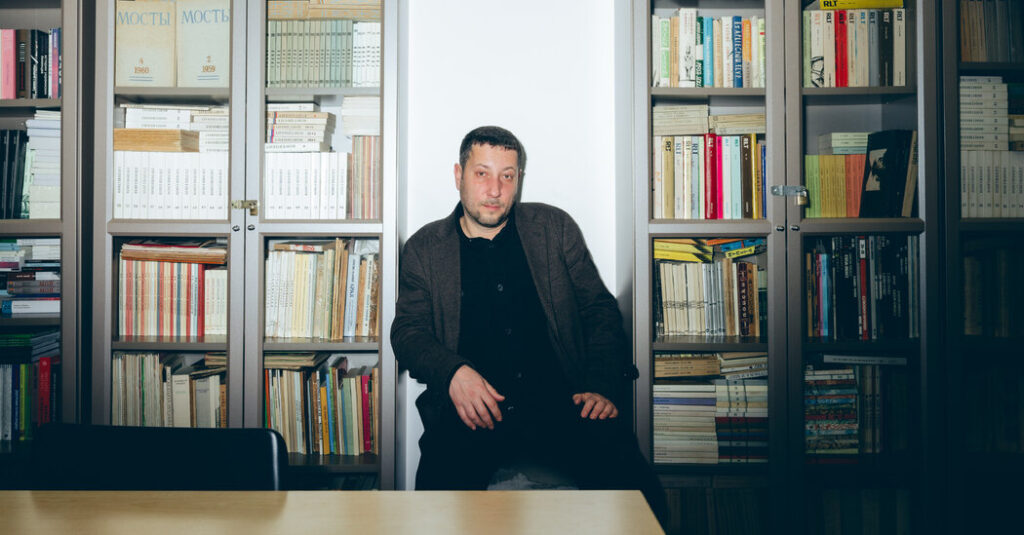
The Tamizdat Project is the brainchild of Yakov Klots, a soft-spoken, unassuming literary scholar who teaches at Hunter. He chose the name from a Russian word meaning “published abroad,” which, along with samizdat (“to self-publish”), was one of the two main methods of evading Soviet book censorship. The Iron Curtain, he noted, “wasn’t so iron after all,” and the books seeped through.
Mr. Klots has assembled the library bit by bit, recruiting his students to build the metal IKEA bookshelves and soliciting book donations from friends and strangers, including the former U.S. ambassador to Russia, John Beyrle.
With this collection, the story of the “significant intellectual effort of both Soviet creators and Western partners — the publishers and funders and whoever else, smugglers — it is all in one place,” said Alla Roylance, New York University’s Slavic studies librarian, who donated some of her own books to the Tamizdat Project. “That is incredibly relevant these days,” she added, as the Kremlin unleashes a new wave of censorship.
Page by page
Mr. Klots grew up with contraband Russian literature in the Soviet city of Perm, near the Ural Mountains. His mother, he said, “would take a train to Moscow just to stop by an apartment of one dissident who would give her Solzhenitsyn.” Then she would stay up late into the night duplicating the borrowed book, page by page.
“One of my childhood memories is my mother typing something at night and me falling asleep to the sound of the typewriter,” he said.
Countless Soviet households have similar stories of treasuring contraband literature — hiding “Doctor Zhivago” under a grandmother’s mattress, making a copy of the poet Anna Akhmatova’s masterpiece, “Requiem.”
In the winter of 2022, Mr. Klots had just finished writing a book about the history of Cold War censorship. Then Russia invaded Ukraine, and the Kremlin began a crackdown on free expression at home at a scale unseen since the Soviet era. Russian officials targeted authors, arrested publishers and censored fan fiction websites. The police raided bookstores, and officials drew up lists of objectionable literature, requiring librarians to pull works by Vladimir Sorokin, Lyudmila Ulitskaya, Haruki Murakami, Truman Capote, Susan Sontag and Danielle Steel, among others.
“All of a sudden it became no longer history, but the present and reality again,” Mr. Klots said. “I just couldn’t stand in front of my students and only teach and only tell them about the peculiarities of Russian literature.”
He founded the Tamizdat Project, through which he built the library, raised money to help students fleeing war and persecution, and archived oral histories of literary repression. When the Tamizdat Project announced it was publishing a book by an author critical of President Vladimir Putin, Russia branded the organization a “foreign agent.” Now, anyone in Russia who so much as shares the Tamizdat Project’s website without a disclaimer could be penalized.
Mr. Klots shrugged off the threat. The Tamizdat Project plans to publish five new titles this winter and spring. If history is any indication, he said, the impact of a tamizdat book could be like a stone thrown in a lake: “Wherever it falls, the waves get much bigger.”
A pure detective story
New York City is a fitting locale for the work of the Tamizdat Project. For most of the 20th century it was home to the publishers, academics, activists and philanthropists who saw the potential of contraband books during and even before the Cold War.
The first novel officially banned in the Soviet Union, “We” — a dystopian vision of totalitarianism by Yevgeny Zamyatin — was published twice in New York before it could be released at home. Mr. Zamyatin managed to send his manuscript abroad, and E.P. Dutton released it, in English, in 1924. More than 60 years later, when Soviet authorities lifted the ban, some of the country’s citizens had already read it. Mr. Zamyatin’s Russian-language original had already been printed in 1952 by Chekhov Publishing House in New York.
“It was just a pure detective story, how every single book got published as tamizdat,” Mr. Klots said.
Chekhov Publishing House received covert funding from the Central Intelligence Agency through the Ford Foundation, writes the British journalist and historian Frances Stonor Saunders in “The Cultural Cold War,” and was one of numerous literary ventures in the city supported by the agency. The C.I.A. also had a banned-book dissemination program, known for years as the International Literary Center, headquartered on Park Avenue. Under the stewardship of the exiled Romanian aristocrat George Minden, the organization ran a vast international book distribution network that smuggled some 10 million books and magazines into communist countries, often by mail and in diplomatic pouches.
At its height, the Cold War project of printing literature banned in — and very often destined for — communist countries explicitly involved more than a dozen New York publishing houses.
Government analysts described Cold War book distribution, probably one of the least expensive of the C.I.A.’s covert operations, as a “demonstrably effective” way of reaching the Soviet elite and influencing their attitudes “toward intellectual and cultural freedom, and dissatisfaction with its absence.”
Newly relevant
As the scope of Russian censorship has widened in recent years, the history of New York’s Soviet-era banned-book publishers has gained new relevance. “Even if these people are no longer around,” Mr. Klots said, they “laid the foundation for a project like the Tamizdat Project to exist and to build on their legacy.”
One of the Tamizdat Project’s most significant donations came from the family of Edward Kline, a philanthropist who led a double life in New York. Most knew him as the millionaire chief executive of the Kline Brothers department store chain, but the Soviet human rights movement knew him as a chief advocate and underwriter of its publishing work.
The Tamizdat Project has started to reveal the extent of Mr. Kline’s activities. Among his many endeavors, he acquired and revived Chekhov Publishing House, releasing what became canonical 20th-century Russian literature: original works by Nadezhda Mandelstam, Lydia Chukovskaya and Joseph Brodsky.
Mr. Kline’s daughter, Carole Feuer, spoke with the Tamizdat Project about the years when Soviet exiles like Mr. Brodsky frequented her family’s Park Avenue apartment. During one visit, a leading dancer of the Bolshoi Ballet, Alexander Godunov, defected to the United States in her living room. “He was somewhat cute,” she said, “and it was the day I was supposed to go to college.”
Several years earlier, Mr. Kline started Khronika Press with the Soviet dissidents Valery Chalidze and later Pavel Litvinov. Khronika produced a bimonthly magazine in Russian and English that regularly broke news of arrests and human rights abuses in the Soviet Union. For a time it served as the main voice of the Soviet opposition.
Without Mr. Kline, his old collaborator Mr. Litvinov told the Tamizdat Project, Khronika Press “wouldn’t have existed.”
A growing movement
Today Mr. Klots is one of many in a growing community of Eastern European immigrants picking up where the Soviet human rights movement left off. A new group of Russian dissidents recently created a new Kronika in New York, this time backed by PEN America and Bard College, with a more expansive mandate than its predecessors: to preserve independent media from places where journalists are persecuted, including Russia and Guatemala. It calls this work “digital resistance to state censorship.”
In Brooklyn, Anya Morlan-Stysis opened Kvartira, a nonprofit bookstore that caters to Eastern European exiles and their supporters. Against bright yellow walls and a wide array of children’s literature, Kvartira hosts talks with dissident authors and evenings for participants to write letters to political prisoners. It is the only brick-and-mortar shop listed in New York City as a vendor by the banned-book publisher Freedom Letters. (Last September Russia added the store’s website to a register of proscribed sites, citing unspecified “extremist information.”)
In 2024 Knopf published “Patriot,” the memoir of the late opposition leader Aleksei Navalny, which Russia has since outlawed for inciting “hatred and enmity” toward the government. Last summer Abrams released an English translation of “Pioneer Summer,” the gay teen romance that the Kremlin banned after it became a popular sensation. This represents only a small fraction of the global output of contraband titles, some 600 or 700 by Mr. Klots’s estimate, produced since 2023.
“I can’t help thinking about what will actually remain from this new time of tamizdat that’s so exponentially growing today,” he said. “I can’t imagine anyone reading Solzhenitsyn as their bedtime reading, can you? But everyone was doing it not so long ago.”
The Tamizdat Project hopes to help a new generation rediscover such books. “It’s enough for a text to find itself elsewhere for it to become a new book,” Mr. Klots said.
The post The Kremlin Banned These Books. You Can Find Them in a New York Library. appeared first on New York Times.