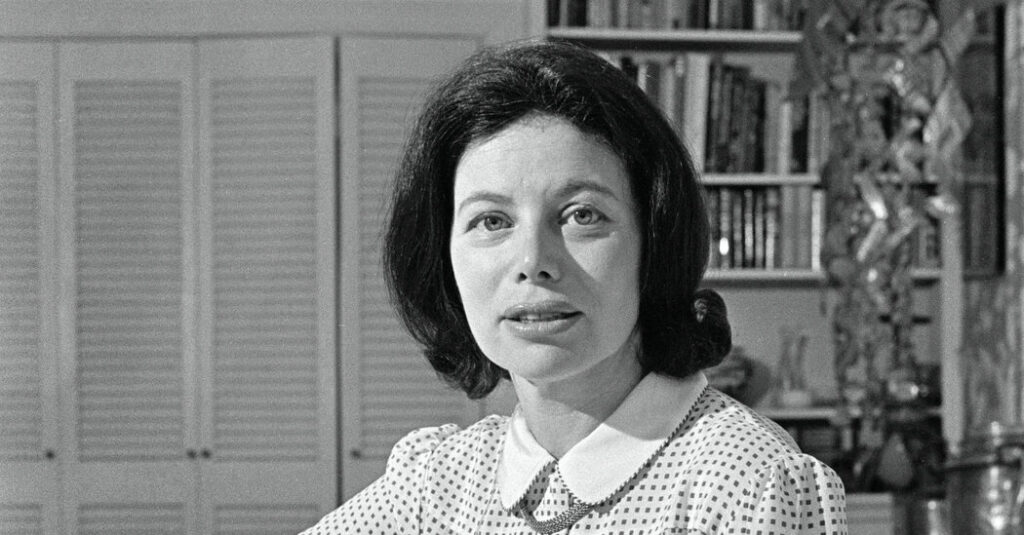
Susan Sheehan, a Pulitzer-winning nonfiction writer whose meticulously built-up portraits of individuals trying to endure on the margins of society originally appeared in The New Yorker, and often were published later as books, died on Tuesday at her home in Washington. She was 88.
Her death was confirmed by her daughters, Maria Sheehan and Catherine Sheehan Bruno.
Ms. Sheehan was the author of eight books, most notably “Is There No Place on Earth for Me?” about a woman’s struggle with schizophrenia as she moves between her parents’ home, a supervised apartment and a mental hospital. The work won the Pulitzer Prize for general nonfiction in 1983.
The book, which began as a four-part New Yorker series, featured an indelible character in Sylvia Frumkin, the pseudonymous heroine, who was often disheveled, hostile and grandiose but who had a kind of genius for run-on, rapid-fire soliloquies. Through much of the book, she is a patient at the state-run Creedmoor Psychiatric Center in Queens.
“I have schizophrenia — cancer of the nerves,” Sylvia declares. “My body is overcrowded with nerves. This is going to win me the Nobel Prize for medicine.”
Reviewers called Ms. Sheehan’s unsentimental and rigorously observed account a journalistic tour de force; during two years of fly-on-the-wall reporting, the author sometimes slept on a cot in Sylvia’s hospital room.
When the series began appearing in the magazine as “The Patient” in 1981, it drew an unusual 500 reader letters and was credited with raising awareness of the 1.5 million people treated in psychiatric facilities yearly.
“I think it’s our obligation to tell of the horror and the ludicrousness of the situation in these hospitals,” Ms. Sheehan told The New York Times in 1982.
Ms. Sheehan also published deeply immersive accounts of a welfare mother in Queens; a prisoner at a maximum-security prison; and a teenager ensnared in the child welfare system. She described her reporting style as “third person invisible.”
Her description of Sylvia in a manic phase began: “It is a hot summer afternoon. Sylvia Frumkin is prancing around the day hall. She is wearing a raspberry-colored blouse and a pair of purple slacks. A white T-shirt is tied loosely around her neck; from time to time, she pulls the T-shirt over her head and wears it as if it were a headband. Every once in a while, she takes off her blouse. She is not wearing a bra. She is not wearing shoes, either, and the soles of her feet are black.”
The critic Vince Aletti wrote in The Village Voice that “Sheehan’s scrupulous, vivid case histories are constructed bit by bit, fine webs of evidence and observation dense with fact but charged with feeling.”
Ms. Sheehan’s book “A Prison and a Prisoner” (1978) scrutinized the penal system through the aperture of a single inmate of a maximum-security prison in New York. In “A Welfare Mother” (1976), Ms. Sheehan slept in the same room and spent seven pages itemizing the purchases of her subject off a welfare check.
In “Life for Me Ain’t Been No Crystal Stair” (1993), a title borrowed from the opening line of Langston Hughes’s poem “Mother to Son,” Ms. Sheehan lays out failures of the foster care system through the stunted world of Crystal Taylor. A daughter of drug addicts, Taylor, who became a mother at 14, lives in a group home where she flails at school, steals and takes to abusive men.
Ms. Sheehan’s prose was cool and restrained, as if to counterbalance the harrowing and chaotic lives of many of her subjects. A Newsweek critic called her writing “tenacious, observant and unsentimental.”
But some reviewers were frustrated by her style, as well as by her choice not to offer judgments about her subjects and the systems that ensnared them.
Writing in The New York Times Book Review about “Life for Me Ain’t Been No Crystal Stair,” Samuel G. Freedman found that Ms. Sheehan’s “detached voice and detailed reporting evoke the flat, episodic quality of a case history.” He lamented that Ms. Sheehan does not illuminate “the social context surrounding Crystal, the collapse in our cities of both public institutions and the family unit.”
Ms. Sheehan and her husband, Neil Sheehan, a correspondent for The Times, both reported from Saigon during the Vietnam War, and they shared a professional partnership. In 1971, Mr. Sheehan secured what would become known as the Pentagon Papers, a top-secret history of the Vietnam War revealing how successive administrations escalated U.S. involvement in Vietnam while privately doubting the chances of a victory.
When Mr. Sheehan went to Cambridge, Mass., in 1971 to examine the 7,000 pages of government records leaked to him by Daniel Ellsberg, a former Defense Department analyst, Ms. Sheehan accompanied her husband. She helped photocopy the trove of documents under the suspicious eye of a copy shop owner who was nervous about the classified markings.
The Nixon administration’s effort to stop The Times from publishing the Pentagon Papers was blocked by the Supreme Court, in a ruling that strengthened the right of a free press to check government abuses of power.
Later, when Mr. Sheehan spent 16 arduous years writing a reckoning of the war, as told through the experiences of one idealistic officer, Ms. Sheehan typed and helped edit the multiple drafts. Both writers adopted nocturnal schedules, sleeping by day; their two daughters had breakfast at 8 a.m., and the parents ate their breakfast at 3 p.m.
Mr. Sheehan’s book, “A Bright Shining Lie: John Paul Vann and America in Vietnam” (1988), won a National Book Award for nonfiction and the Pulitzer Prize in general nonfiction.
Susanna Maria Sachsel was born in Vienna on Aug. 24, 1937, the only child of Catherine (Herrmann) Sachsel and Charles Sachsel. Her father ran a grain import-export business. He was part Jewish and expected the business to be seized after Germany’s annexation of Austria in 1938. The family fled to London, then to New York City in 1941; Mr. Sachsel died that year.
Susanna’s mother married Lazar Margulies, who adopted her daughter, whose name was changed to Susan Mary Margulies.
Susan graduated from Hunter College High School in 1954, and, four years later, from Wellesley College, earning a bachelor’s in French.
She moved to New York, landed a job at Esquire as an editorial assistant and married Forrest Black II in 1959, but they divorced within a year.
She met Neil Sheehan on a blind date set up by Gay Talese and David Halberstam, two Times reporters who went on to distinguished careers. Mr. Sheehan, who had covered the Vietnam War for United Press International, had just been hired by The Times to report from Southeast Asia, and the couple married in Jakarta, Indonesia, in 1965.
They soon moved to Saigon, where both covered the war. Ms. Sheehan contributed “A Reporter at Large” dispatches to The New Yorker, some of which were collected in a 1967 book, “Ten Vietnamese.”
In 1966, the couple moved to Washington, where Mr. Sheehan became The Times’s Pentagon correspondent. He died in 2021. Besides their daughters, Ms. Sheehan is survived by two grandsons.
Ms. Sheehan also contributed articles to The Times, The Atlantic and Harper’s. Her other books include “A Missing Plane” (1986), a thematic departure for her, about the discovery in New Guinea of a B-24 bomber lost during World War II with 22 men aboard.
Ms. Sheehan reveled in the freedoms and editorial support she had as a writer for The New Yorker. “Where else could you say to the editor,” she told The Washington Post in 1982, “‘I want to write about an insane asylum,’ and he says, ‘fine,’ and you come back a year and a half later with over 100,000 words, and he prints them.”
Trip Gabriel is a Times reporter on the Obituaries desk.
The post Susan Sheehan, Chronicler of Lives on the Margins, Dies at 88 appeared first on New York Times.