The Supreme Court announced on Monday that it had agreed to hear a major climate lawsuit in which the oil industry is claiming it shouldn’t be sued in state courts over its role in global warming. The outcome could have wide bearing on dozens of other lawsuits around the country.
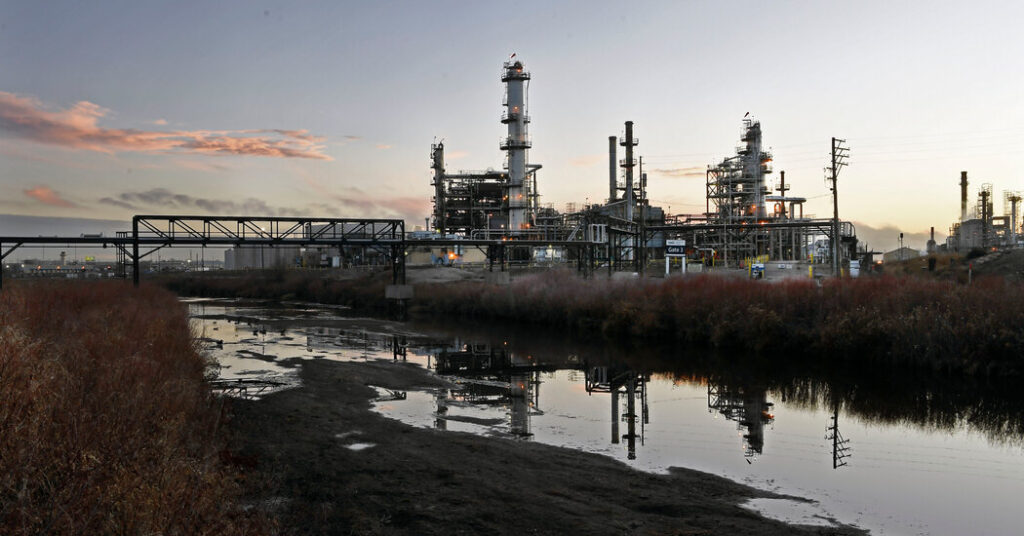
The court said it would hear arguments on a petition by Exxon Mobil and Suncor, a Canadian energy giant, in a lawsuit brought by the city and county of Boulder, Colo. The suit, first filed in 2018, sought to hold the companies liable for the effects of climate change, citing state laws.
About three dozen similar lawsuits have been filed in the United States by state, local and tribal governments in the past decade. They generally seek monetary damages for costs that municipalities are incurring because of climate change. Many also make consumer fraud claims, arguing the companies covered up what they knew about the risks of using their products. Some have been dismissed, while others have been allowed to advance in the courts. None have made it to trial yet.
In Colorado, as they have elsewhere, the companies tried to move the matter to federal court, arguing that the complex issue of global greenhouse-gas emissions must be addressed under federal, not state, law. A federal judge denied that request in 2019, and the 10th Circuit Court of Appeals affirmed the decision. The companies asked the Supreme Court to step in then, but the justices declined. (The Supreme Court had also declined to hear several similar petitions over the years.)
But that changed amid a vigorous push by the oil industry and the Trump administration to shut down climate lawsuits nationwide. They argue that the specter of billions of dollars in damages could destroy the U.S. energy sector.
The Justice Department sued Hawaii and Michigan in a bid to stop those states from filing climate lawsuits, and industry allies have redoubled their efforts to get the courts and lawmakers to block the cases. The conservative legal scholar John Yoo, who submitted an amicus brief in the Boulder case, wrote in a recent essay that the justices must “end environmental extortion of American energy.”
States have not been deterred. Hawaii filed its lawsuit almost immediately after the Justice Department suit. And Michigan recently filed a federal antitrust lawsuit against four oil companies and the American Petroleum Institute, the oil industry’s main trade group.
The petition before the justices in the Boulder case hinges on the question of whether federal law “precludes state-law claims seeking relief for injuries allegedly caused” by greenhouse-gas emissions. In their announcement on Monday, the justices also asked the parties to address some additional legal questions.
This debate could be shaken up by the Environmental Protection Agency’s recent killing of the endangerment finding. That scientific finding by the agency was the foundation of federal greenhouse gas regulations. The Supreme Court has previously ruled that the E.P.A.’s role managing those regulations blocked many federal lawsuits over harms from climate change. Some legal experts say the end of the endangerment finding opens up a new lane for lawsuits against the fossil fuel industry in federal court.
But as that shakes out (and as lawsuits against the E.P.A.’s move start to pile up) the industry has stayed focused on finding ways to shut down climate litigation entirely.
The American Petroleum Institute, which is named in several of the lawsuits, has called ending the lawsuits was one of its top goals this year, and a Congressional effort to block the lawsuits is afoot. Over the summer, Republican state attorneys general called for a “liability shield” for the industry, similar to the one that protects gun manufacturers from lawsuits. Representative Harriet Hageman, a Wyoming Republican, said recently that she was working on writing such legislation.
In Utah and Oklahoma, state lawmakers have also introduced bills that would protect energy companies from liability for emissions. The proposals resemble a model bill drafted by an advocacy group linked to the conservative activist Leonard Leo.
Kathy Mulvey, a campaign director at the environmental group Union of Concerned Scientists, said the state proposals offered “a legal escape hatch for some of the most significant polluters on the planet.”
In Colorado, the State Supreme Court ruled in May that the Boulder case could proceed to trial. Five of the Colorado justices supported that position; two dissented. The majority found that Boulder was not trying to curb emissions, as the companies maintained, but rather to seek compensation for the past and future costs of climate change.
The Trump administration had urged the justices to take up the Boulder case and stop the growing number of climate lawsuits. In a brief filed in September, senior Justice Department officials wrote that the threat of endless litigation and a patchwork of conflicting regulations across the country loomed over the case. If it were allowed to continue, they wrote, “then every locality in the country could sue essentially anyone in the world for contributing to global climate change.”
Karen Zraick covers legal affairs for the Climate desk and the courtroom clashes playing out over climate and environmental policy.
The post Supreme Court to Weigh Oil-Industry Effort to End a Major Climate Suit appeared first on New York Times.