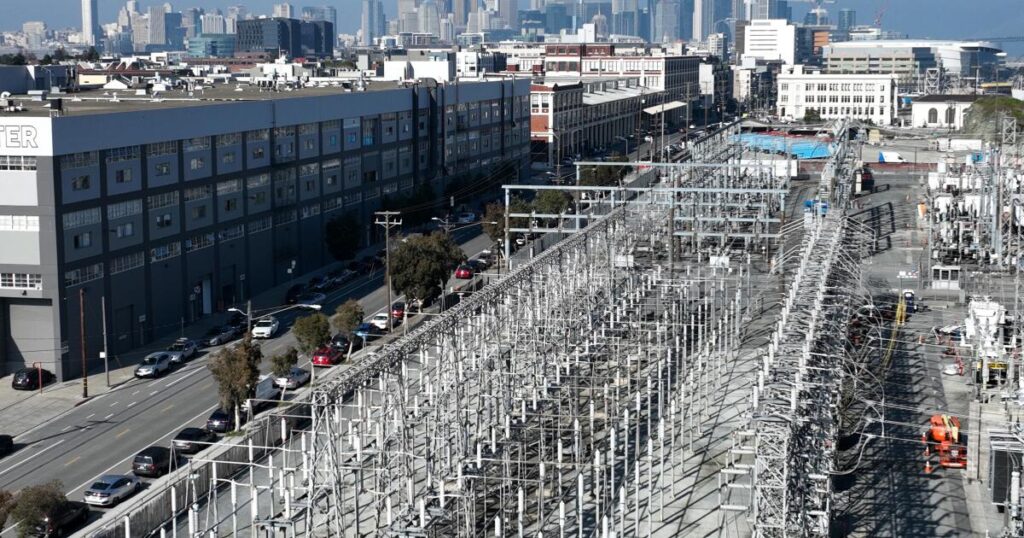
Senate Bill 875 would enable San Francisco to finalize purchase of Pacific Gas & Electric assets so that it can form a publicly owned utility in the area instead. — Bay Area lawmakers on Monday announced new legislation that would allow San Francisco to exit its 120-year relationship with Pacific Gas & Electric, the investor-owned utility that serves about 16 million people across Northern and Central California.
Senate Bill 875 would enable the city and county of San Francisco to finalize purchase of PG&E assets so that it can form a municipal utility in the area instead, said Sen. Scott Wiener (D-San Francisco), who announced the plan on the steps of City Hall. Members of the San Francisco Board of Supervisors said they will be drafting a resolution to support the bill.
PG&E is the largest investor-owned utility in California and one of the largest in the nation. The company has long faced criticism over its aging infrastructure and wildfire risk, including deadly blazes in 2017 and 2018 that were linked to faulty electrical equipment.
Wiener said poor maintenance of PG&E’s grid led to recent blackouts in the area that left hundreds of thousands of people without power around the holidays. He said San Francisco pays the second highest electricity rates in the country and more than double what its neighbors in Sacramento and Palo Alto pay through their local municipal utilities.
“Under PG&E’s monopoly, San Franciscans are paying more for worse service,” Wiener said. “We should get a choice to leave this broken relationship, and SB 875 is a critical step to get there.”
San Francisco has been trying to exit its relationship with PG&E for years, including a 2019 offer to purchase its grid assets for $2.5 billion, which the company declined. In 2021, San Francisco filed a petition with the California Public Utilities Commission to determine a fair price for PG&E and its assets. The valuation process was supposed to last 18 months, but has been delayed by hundreds of filings from PG&E, Wiener said — a claim PG&E denied.
The bill proposed Monday would speed up the purchase process by making it easier for cities to show that it is in the public interest to convert to a municipal utility. It would also limit CPUC review to determining whether the transaction is fair and reasonable for affected public utility employees. The bill would also establish enforceable timelines to prevent PG&E from causing excessive delays at the CPUC in the future, Wiener said.
In a statement, officials with PG&E said the company remains committed to serving the region’s residents and that “government takeovers of parts of our grid would not make customer energy bills less expensive.”
“San Francisco has dramatically underpriced the value of PG&E’s electric system, suggesting that the assets in San Francisco are worth only about $2-$3 billion,” spokeswoman Lynsey Paulo said in an email. “Not only is that a lowball amount, but the California Public Utilities Commission (CPUC) has been clear that the City and County of San Francisco (CCSF) would have to pay far more than the value of the assets, which means a takeover will drive customers’ rates up, not lower them.”
Specifically, the CPUC determined that in addition to buying the assets, San Francisco would have to pay PG&E to rebuild its system — including new lines and substations — to make all customers whole after the separation, Paulo said.
San Francisco would also owe PG&E damages to cover state policies such as wildfire mitigation and low-income customer programs to “make sure that these costs are not unfairly shifted onto these customers who continue to receive electricity service from PG&E,” Paulo said.
Severin Borenstein, director of UC Berkeley’s Energy Institute, said it’s hard to tell how those added costs would factor into the equation, but that exiting PG&E would probably lead to lower bills for ratepayers in San Francisco and higher bills for remaining PG&E customers in rural and less dense areas, which are currently being subsidized by the city. That could make the legislation less attractive to some stakeholders, he said.
Still, there is “no question” that Weiner has raised legitimate concerns about operational failures at PG&E, Borenstein said. But divorcing the utility is likely to be a difficult and drawn-out process for San Francisco. Sacramento’s similar effort to leave PG&E and form the Sacramento Municipal Utility District in the 1940s led to years of legal and political battles, with the city ultimately using eminent domain to acquire PG&E’s local system.
“The track record is that these are long, costly, difficult processes that usually fail,” Borenstein said, although he noted that Wiener’s legislation is attempting to “make it less long and less costly and less difficult.”
The troubled utility has faced many challenges in recent years. In 2019, PG&E filed for bankruptcy protection to shield itself from tens of billions of dollars in potential liabilities after fires ignited by its grid killed more than 100 people. It emerged from bankruptcy in 2020, with officials promising it would be a “reimagined utility.”
As part of its deal, the company created a multi-billion dollar trust for wildfire victims and agreed to major safety and governance reforms, including increased oversight and wildfire risk reduction such as grid hardening and vegetation management. The company has so far buried about 1,000 miles of a promised 10,000 miles in high-risk areas.
Wiener, who also introduced a failed 2020 bill to make all of PG&E a municipal utility, said Monday the company raised electricity rates nearly 40% between 2022 and 2025. Paulo said the company has been working to drive costs down, and that residential electricity prices are now about $20 lower than they were last January for average customers who get both energy supply and delivery from PG&E.
Several members of the San Francisco Board of Supervisors said they will support Wiener’s legislation.
“It has been well more than a decade that PG&E has struggled and failed to provide power safely to its customers, and in San Francisco, we have seen that,” said board president Rafael Mandelman. “And it is reasonable for San Francisco and other municipalities to be looking at alternatives to provide the power that our businesses and our residents rely on.”
SB 875 is expected to go into print Monday night and will head to the Senate Energy Committee for review sometime in the spring.
The post San Francisco lawmakers announce plan to ‘break up’ with PG&E appeared first on Los Angeles Times.