GUADALAJARA, Mexico — Mexican forces located the drug kingpin known as “El Mencho,” whom they killed in a major operation over the weekend, in part by tracking one of his girlfriends to a secluded cabin, Mexican officials said Monday.
Officials canceled school in some states and warned communities to stay inside as reports spread of violent cartel reprisals, and authorities deployed thousands of troops to the western Mexican state of Jalisco. But Mexico’s president said Monday the country was under control and returning to normalcy.
Security forces closed in on Nemesio Rubén Oseguera Cervantes, 59, at a cabin in Tapalpa, in Jalisco. He fled as his bodyguards opened fire. Eight cartel members were killed in the gun battle, Gen. Ricardo Trevilla Trejo, Mexico’s secretary of national defense, told reporters Monday.
Authorities captured the cartel leader, wounded by gunfire, in nearby woodlands. They took him, two of his bodyguards and a wounded soldier by helicopter to get medical treatment, but they died en route, Trevilla said. Officials decided to head for an airport in Michoacán to transport the bodies by air force plane to Mexico City.
Mexican special forces and National Guard troops helped plan and execute the operation, with support from the Mexican Air Force, Trevilla said. Mexican troops “accomplished their mission,” he said, emotional and tearful, and demonstrated the “strength of the Mexican state, without a doubt.”
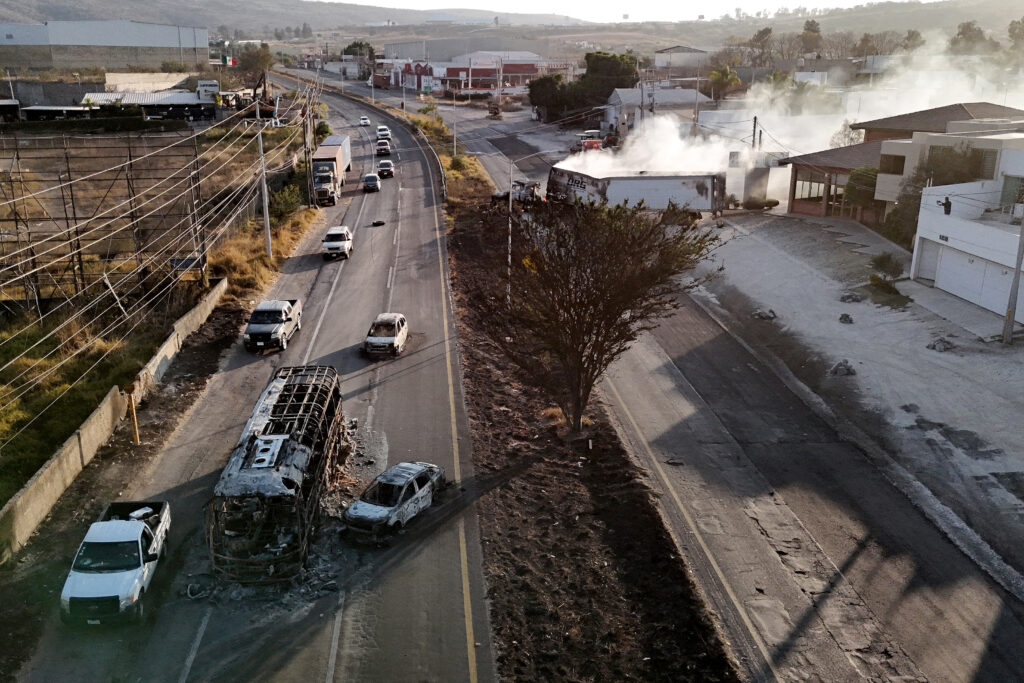
The killing of Mexico’s most powerful drug lord provoked violence: Beginning Sunday, the cartel burned vehicles, blocked highways, attacked gas stations and banks, and set other fires, said Omar García Harfuch, Mexico’s top security official. The government registered 85 blockades across the country, with 18 in Jalisco alone, and 27 other acts of violence against authorities. Seventy people were detained in seven states. More than 25 security officials were killed in the operation, as was a 59-year-old woman. More than 30 “criminals” were also killed, García Harfuch said. He praised Mexican forces for “debilitating an organization with international reach.”
Harfuch called Oseguera’s Jalisco New Generation Cartel the “principal” organization responsible for violence in the country, “including homicide, human trafficking, extortion, kidnapping, and armed attacks against authorities.”
In an overnight statement, the U.S. Embassy issued alerts covering areas of 18 Mexican states — more than half the total. It warned Americans in eight cities, including popular tourist destinations such as Puerto Vallarta and Cancún, to shelter in place, citing dangers from blocked roads and criminal activity.
In a late-night message, President Claudia Sheinbaum urged Mexicans to remain “informed and calm.”
Guadalajara, the capital of Jalisco, was among the cities hit hardest in Sunday’s initial wave of violence. Pablo Lemus Navarro, Jalisco’s governor, said in a video on social media that he had declared a “code red” emergency, suspending public transportation, major events and school on Monday.
Photographs taken in the immediate aftermath of Oseguera’s killing showed the burned-out wreckage of cars and buses blocking Guadalajara street junctions and entrances to businesses, with surrounding neighborhoods largely empty after residents were warned to stay inside.
In Puerto Vallarta, a vacation resort on Jalisco’s Pacific coast, footage verified by Reuters showed black smoke billowing over the city and burning vehicles blocking a highway underpass.
Oseguera was Mexico’s most dominant cartel leader, expanding the Jalisco New Generation Cartel into a major power that took control of lucrative drug routes into the United States. The cartel, which traffics large quantities of fentanyl, cocaine, heroin and methamphetamine across the U.S.-Mexico border, eventually eclipsed the rival Sinaloa Cartel as Mexico’s most powerful group.
According to a statement from Mexico’s Defense Ministry, security forces had intended to detain Oseguera, but a shootout forced them to return fire. The statement said Mexican forces killed four cartel members and fatally wounded three others, one of whom was Oseguera. It said he died while being transferred by air to Mexico City.
Speaking on the condition of anonymity because of the sensitivity of the issue, a U.S. defense official said Mexican forces conducted the operation with participation from a U.S.-Mexico task force. The unit, known as Joint Interagency Task Force-Counter Cartel, integrates intelligence personnel and law enforcement with the military.
U.S. Deputy Secretary of State Christopher Landau welcomed Oseguera’s killing in a post on X, describing him as “one of the bloodiest and most ruthless drug kingpins.”
Previous killings and arrests of Mexican cartel leaders have led to sharp upticks in violence — including revenge attacks and inter-cartel battles over territory. In 2019, the capture of Ovidio Guzmán López, son of the notorious former Sinaloa cartel leader, Joaquin “El Chapo” Guzmán, triggered so much immediate violence that security officers were forced to release him to his cartel after just three hours. And when the drug lord Ismael “El Mayo” Zambada was captured and arrested by U.S. authorities in 2024, the all-out battle for control of his Sinaloa cartel caused killings in the state that shares its name to spike.
Over the weekend, social media footage taken from a terminal building at Guadalajara International Airport that Reuters verified showed smoke billowing across the horizon. On Monday morning, online flight information showed widespread delays and cancellations at the airport, although some flights were still scheduled to depart.
The U.S. Embassy in Mexico said on social media that while incidents had occurred in the vicinities of the Guadalajara, Puerto Vallarta and Tepic airports, the airports themselves continued to operate normally.
Sands reported from London.
The post Mexican forces tracked slain cartel boss to secluded cabin, officials say appeared first on Washington Post.