The only passenger in the car when an American citizen was shot and killed by a federal officer in South Texas last year had planned to speak up and contradict the government’s account of the shooting. However, the passenger, Joshua Orta, died in an unrelated car crash over the weekend.
Mr. Orta, 25, was in the passenger seat on March 15, 2025, when his childhood friend, Ruben Ray Martinez, 23, was shot multiple times in South Padre Island by an Immigration and Customs Enforcement officer after the authorities said he failed to comply with commands to exit his vehicle.
In a written statement obtained by The New York Times, Mr. Orta said that the two men had offered no resistance to law enforcement officers and were trying to comply with commands to turn around the car when the situation got out of control and Mr. Martinez was shot.
Mr. Orta had provided his version of events in the statement, which was taken in September by lawyers representing Mr. Martinez’s family to be used for future legal proceedings. He was planning to sign the statement and cooperate with investigators hired by the family before he died Saturday in a car crash on a San Antonio highway.
The stepfather who raised him confirmed his death to The Times on Sunday.
“First and foremost, Joshua’s death is an awful tragedy for his family and friends, and the Reyes family is grieving with them,” said Alex Stamm, a lawyer for Rachel Reyes, the mother of Mr. Martinez. “In terms of Ruben’s death, the world has also now lost a critical eyewitness.”
“We believe Joshua’s account, and, as we have seen recently in Minneapolis, Chicago and elsewhere, it is critical that the public be shown every piece of evidence in the government’s possession, and that any witness come forward,” Mr. Stamm added.
When asked about Mr. Martinez’s killing last week, the Department of Homeland Security described the shooting as an act of self-defense, saying the agent had “fired defensive shots to protect himself, his fellow agents and the general public” after the driver “ran over” a Homeland Security Investigation special agent.
In a statement Sunday, a spokesperson for the Department of Homeland Security said, “We stand by our original statement.”
In an interview in the family’s San Antonio home Sunday afternoon, John Arriaga, 47, a landscaper, said Mr. Orta had shown signs of trauma since he had witnessed his friend’s killing. Mr. Arriaga said Mr. Orta had planned to talk to lawyers and investigators about what he saw.
“He told me that he was involved and that he was going to testify,” Mr. Arriaga said. “He said, ‘I need to do whatever I have to do because of my friend.’”
The episode involving ICE occurred around 12:40 a.m. on March 15, when, according to internal agency documents reviewed by The Times, Mr. Martinez initially did not follow officers’ instructions to stop his vehicle. He eventually slowed to a stop after receiving verbal commands. Federal agents then surrounded his vehicle and told him to get out of the car before Mr. Martinez accelerated and hit a federal agent who landed on the roof of the car, according to the government documents.
A different agent fired multiple times through the driver’s side window. Mr. Martinez was transported to a hospital in Brownsville, Texas, where he died. The documents did not name the officers involved in the encounter. Charles Stam, another lawyer for the Martinez family, confirmed that Mr. Martinez was the victim mentioned in the ICE report.
In the September statement, Mr. Orta contradicted the federal agency’s description of what happened in South Padre Island. In it, Mr. Orta wrote that he and Mr. Martinez had driven to the island to celebrate his friend’s 23rd birthday. On that day, they came upon the scene of a car crash and Mr. Martinez appeared concerned because they had an open container of alcohol in the car. Moments later, one of the officers at the scene told them to turn around, according to the statement.
Mr. Orta added that because the traffic was backed up, there was no room to move and added that he did not see his friend run over an agent. Instead, he wrote, “As we inched forward in traffic to get turned around, another officer, a state trooper, walked up to our car” and “slapped the hood.”
Moments later, Mr. Orta said in the statement, an officer at the scene “seemed to be trying to get in front of the car.” That’s when the scene got out of control and other officers yelled at them to stop and drew their guns, according to Mr. Orta’s written account.
Mr. Orta described a federal agent firing “multiple shots,” through the driver’s open window, “without giving any warning, commands or opportunity to comply.” The bullets struck Mr. Martinez’s chest, he said in his statement.
“I heard Ruben say, ‘I’m sorry,’ and then he slumped backward,” Mr. Orta said in the statement.
Mr. Orta said he then saw the officers place Mr. Martinez face down on the ground and handcuff him.
“Ruben was unarmed, nonviolent, not fleeing and not resisting at the time he was shot. His killing was unjustified and excessive,” Mr. Orta said in the statement.
The shooting of Mr. Martinez is under investigation by the Texas Rangers, a state agency that reviews shootings involving law enforcement officers and oversees border security for the Texas Department of Public Safety. Several local, state and federal elected officials have called for more investigations.
The agent who was hit by Mr. Martinez’s vehicle was released from the hospital after he was treated for a knee injury, according to the ICE report.
Mr. Orta died in a fiery car crash at around 1 a.m. on Saturday when he lost control of the vehicle he was driving and struck a utility pole. The car caught on fire and Mr. Orta died before the three other people in the car, including a stepsister, were able to pull him out, Mr. Arriaga said. The crash over the weekend had no connection to the shooting last March.
According to a preliminary San Antonio police report, which did not name Mr. Orta, the person behind the wheel was driving “at a high rate of speed” when he attempted to exit the highway and lost control of the vehicle.
Mr. Arriaga got an alert on his phone about the crash and headed to the scene. When he arrived at around 1:30 a.m., he saw a charred vehicle and his injured daughter. “The three of them got out and they were trying to pull him out, but then it exploded,” Mr. Arriaga said.
Mr. Orta’s stepsister, who suffered several bruises and burns, remained at the hospital, Mr. Arriaga said.
It is unclear if the absence of the passenger witness will hurt the investigations going forward.
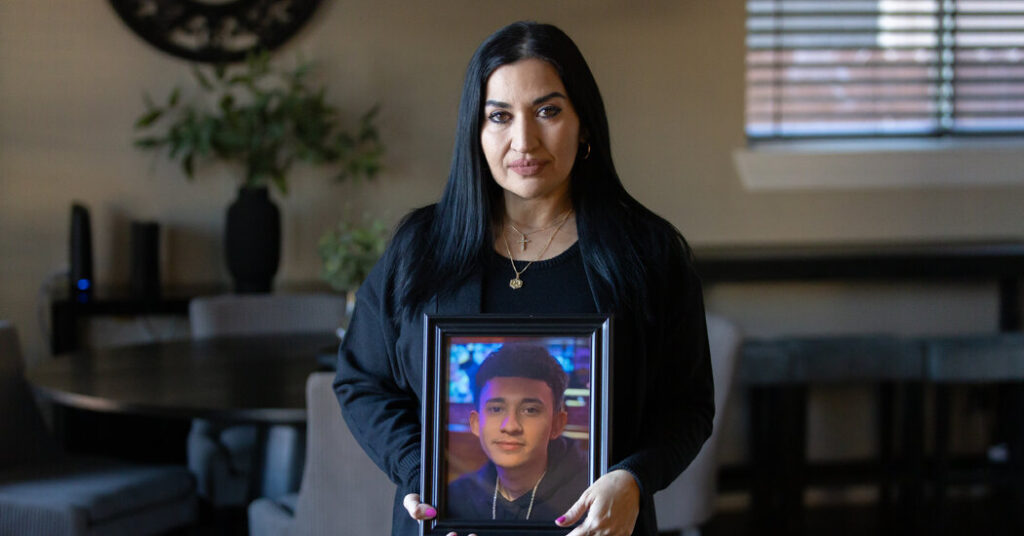
Mr. Martinez’s mother, Rachel Reyes, said in an interview on Sunday that Mr. Orta’s description matched what investigators had initially told her. Ms. Reyes described her son as a hard-working young man who did not have a history of confronting law enforcement officials.
“I was very surprised when I saw what the government document said about my son,” she said. “That’s not what they told me. I was shocked and insulted.”
Mr. Martinez’s killing occurred months before two other fatal shootings in Minneapolis set off nationwide protests against ICE and the Trump administration.
The killings of Renee Good and Alex Pretti, both American citizens, sparked widespread controversy after official accounts were undermined by bystander videos. No footage of Mr. Martinez’s killing has surfaced.
Ms. Good, a Minneapolis mother, was killed in her car by masked federal agents on Jan. 7, and Mr. Pretti, an intensive care nurse, was fatally shot on Jan. 24 during a surge of immigration agents in the Twin Cities. Bystander videos of both killings circulated quickly and helped propel protests across the country. Since September, federal agents have fired at vehicles at least 10 times in six different cities.
Mr. Martinez is at least the third U.S. citizen shot and killed by federal immigration officers since the start of President Trump’s second term. His presidency has been marked by a push to maximize illegal deportations and to confront those who oppose his actions.
An immigration agent is allowed to use deadly force only if the officer “has a reasonable belief that the subject of such force poses an imminent threat of death or serious bodily injury,” according to the Homeland Security Department’s policy. The policy also states that officers should avoid placing themselves in positions in which they have no other option but to use deadly force.
Mr. Arriaga said that his son changed after he witnessed his friend’s killing on March 15. Later that day, they found him in the couch, pale and “out of it,” his father recalled. “He just hugged us and cried.”
Georgia Gee contributed research.
Edgar Sandoval covers Texas for The Times, with a focus on the Latino community and the border with Mexico. He is based in San Antonio.
The post Key Witness Who Disputed ICE Account of Fatal Texas Shooting Dies in Car Accident appeared first on New York Times.