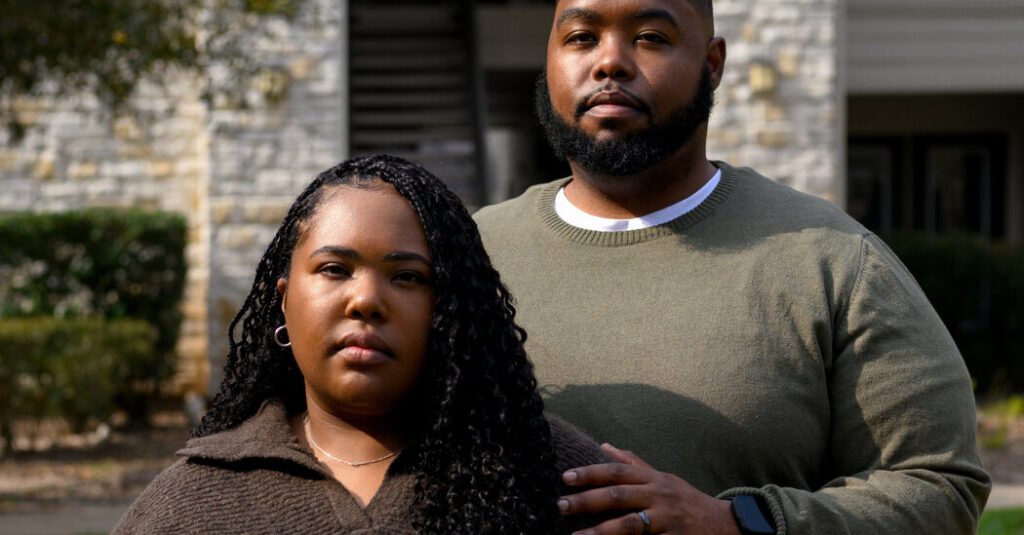
After getting engaged in 2023, Ashlan and Kai McDaniel heard the same advice from both sets of their home-owning parents: Stop renting and buy.
The couple, ages 28 and 29, soon began touring homes in and around Houston. Weeks into their search, they nearly made a purchase, but they said the process felt rushed, and they realized they didn’t understand the market well enough to commit. So they focused on their wedding in November and continued to pay $1,400 a month to rent their one-bedroom apartment.
Now, with the wedding behind them, they’re back in the market. The McDaniels are searching for an older brick home with updated appliances for no more than $300,000. But inventory in their price range feels thin, and most listings are new construction, they said, which they are wary of after a friend’s recent purchase required constant repairs.
“It feels very overwhelming,” said Ms. McDaniel, a workers’ compensation specialist. “Especially when people my age are on social media like, ‘Got my keys to my new house,’ and it’s like, ‘Wow. You know, I want that for us.’”
High down payments. Elevated interest rates. A lack of affordable homes. Even in what economists call a buyer’s market — where supply outpaces demand — many house hunters say the math still doesn’t work.
The biggest obstacle is affordability. Home prices have surged about 50 percent since the pandemic. Today, buyers need to earn roughly $93,000 to afford a typical home with a 20 percent down payment, up from the $52,000 needed in February 2020, according to data from the real estate marketplace Zillow. In a recent New York Times/Siena poll, more than half of voters under 30 said housing was the expense they worried most about affording.
As high prices push middle- and low-income buyers to the sidelines, the housing market is tilting more toward investors and high-income households. In 2025, investors accounted for 30.2 percent of all home purchases, a surge from 16.1 percent in 2020, during the beginning of the pandemic, according to data from Cotality, a property data and analytics firm. A report from Realtor.com noted that the shift was due not to a buying spree but to a retreat by traditional buyers.
The strain has become so intense that in November President Trump floated the idea of a 50-year mortgage to reduce buyers’ monthly payments, even though such a loan would add hundreds of thousands of dollars to the cost of a typical home. However, Mr. Trump also said in late January that he did not want home prices to fall and wanted to drive “housing prices up for people that own their homes.”
If this trend persists, it could likely keep construction levels low and force out first-time buyers — whose share has dropped to a record-low 21 percent, with the typical buyer now 40 years old, according to an annual survey from the National Association of Realtors. In 1987, data from the association showed, the typical first-time buyer was more than a decade younger — 29.
As a result, some buyers are waiting longer or getting more creative. Half of all buyers in 2025 said they had used at least two sources to fund their down payment, an increase from 2019, according to a Zillow report. That share rises to 57 percent for Gen Z and 56 percent for millennials.
Brandi Robinson, 27, and Joshua Barnes, 28, have been searching for a single-family home in Prince George’s County, Md., since July.
The married couple moved in with Mr. Barnes’s parents in November to save more money and have a budget of around $425,000. But they have been outbid multiple times, even on homes where they were willing to compromise on yard space, location or layout. Recently, they skipped touring a promising property after seeing five other families at an open house, convinced they wouldn’t stand a chance in the bidding.
“I think we just anticipated that it was going to go so much quicker than this,” said Ms. Robinson, a communications manager. “I feel like initially everyone was telling us that this is a buyer’s market — ‘It’s so good, and it’s going to be perfect for you’ — and it’s really not.”
Last week, Ms. Robinson and Mr. Barnes said they hoped to buy a single-family home in Charles County, outside their original plan and ideal location.
Buying a home today also looks different from the way it did to previous generations. In the past, the primary focus was saving for a down payment and covering the monthly mortgage, said Matthew Lyon, advice director at USAA. Today’s buyers face greater financial volatility — from layoffs and job insecurity to the fact that Americans stay in their homes longer than they did 20 years ago. Around 42 percent of Gen Z and 40 percent of millennials say they have delayed or changed other life goals because of housing costs, according to a survey by Intuit Credit Karma.
Younger and first-time buyers now are carefully weighing the full financial picture, not just the mortgage but taxes, insurance, homeowners’ association fees, utilities and maintenance repairs.
“It is less about stretching to get in and more about entering homeownership from a position of stability,” said Sam Diarbakerly, chief executive and private wealth adviser at Generation Capital Advisors.
The top actions that Americans take just to afford a down payment on a home include working extra hours, cutting expenses and delaying other major purchases, according to Credit Karma’s survey. Around 12 percent said they had to move in with family in order to save.
Sarah Eller, a 26-year-old single mother in Sierra Vista, Ariz., had to do all of this and more.
Two years ago, Ms. Eller and her 5-year-old daughter moved back in with her parents after she finished nursing school. When her parents took a monthlong trip in October, she realized the value of having privacy and her own space. She quickly set a goal to save for her own home and began cutting her spending.
After looking at home prices in her desired states (Texas, Colorado and Utah), she realized she was not nearly as prepared as she thought to enter the market this year. Since December, Ms. Eller, a registered nurse, has saved about $2,000 each month and was aiming to amass around $50,000 by late 2027.
But she recently began to question whether rushing into a purchase made sense. Instead, she decided to renovate her parents’ garage into her new home, delaying her homeownership plans until she paid off her $59,000 in student loan debt and saved up at least $100,000.
“When I get into the home, I don’t want to be broke, because anything could happen,” Ms. Eller said.
With about two-thirds of Americans already owning homes, the run-up in prices has generated trillions in wealth for existing homeowners, while locking out many first-time buyers. The divide is visible on the ground: Felise Eber, a real estate agent in South Florida, described the high-end market as “moving quite well,” while in New York City, Ashley Reidy Quinn, an agent there, said that even though most homes were selling below the listing price, discounting was especially pronounced in the $20 million-plus ultraluxury tier.
As mortgage rates are expected to ease this year, according to recent forecasts, the question is whether this shifting market will create openings for middle-income households or cement housing as an asset class dominated by the wealthy.
Sean Higgins, 27, and Caroline Rueve, 26, aren’t new to buying a home. They purchased a one-bedroom condominium in Chicago in 2022 while dating, thinking it was smarter to build equity than pay rent.
But now, with a wedding in June and plans to have children, the couple are hunting for a larger place. They sold their condo in November in just a week and moved into a short-term, $2,500-a-month rental while searching for a two-bedroom unit with an additional living area or a den.
“It’s kind of become my morning routine. Instead of waking up and checking Instagram, I wake up and check Realtor.com,” said Ms. Rueve, an account manager.
They haven’t found anything that fits their list yet. They want to stay in the city, where Mr. Higgins works as a sales engineer, and are budgeting up to $600,000.
The pair had hoped that their existing equity and prior home-buying experience would help them secure a property more quickly, but the market hasn’t made that possible, they said. Ideally, they would like to close on a home before April to avoid overlapping rent and mortgage payments. Given the market conditions, however, they said they might need to extend their lease.
Kailyn Rhone is a Times business reporter and the 2025 David Carr fellow.
The post It’s a Buyer’s Market, but Homeownership Eludes Many Americans appeared first on New York Times.