Today marks four years since Russia’s full-scale invasion of Ukraine. In 2022, no one thought the war would last this long. But Ukraine has defied all odds and denied Russia victory.
For the rest of Europe, there is a lot to learn, especially as the NATO alliance and the unconditional backing of the U.S. military are no longer certain. European defense budgets are rising. Armies are recruiting. More military equipment is being “Made in Europe.”
And there may be a deeper shift taking hold. Over the course of my conversations with security experts in recent weeks, I kept hearing an intriguing phrase being thrown around: “the European way of war.” Today I write about what that might look like.
Europe rethinks war
Could Europe defend itself without the United States?
The conventional wisdom is no. Europe relies on America for nuclear deterrence, air and missile defense, intelligence capabilities and much more. The U.S. has the stealthiest jets! The biggest bunker busters!
All of this is true.
But some are now questioning whether Europe actually needs all of this to have a viable self-defense strategy.
“We don’t need to be better than the U.S., we need to be better than Russia,” said Christian Mölling, founder of the Berlin-based think tank European Defense in a New Age.
That thought could potentially be galvanizing. Russia has about 144 million people and 1.1 million active soldiers to Europe’s 450 million people and 1.5 million active soldiers.
Not having America’s capabilities would certainly mean doing things differently. It might mean accepting more risk for European soldiers. And it would mean a messier leadership structure than Europe’s fighting forces have gotten used to. But it could also mean that Europe moves closer to strategic autonomy and a European-led defense strategy.
This is what the people thinking along these lines are calling “the European way of war.”
The American way of war
One of them is Claudia Major, an expert on trans-Atlantic security. She told me that America’s way of fighting had evolved around specific characteristics — some cultural and some geographic.
The U.S. fights with a uniquely intense focus on air power. Its tolerance for losing soldiers is low. Minimizing casualties has been a precondition to recruit soldiers for the many wars the U.S. has fought in recent decades.
Then there’s geography. America, with oceans on either side, has a military that is designed to project power around the globe.
The U.S.-led NATO alliance meant that European countries were also trained in this way of fighting, Major told me. The way America plans and conducts wars became Europe’s way, too.
There are still many in European defense circles who would prefer to keep fighting the way they’re used to, and focus on acquiring more of the capabilities the U.S. currently provides to NATO.
But those talking about a European way of war say the focus on merely replacing what the U.S. provides can be distracting.
They say the most important aspect of decoupling from the U.S. isn’t buying more fighter jets. It’s making the psychological break required to rethink European security with Europe’s geography, political culture, strategic priorities and resources in mind.
A European way
What would that look like?
For starters, Europe would need to adapt its deterrence plans to the reality of its resources, said Mölling. Right now, he said, deterrence in Europe involves tens of thousands of U.S. troops deployed across the continent.
Deterrence without the U.S. would mean redeploying fewer soldiers in more strategic ways and finding alternatives to U.S. air power, Mölling said. That might mean a greater emphasis on ground-based firepower like cruise missiles.
It might also mean more static defense lines like physical trenches and berms in the Baltic countries, and land mines along stretches of the NATO border.
And in war, it would probably mean greater casualties because without American intelligence and air power, Europe would be slower to identify targets.
Even in peace time, the psychological cost would be high. Land mines in Europe. Militarized borders, East German-style. They could bring home the reality of war in a way that U.S. air bases do not.
The Ukraine factor
The last four years of war in Ukraine have highlighted how valuable U.S. capabilities and resources are to Europe’s defense. But they have also provided some crucial lessons.
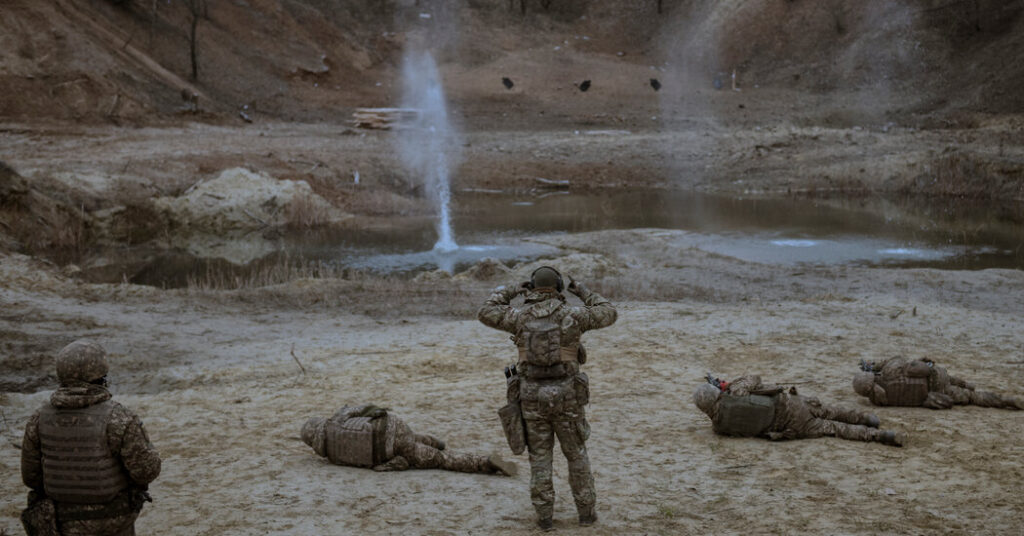
Ukraine didn’t get all of the U.S.-made fighter jets and other weapons it asked for. It has compensated with drones and self-propelled howitzers. It has made up for troop shortages with mines, berms and trenches.
Ukraine has also crystallized the main scenario that Europeans must prepare for: defending against aggression from a neighbor, instead of projecting power across the world, Mölling said.
Ukraine, viewed through this lens, is an investment in the future of European defense. It has a battle-hardened military, the continent’s second-largest standing army and its most vibrant defense tech start-up sector.
Its expertise in drone warfare could help Europe in future conflicts. Germany and Ukraine just signed an agreement for Ukrainian veterans to train German soldiers in drone warfare.
The Ukraine war also offers a lesson in the importance of “gray zone” tactics like sabotage and information warfare, which many European countries are woefully unprepared for. (I’ll write more about those scenarios soon.)
Ultimately, the biggest problem with transitioning to a European way of war, of course, is the same as the problem with a European way of anything: When America is engaged, it’s clear who’ll be calling the shots. When America steps back, the question of leadership gets a lot messier.
“If you don’t have the leadership that decides when to use military force,” Major said, “all the weapons in the world won’t save you.”
MORE TOP NEWS
Mexico on edge after the killing of ‘El Mencho’
The Mexican government said it was restoring order yesterday after a military raid on Sunday that killed Nemesio “El Mencho” Oseguera Cervantes, the country’s most wanted cartel boss.
After Oseguera’s death, his Jalisco New Generation Cartel retaliated with violent attacks in cities and beach resorts across Mexico, killing at least 62 people. Read the latest.
Mexico’s defense secretary said that the authorities had located the cartel boss by tracking one of his romantic partners, with help from U.S. intelligence. The Trump administration had threatened military strikes against Mexico if it did not do more to fight cartels.
The survival of the Jalisco cartel, Mexico’s most powerful criminal organization, is now in doubt. Analysts are also questioning whether the government can sustain a new fight while it also battles the Sinaloa Cartel, the Jalisco group’s archenemy.
A return to tariff chaos
E.U. officials said yesterday that they were putting their trade deal with the U.S. on pause after the U.S. Supreme Court struck down Trump’s tariff policy
The Trump administration has turned to a patchwork of trade laws to recreate the sweeping tariffs. The new policy will require Congressional approval in 150 days.
Britain, Australia, Japan and South Korea are among the U.S. trading partners who are now facing higher duties under the new global tariff rate of 15 percent.
OTHER NEWS
-
The British police arrested Peter Mandelson, the former British ambassador to the U.S., over allegations that he passed government information to Jeffrey Epstein.
-
The U.S. and Iran plan to meet on Thursday for what appear to be last-ditch negotiations to avoid a military conflict. Here’s why Iran is rejecting U.S. demands on uranium enrichment and ballistic missiles.
-
Hungary said that it would block a new E.U. sanctions package on Russia and a financial aid package to Kyiv worth more than $100 billion.
-
The International Criminal Court will determine whether Rodrigo Duterte, the former leader of the Philippines, will face trial for thousands of extrajudicial executions.
-
France summoned the U.S. ambassador to Paris to protest the State Department’s criticism of an attack on a right-wing activist in Lyon.
-
The crypto exchange Binance fired internal investigators who uncovered sanctions violations related to Iran, according to a Times investigation.
-
A blizzard pummeled 40 million people in the Northeast U.S., causing power outages and transit chaos.
WHAT ELSE IS HAPPENING
-
Nick Reiner pleaded not guilty in the murder of his parents, the Hollywood director Rob Reiner and Michele Singer Reiner.
-
An involuntary utterance of a racist slur by a man with Tourette’s syndrome was broadcast to millions of BAFTA viewers.
SPORTS
Football: Matches in Mexico were postponed because of the violence after the killing of the cartel boss El Mencho.
Skiing: Here’s a closer look at Johannes Høsflot Klæbo, the first athlete to win six gold medals in a single Winter Olympics.
Olympics: These were the weirdest and wildest moments at the Games.
Top of The World: The most clicked link in your newsletter yesterday was about the medal standings at the Winter Olympics.
GENRE OF THE DAY
Phonk
— A genre of electronic dance music with rap roots often heard in YouTube Shorts and TikToks. It’s the soundtrack to gaming montages, fan edits, motivational clips — basically anything aiming to convey high-energy vibes.
MORNING READ
The Chinese director Lou Ye is known for his clashes with China’s censors, who have barred about half of his films from screening in the country. While his work has been honored at Cannes and Venice, he said he wanted most to reach a Chinese audience. He has accepted significant cuts to some films to release them domestically.
Lou’s latest movie looks like a departure from form. It doesn’t touch on taboo subjects, like the Tiananmen Square massacre. It doesn’t examine how ordinary Chinese respond to a changing society, the animating question of his oeuvre. It doesn’t even have any dialogue. It’s a concert film about a Chinese rock band, Re-TROS, and Lou’s first foray into nonfiction. Read more.
AROUND THE WORLD
The ugliest building in the world’s most beautiful city
Many Parisians like to joke that the best view in the city is from the top of the Tour Montparnasse, because that’s the only place you can’t see the building itself.
Now, after more than 50 years, the skyscraper is getting a face-lift. A consortium of French architects is reimagining the building as a lighter, more transparent structure, with verandas and a lush roof garden. Work is expected to begin soon, and yet debate about the makeover rages on. Read about the remodeling of Paris’s least-loved landmark.
RECOMMENDATIONS
Read: Apron tugger. Shadow daddy. Wallflower. This guide to romance tropes will help you find your next book.
Watch: Here are five new movies our critics are talking about.
Admire: Through his rustic country house in Majorca, a French designer hopes to inspire a more environmentally conscious way of life.
RECIPE
These meat-stuffed potato patties trace their roots to Christian communities across India, Pakistan and Iraq, where they’re served at weddings, holidays and family feasts. Golden and crisp on the outside, they work as either a snack or a centerpiece.
WHERE IS THIS?
This pathway lined with live oaks is emblematic of which American city?
TIME TO PLAY
Here are today’s Spelling Bee, Mini Crossword, Wordle and Sudoku. Find all our games here.
You’re done for today. See you tomorrow! — Katrin
We welcome your feedback. Send us your suggestions at [email protected].
Katrin Bennhold is the host of The World, the flagship global newsletter of The New York Times.
The post Europe’s New Way of War appeared first on New York Times.