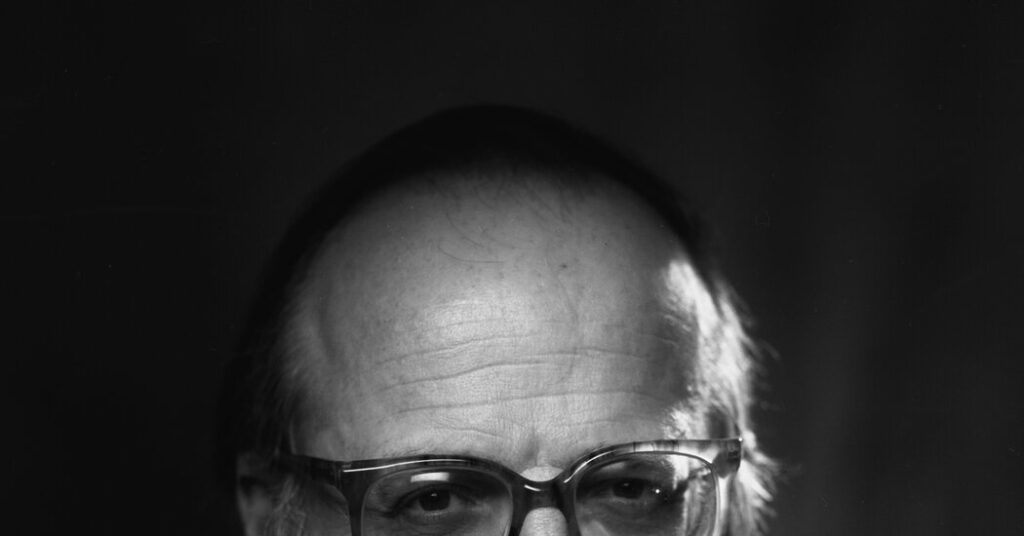
Edward Hoagland, whose shimmering essays explored the wonders of the natural world, the sights of faraway places and his own journeys into blindness, died on Tuesday in Manhattan. He was 93.
His death, at an assisted living facility, was confirmed by his daughter, Molly Magid Hoagland.
Widely considered one of the country’s foremost essayists and often described as an heir to Thoreau, Mr. Hoagland was famed for transforming the modern nature essay into a vehicle for autobiographical introspection.
His work simultaneously explored physical landscapes — including those of Africa, Alaska and British Columbia — and the terrain of his own life, from the speech impediment that isolated him throughout his youth to the blindness that overtook him in his 50s, the surgery that restored his sight for a time and his eventual return to blindness.
In his hands, nature writing and personal history dovetailed impeccably, as if to declare that the subject matter of each was nothing less than life’s inexorable cycle.
John Updike called him “the best essayist of my generation,” and for Philip Roth, he was “America’s most intelligent and wide-ranging essayist-naturalist.” Critics praised Mr. Hoagland’s sinuous, polished, unsentimental prose; near-microscopic powers of observation; unflinching candor about his life; and generally unhectoring urgency about the earth’s.
Reviewing his 1973 essay collection, “Walking the Dead Diamond River,” in The New York Times Book Review, Alfred Kazin wrote: “Anyone who writes for magazines on all manner of topics with regular, predictable brilliance, as Edward Hoagland does, invents a personality, a talisman of a hero who says, ‘I walked,’ ‘I saw,’ with a comeliness unknown to most pedestrians. This ‘I’ is usually up to everything he may encounter in this dizzying, overabundant world.”
Mr. Hoagland’s many collections, which also include “The Courage of Turtles” (1970), “Red Wolves and Black Bears” (1976) and “The Tugman’s Passage” (1982), brought together essays first published in The Times, The New Yorker, The Atlantic and elsewhere.
Unlike many nature writers, he did not confine his gaze to pastoral settings. Dividing his time for many years between homes in Greenwich Village and Sutton, in northeast Vermont, he wrote with equal acuity about the city.
“I loved the city like the country — the hydrants that fountained during the summer like a splashing brook — and wanted therefore to absorb the cruel along with the good,” he wrote in “In the Country of the Blind,” an essay in “Compass Points” (2001).
He continued: “My own solution to a sad spell was also to head outdoors and climb a spruce, find a pond, or hitchhike west, where I achieved an acquaintance with the frontiers that were left. In the city, it was to seek the most crowded places, Coney Island, Union Square, the Lower East Side, Times Square, on the same instinctive principle that life in bulk is good.”
For all Mr. Hoagland’s renown as a writer of nonfiction, it took him more than a decade to blaze a trail to that genre: He had begun his career as novelist.
It was a calling for which he was very much obliged to overcome his upbringing.
Solitary Walks as a Boy
The son of Warren and Helen (Morley) Hoagland, Edward Morley Hoagland, known as Ted, was born in Manhattan on Dec. 21, 1932.
His father was a lawyer for Standard Oil, and the family, Mr. Hoagland wrote long afterward, was part of “the Protestant establishment.” When Ted was 8, they moved to Fairfield County, Conn.
From childhood, Ted was affected by a severe stutter, which no amount of speech therapy would vanquish. He found comfort in books, and in solitary walks in the Connecticut countryside.
“Even when we still had a few bobcats in the woods the local snapping turtles, growing up to 40 pounds, were the largest carnivores,” Mr. Hoagland wrote in one of his most celebrated essays, the title piece of “The Courage of Turtles.” “You would see them through the amber water, as big as greeny wash basins at the bottom of the pond, until they faded into the inscrutable mud as if they hadn’t existed at all.”
He also determined early on to be a writer — a life, he knew, that would afford him a fluent means of communication. But the plan did not sit well with his parents.
“I tended to downplay my various excitements in the house lest they be restricted or used against me,” he wrote in “Small Silences,” in his collection “Sex and the River Styx” (2011). “It was not a silly instinct because my parents did soon tell me I was reading too much, and by prep school were telling my favorite teachers that I was too intrigued by nature and writing; that these were dodges due to my handicap and might derail a more respectable career in law or medicine.”
After graduating from that prep school, Deerfield Academy, in Deerfield, Mass., the young Mr. Hoagland entered Harvard.
There, his future in fiction seemed assured. He studied writing with the poet Archibald MacLeish, who became an esteemed mentor. During the summers, he lit out for the kind of roustabout life that was considered part of a novelist’s compulsory education, working as a cagehand for Ringling Brothers and Barnum & Bailey Circus and fighting wildfires in California for the United States Forest Service.
While he was still an undergraduate, Mr. Hoagland won the Houghton Mifflin Literary Fellowship. The prize included publication of his first novel-in-progress, “Cat Man,” which appeared in full in 1956.
“Cat Man” centered on a milieu that Mr. Hoagland had come to know well: the seamy world of circus cagehands — rough, transient men who drank their pay and slept under the lion cages at night.
Mr. Hoagland’s father, worried that his son’s unbridled depiction of that world and its myriad debaucheries would sully the elder Mr. Hoagland’s lawyerly reputation, tried to halt the book’s publication. He failed.
Reviewing “Cat Man” in The Times, Orville Prescott wrote: “Edward Hoagland is young and gifted. He is a phenomenal reporter of circus life.”
However, he added: “In certain respects,” the novel “may baffle and exasperate. This is because of Mr. Hoagland’s failure to portray his central character convincingly.”
After earning a bachelor’s degree from Harvard in 1954, followed by two years in the U.S. Army, Mr. Hoagland continued his fiction career. His next novels extended his exploration of marginal worlds to the boxing ring in “The Circle Home” (1960) and a New York welfare hotel in “The Peacock’s Tail” (1965).
Nonfiction Brings Acclaim
He found his literary métier with his first nonfiction book, “Notes From the Century Before” (1969). A single long narrative of a trek through British Columbia, with its people and places indelibly portrayed, it drew rapturous critical praise.
Throughout Mr. Hoagland’s nonfiction was woven a ruminative thread of memoir: the pain of isolation born of his stutter (“vocal handcuffs,” he called the condition); his difficulties with women (his first marriage, to Amy Ferrara, ended in divorce, as did his second, to Marion Magid, a longtime editor at Commentary magazine); the contents, and discontents, of his sex life; his bouts of suicidal thoughts; and his two bouts with blindness.
In his 50s, Mr. Hoagland began to lose his eyesight to cataracts and damaged retinas. For three years he was legally blind, a particular grief for someone who a decade earlier had written, “To live is to see.”
An innovative operation, involving the insertion of plastic implants into his eyes, reversed his condition, although his doctors told him that his newfound sight would not last.
There followed, in the 1990s, years of tireless travel and ravenous seeing — taking in what he could, while he could, he wrote, “like a prisoner sprung from a dungeon.”
The books that resulted were considered some of his finest, among them “Tigers & Ice: Reflections on Nature and Life” (1999), which recounted journeys to India and Antarctica; and “Compass Points,” his most overtly autobiographical collection.
In old age, Mr. Hoagland was overtaken by blindness once more.
“Blindness is enveloping,” he wrote in a 2016 essay in The Times. “Sights, like sounds, randomly evoke a surge of memories ordinarily inaccessible that lighten and brighten the day.”
As Mr. Hoagland made plain throughout his work, he was a preservationist. He wished ardently to conserve the flora and fauna he loved. And, as the culture slid uneasily into post-modernity, he also pined for the world to be put back the way it was. (To the end of his career, he wrote on a manual typewriter.)
This stance, which translated to a genteel dyspepsia on the page, engendered complaint from both ends of the political spectrum. Some critics on the right damned Mr. Hoagland as a lachrymose tree-hugger. Some on the left taxed him with sexism and, in one highly public incident, homophobia.
Reviewing “The Tugman’s Passage” in The Times Book Review in 1982, Geoffrey Stokes said, “Hoagland writes as directly and brilliantly about his own sexuality as has any living male writer.”
However, Mr. Stokes added: “For what seems to me to be irredeemable hostility of spirit, nothing quite equals Hoagland’s portrait of an older woman, a ‘$60,000-a-year-executive, whose cough is unexpectedly deep-voiced in the morning, but whose soft excesses of flesh almost seem to “ask” for cancer because they are appendices without a function now.’ Can this passage be serious? Breast cancer is what they deserve?”
Commotion at Bennington
In December 1990, Bennington College, the Vermont school where Mr. Hoagland had taught for many years, declined to renew his contract amid accusations by some students of homophobia. The accusations stemmed from a brief passage in a long essay he had published that year in Esquire and later in The Guardian.
In the essay, which bemoaned what he saw as the waning of literary dissent, he touched on the AIDS epidemic, which “spread with faxlike speed,” he wrote, “because of a gale of often icy promiscuity.”
A public commotion ensued, with some observers tarring Mr. Hoagland as anti-gay and others condemning Bennington as hewing to extremes of political correctness.
In June 1991, the college relented, and Mr. Hoagland was reinstated.
“I never imagined such frankness could get me into so much trouble,” he told The Boston Globe the next month.
Mr. Hoagland, who had also taught over the years at the New School for Social Research in Manhattan, Sarah Lawrence College in Bronxville, N.Y., and elsewhere, retired from teaching in 2005.
His companion, Trudy Carter, died in November. In addition to his daughter, Molly, he is survived by two grandsons.
Among his other books are the essay collection “Balancing Acts” (1992); a volume of short stories, “The Final Fate of the Alligators” (1992); the travel narrative “African Calliope: A Journey to the Sudan” (1979); and the well-received novels “Seven Rivers West” (1986), “Children Are Diamonds: An African Apocalypse” (2013) and “In the Country of the Blind” (2016), rooted in his renewed experience of the condition.
His many laurels include two Guggenheim fellowships, the Rome Prize and membership in the American Academy of Arts and Letters.
In an autumnal essay published in The Times in November 1994, Mr. Hoagland turned his naturalist’s eye toward the closing chapter of life’s cycle.
“I don’t expect to rejoin or ‘miss’ these people in the hereafter,” he wrote of family and friends who had died, “yet, having spent a great deal of my personal and professional life riding a surf of wind-song, wolf howls, elephants snuffling, trees soughing, grasshoppers buzzing, frogs croaking, I do think I’ll mix in somehow with all of the above, the wine of human nature blending with the milk of outdoor nature in a mulligatawny soup of soil, rainwater and pondy chemicals, with infinite possibilities once again.”
Ash Wu contributed reporting.
The post Edward Hoagland, Lyrical Chronicler of the Natural World, Dies at 93 appeared first on New York Times.