THE MIXED MARRIAGE PROJECT: A Memoir of Love, Race, and Family, by Dorothy Roberts
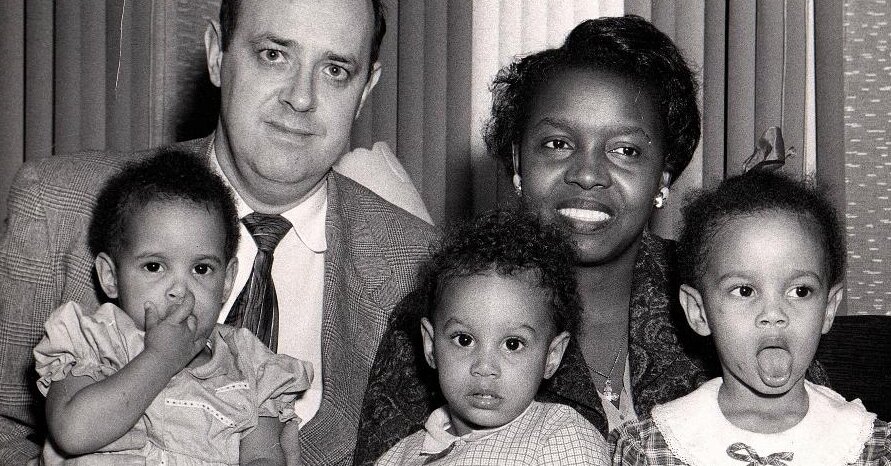
“For as far back as I can remember, my father was writing his book,” Dorothy Roberts recalls in her searing memoir, “The Mixed Marriage Project.” Robert Roberts, an anthropologist at Roosevelt College in Chicago, spent five decades studying interracial marriage, but died before finishing his project in 2002, leaving behind 25 boxes of interview transcripts and research materials.
The author, a sociology professor at the University of Pennsylvania, kept the boxes in storage for several years before setting aside a summer to examine their contents, hoping to learn the reason behind her father’s writer’s block. In the process, she discovered more than she anticipated about her own family’s origins.
She’d always assumed that her white father’s interest in interracial couples was sparked by his relationship with her mother, a Black Jamaican immigrant who was once his student. But the documents revealed that her father’s project began decades before their marriage, which raised disturbing questions in her mind: Did her father marry her mother for love? Or was she — and by extension their three daughters — part of his research?
“The interviews didn’t just illuminate history,” the younger Roberts writes; “they pulled me headlong into mysteries that shattered my settled understanding of my family.”
The author is in an odd position here: a sociologist probing her anthropologist father’s attempt to sway public opinion in favor of mixed-race couples. She’s the founding director of Penn’s Program on Race, Science & Society, and has written extensively on the intersection of gender, race and class. Her best-known book, “Killing the Black Body” (1998), examines systemic controls on Black women’s reproductive freedoms.
In “The Mixed Marriage Project,” she seems to be squinting at her father’s words, trying to discern the truth of the man behind them. She winces at his use of the word “Negroid” to describe biracial children but admires his focus on commonalities between humans at a time when many anthropologists were pushing theories of white superiority.
When Robert Roberts conducted his first interview in 1937, most states still prevented whites from marrying people of color, and scientists warned that children born of such unions would be defective, “hybrid humans.”
He often collaborated with his wife, Iris, who stopped pursuing a Ph.D. in anthropology after the author was born. Finding subjects in deeply segregated Chicago was difficult; they’d catch wind of an interracial couple and show up on their doorstep unannounced. Luckily, many were game to be interviewed, and Iris would talk to the wife in one room while their husbands spoke in another. All told, almost 500 couples participated in the study.
Over time, the reasons couples gave for getting married shifted. In the 1930s, most said they married for love. But by the ‘60s, many said their marriages were symbolic of how integration could succeed in the broader society.
The transcripts reveal many sad anecdotes from a shameful era. The Chicago police organized large-scale raids on clubs and even private homes where Black and white people socialized, in order to enforce segregation well into the 1960s. In one interview, a white wife said that she pretended her Black husband was her chauffeur to avoid humiliating stares and kept her marriage a secret at work for fear of losing her job. In another, a woman described the terror of being run out of her neighborhood by an angry mob when they learned her son was biracial.
Even Roberts’s own family faced adversity. Her father waited to marry Iris until his mother died, fearing her reaction, and he was subsequently disowned by his younger brother. On childhood road trips, she remembers her father checking into hotels while his wife and daughters waited in the car out of concern that a racist clerk would turn them away.
Reading about these hardships made me recall my own experiences growing up in Indiana with a Black brother in the 1970s and 80s. The overt racism we faced included name-calling, being refused service at a restaurant, and getting jumped outside of a public pool by a group of kids who accused my brother David of “polluting” the water. But far worse than these isolated incidents were the routine ostracism and everyday hostility we faced.
Indeed, dealing with the constant, soul-chipping scourge of bigotry in addition to the normal frictions of married life proved too much for many of the couples in Robert Roberts’s study. “Their unions could not transcend or destroy the color line, as my father had hoped,” his daughter writes.
Nonetheless, he continued his interviews well into the 1980s, blowing through deadlines, publishers, his years on this planet.
Roberts comes to believe that the reason her father never finished his book is deceptively simple. “I think Daddy didn’t want to end his mixed marriage project, a project that had become synonymous with his life and my family’s life together.”
What a gift that his daughter has completed his work, in her own way, here.
THE MIXED MARRIAGE PROJECT: A Memoir of Love, Race, and Family | By Dorothy Roberts | One Signal | 307 pp. | $30
The post Did Her White Father Marry Her Black Mother for Love, or for Research? appeared first on New York Times.