“Take what you’ve got and make it work for you.”
This is the advice that award-winning chef and cookbook author Joseph G. Randall, known as the “Dean of Southern Cooking,” imparted to young cooks when he and I spoke in December 2021 on my “Corner Table Talk”podcast. Perhaps a nod to the humble beginnings of traditional Southern food, it was simple advice, expressed with his typical humility.
Randall, also known as Chef Joe, died Feb. 14 at home in Savannah, Ga., surrounded by family and loved ones, according to his daughter Cari Randall. He was 79.
His life’s calling was championing the contributions of Black chefs. And he particularly inspired me, as a Black restaurateur in Los Angeles, and became a beloved mentor and friend to me over three decades.
Randall was a second-generation hospitality professional raised in Harrisburg, Pa. His father was a mason, civil rights activist and country club owner. After a 10-year fight, his father was granted Pennsylvania’s first liquor license for a country club in 1959. Randall’s uncle Richard, a hotelier, caterer and restaurateur in Pittsburgh, gave him his first job as a dishwasher.
“He gave me a tease for the business. He had very strict policies for employees, no smoking or drinking, and for how they dressed. He was catering parties mostly for white folks, ‘cause they were the ones who could afford to pay,” he said about his uncle on the podcast.
A career in hospitality followed, spanning more than five decades. Randall attended UC Berkeley, where he received restaurant management certificates, and later served as a cook in the United States Air Force. He’d eventually find a mentor in pioneering African American chef Robert W. Lee, executive chef at the Harrisburger Hotel in Harrisburg, Pa., who trained and hired an all-Black kitchen staff.
Randall went on to work in many kitchens, and was executive chef at Cloister restaurant in Buffalo, N.Y., and Fishmarket in Baltimore. In 1989, Randall opened the Restaurant at Kellogg Ranch, a training restaurant at Cal Poly Pomona. A little over a decade later, he founded Chef Joe Randall’s Cooking School in Savannah, Ga., where he continued to mentor young culinary talent.
Motivated to recognize the Black culinary professionals who had long been ignored by the industry, in 1993 Randall founded the African American Chefs Hall of Fame, as part of the Taste of Heritage Foundation. In 1998, he co-authored “A Taste of Heritage: The New African American Cuisine” with author and historian Toni Tipton-Martin, a foundational cookbook that started a national conversation about the depth and influence of Black culinary traditions. In 2016, his work was placed on a national stage in the Smithsonian Museum alongside other Black food figures including Edna Lewis, Leah Chase, Hercules Posey and Patrick Clarke, in an exhibit highlighting the most pivotal figures in African American cooking.
I met Randall in the early ‘90s when he hosted a gathering of Black chefs, including renowned chef Patrick Clarke, on the rooftop of the L’Ermitage Hotel in Beverly Hills. Some partners (including former Laker Norm Nixon, Oscar-winning actor Denzel Washington, record producer Lou Adler and I) were in the planning stages of opening Georgia, an upscale Southern restaurant on Melrose Avenue.
Randall, aware of the high-profile potential of our restaurant, introduced me to the “Godmother of Southern Cooking,” Edna Lewis, with the intention of having her join our team in Los Angeles. In 2012, he established the Edna Lewis Foundation in her honor, which remains active today.
Randall also connected us with our opening chef, the talented Jeanette Holly. When we parted ways with Holly, Randall stepped in alongside chef Dave Danhi, who worked at my former nightclub the Roxbury, to reshape the menu to focus on more traditional Southern fare.
It was Randall who, in the tradition of Edna Lewis, wanted to differentiate soul food from Southern cuisine, with the latter reflecting a broader interpretation of the food that African Americans historically played a significant role in shaping. As he told me, “Soul food is part of the contribution — not the totality of African American cuisine. We’ve allowed ourselves to be pigeonholed.”
In 2019, my wife Linda and I had the pleasure of visiting Randall at Good Times Jazz Bar & Restaurant in Savannah, where, as executive chef, he combined his love of Southern cuisine and live music.
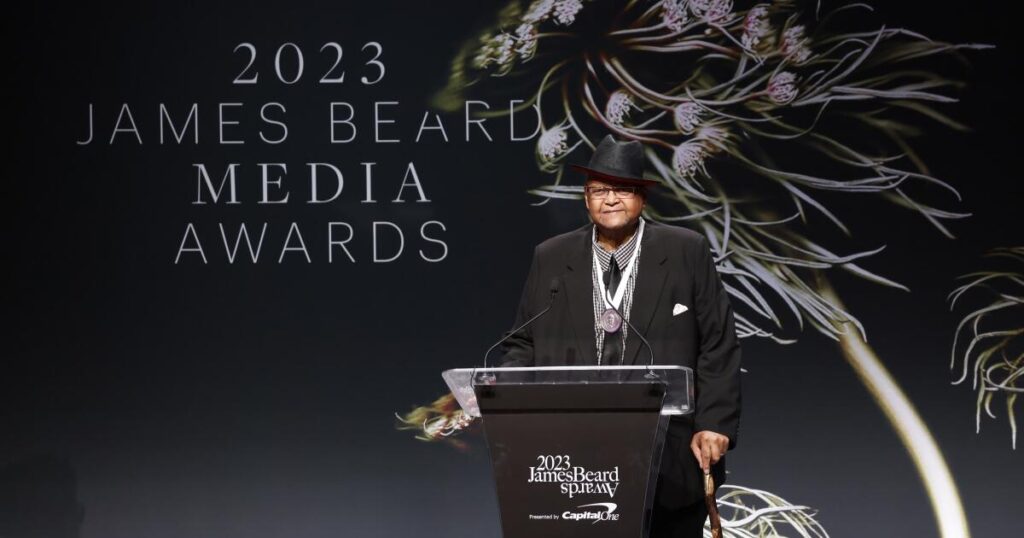
“A Taste of Heritage” was inducted into the Cookbook Hall of Fame by the James Beard Foundation in 2023.
Although we’ve had many conversations since then, the James Beard event in Chicago was the last time I saw Randall. We met for breakfast the morning after he received the prestigious honor. Randall showed up wearing a wide-brimmed hat and a smile to match. We discussed our shared appreciation for the inclusivity that the James Beard Foundation had committed to in the years leading up to his award. With no hint of resentment that the recognition took so long, Chef Joe reiterated something he’d said to me in a prior conversation: “I just don’t see any reason not to be joyful in my heart and love people — because I want to be loved.”
“My dad set a new standard for balancing one’s love for family, community and life as a culinary professional,” said Randall’s daughter Cari P. Randall. “He is a trailblazer, a pioneer and a man that loved all facets of life and it loved him back. As proof of this, my parents were married for 47 years, setting a great example of what a longstanding partnership and commitment can look like.”
Randall is owed a debt of gratitude for championing the important and too-often overlooked culinary contributions of African Americans. I am among the many who will miss his voice. His legacy lives on through his wife of 47 years, Barbara Randall, and their children Cari, J. Christopher and Kenneth Randall.
Brad Johnson is the restaurateur and hospitality professional behind numerous L.A. restaurants and nightclubs including Post & Beam, Georgia and the Roxbury. He is host of the “Corner Table Talk” podcast.
The post Chef Joseph ‘Joe’ Randall, trailblazing ‘Dean of Southern Cuisine,’ dies at 79 appeared first on Los Angeles Times.