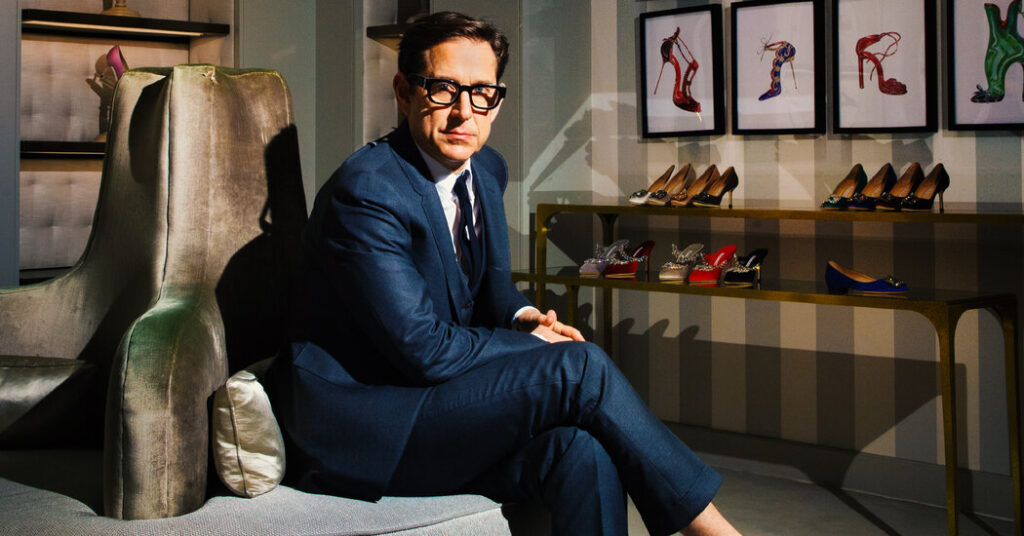
Surely it wasn’t all Richard Baker’s fault.
Saks Global, the department store group behind Saks Fifth Avenue, Neiman Marcus and Bergdorf Goodman, formed just 13 months ago, is under bankruptcy protection. Much of the fashion industry has blamed Mr. Baker, its former chairman and architect, for what may be lost.
That’s why on a cold winter morning, he sat in a borrowed Manhattan conference room across the street from the company he used to run, explaining why he — albeit a bit sad and beleaguered — was nothing less than a savior of luxury department stores. “As an entrepreneur,” Mr. Baker said, “we actually did a very successful job. Notwithstanding what you’ve been reading lately.”
It was the first time that Mr. Baker, 60, had addressed the January bankruptcy of Saks Global, which left the future of three of the oldest and most storied American retailers in flux.
But in Mr. Baker’s telling, there were a host of external factors that led to the cratering of Saks Global and his subsequent ouster: Shoppers were under economic strain, tariffs hurt margins, a popular online newsletter scared his vendors into withholding products because they worried they wouldn’t get paid.
Saks Global has closed 57 Saks Off 5th shops and all five remaining Neiman’s Last Call stores. Hundreds of people have lost their jobs as part of the restructuring, with more layoffs and job cuts to come. Brands like Chanel, Zegna and Akris are owed more than $700 million, and some smaller fashion brands that sold principally through his stores may not survive.
And it is but the latest in a string of department stores that passed through Mr. Baker’s hands over the last 20 years only to buckle thereafter. In 2006, he bought Lord & Taylor and ran it for 13 years before selling it for parts. Then, in 2008, he bought Hudson’s Bay, the Canadian retailer, which he offloaded in 2024 and which was liquidated soon after.
Mr. Baker acquired an ailing Saks Fifth Avenue 13 years ago. He thought that adding Neiman Marcus to the mix in 2024 would help by creating a powerhouse of high-end retailers. It didn’t, but it might have if he hadn’t ladled on the debt.
Mr. Baker said he had recently been up late counting the jobs he had supposedly saved by keeping his stores running long after others had written them off as dinosaurs, given the rise of e-commerce and the fall of America’s shopping malls.
“I had 50,000 people working for 10 years longer than they would have,” said Mr. Baker, wearing a cashmere crew neck from Loro Piana, one of the luxe brands he used to sell. “That’s more than a half a million work years. I kept each one of these businesses going longer than anyone on Earth ever could have.”
Many in the retail industry disagree. “The only legacy here is destruction,” said Lori Goldstein, a celebrity stylist and fashion editor.
The Memo
There’s a jazz-hands quality to Mr. Baker. Like many in real estate before him, he’s a guy who rarely stops selling. To sell you a business, he will sell you a line. And if he has sold you on a business that ultimately failed, he will offer many more lines about why.
A number of those lines will be true. Certainly, the last 20 years have not been kind to giant luxury emporia located in the most expensive cities in the world. But the fact remains: Mr. Baker’s companies were heavily leveraged, and that posed a series of risks.
Mr. Baker lives in a Greenwich, Conn., mansion with a James Turrell swimming pool, but he never saw himself as a merchant who agonized over high heels on the shoe floor. Instead, as he puts it, he was “an entrepreneur,” whose dream was to consolidate America’s high-end department stores by using their underlying real estate.
The story of how he convinced investors to buy into that vision, only to become synonymous with the death of the luxury department store, begins in 2005.
The son of a successful real estate developer, Mr. Baker’s heroes included billionaire industry icons like Harry Helmsley, who owned the Empire State Building, and Vornado Realty Trust co-founder Steven Roth. “I was always enamored with — at the time, I didn’t know the words — Prop OpCos, where you operate the business inside of the real estate, and the better the business does, the more valuable the real estate was,” Mr. Baker said.
After college, working “with, not for my father,” as he put it, Mr. Baker helped transform his family business in Connecticut by building over 50 Walmart stores on the East Coast. He then set his sights on high-end department stores, which were struggling to adapt to digital competition but operating in buildings that could be exploited.
”People didn’t understand the value of the real estate,” Mr. Baker said. “And what was really going on was the operators were hiding how bad the operations were by not charging rent to themselves.”
According to Jared Kushner, who knows Mr. Baker through his wife, Ivanka Trump, because her former fashion brand was sold at Saks: “He is very creative, always coming up with new ideas, always thinking about what the next thing is.”
It was in 2005 that Mr. Baker wrote a memo to himself listing the department stores he wanted to acquire: Lord & Taylor, Hudson’s Bay, Saks, Neiman Marcus and Germany’s Galeria Kaufhof.
“I was able to buy a company by putting the real estate in a property company, leaving the operating company in a separate company, financing against the valuable real estate and basically buying the whole company for very little to no cash,” he explained. “I was able to acquire them very efficiently, because I was right.”
Mr. Baker purchased Lord & Taylor in 2006 for $1.2 billion. He funded it with $1.18 billion in debt backed by real estate and $25 million in equity from his family’s private equity firm. “They thought that Lord & Taylor was going to be gone in three months,” Mr. Baker said. “Instead I ran the business for 13 years.”
Two years later, Mr. Baker, whom The Times once referred to as “Willy Wonka on a chocolate high,” added the second store on his list, Hudson’s Bay. Known as “The Bay” to Canadians, it started as a fur trader in 1670 and was the oldest company in North America.
“It was such a disaster it was going to be bankrupt within the next three or four months, if I hadn’t come in,” Mr. Baker said. “It was a miracle that we kept that business going.”
In 2013, Mr. Baker added Saks Fifth Avenue to his empire by buying out shareholders for a total of $2.9 billion in cash and debt. The allure of Saks was its flagship store on Fifth Avenue, built in 1924 in a neo-Renaissance style across the street from Rockefeller Center. In 2014 Mr. Baker took out a $1.25 billion mortgage on the building, which was valued at $3.7 billion.
In 2017, Mr. Baker sold Lord & Taylor’s premiere building, also on Fifth Avenue, to WeWork for $850 million, or about 70 percent of what he had paid for the entire chain of about 50 stores. The Manhattan one, a city landmark that had sold clothes and handbags since before World War I, was converted to office space. Mr. Baker then sold Lord & Taylor’s retail arm in 2019 to Le Tote, an online woman’s clothing rental business, for $100 million. That company filed for bankruptcy in 2020.
Still, Mr. Baker casts those moves as evidence of his deal-making vision. Others point to it as evidence that he is an architect of doom.
“Landlords lose, debt holders lose, but I am not sure Richard Baker loses,” said William Susman, head of retail for investment firm Cascadia Capital.
‘On Flimsy Ground’
By 2023, as Saks was falling late on some vendor payments, Mr. Baker saw opportunity in a deal for Neiman Marcus, which he had long coveted, and began courting investors. “I traveled around the world and raised many billions of dollars of both debt and equity from very sophisticated people who did lots of analysis and lots of due diligence,” he said.
He ultimately secured $2.2 billion in debt alongside $475 million in equity from Amazon. Additional capital came from Salesforce and Authentic Brands.
Mr. Baker’s pitch was that combining Saks and Neiman would lead to $600 million in savings over the course of five years. The new company would have more leverage over brands that might entice customers.
But challenges emerged almost immediately after the deal, lawyers for Saks later said in bankruptcy court. The interest on the debt owed by the company made it struggle to manage its cash. That made it harder to find savings.
Following that deal, Mr. Baker spun off Hudson’s Bay, which was sagging under $1 billion in debt. It soon filed for bankruptcy.
“I admired his bravado, his sense of showmanship and his ambition, which knew no bounds,” said John Demsey, a former top executive at Estee Lauder, which sold its beauty products at Saks for decades. “What I didn’t know was on what flimsy ground it was built.”
Final Threads
In February 2025, two months after Saks purchased Neimans, Marc Metrick, the combined company’s C.E.O., sent an email to brands saying that Saks and Neiman Marcus would take up to three months to pay them for items already delivered.
A series of stories in the online newsletter Puck laid out the issues with vendors. In October 2025, Saks filed suit against Puck, saying it had engaged in a “sustained campaign of false and sensationalist reporting.”
Puck declined to comment. The lawsuit is ongoing.
By November, many brands stopped shipping to Saks altogether. In December, as the bills piled up, the company sold the land beneath Neiman Marcus stores in San Francisco and Beverly Hills.
It wasn’t enough. As Saks stared down a $100 million interest payment, it became clear that the company would have to file for bankruptcy protection. Mr. Metrick stepped down as chief executive and Mr. Baker took the role.
Mr. Baker raced to raise $1.75 billion in emergency money to fund the company’s business in bankruptcy. He did it, but lenders insisted on a new C.E.O.
“The bondholders were unhappy that they found themselves in this situation,” Mr. Baker said, discussing his ouster. “Why would they want to put all their marbles with the same guy over and over again?”
Geoffroy van Raemdonck, the former Neiman Marcus boss, was named the new chief executive of Saks Global. when Saks filed for bankruptcy in January.
Saks Global said in a statement that the retailer has made “swift and steady progress” in rebuilding trust with vendors. “The funding also solves previous inventory challenges that stemmed from the lack of liquidity that hindered the company during 2025,” the company said.
“Throughout my business career, certain people have marched in one direction, and I’ve often marched in a different direction. Sometimes it served me well, and sometimes it hasn’t,” said Mr. Baker. At this point, “I’m happy to be out of the department store business.”
Moving On
Amazon has deemed its investment in Saks “worthless,” its lawyers said in bankruptcy court. They added the company had “serious concerns” that it was induced to provide services “under false pretenses.”
But small, independent designers that sold their products to Saks Global will suffer most, said Joseph Sarachek, a bankruptcy attorney who is representing more than 30 of them. “Upcoming brands thought they were getting a big break by showcasing at Saks and Neiman,” he said.
The designer Naeem Khan, who has been selling to the Saks Global stores for 25 years, said the company owes him approximately $700,000. He said that if he had not gotten a loan, he would have had to sell a house to keep his brand going.
Mr. Baker said that it’s “not a good outcome, period. No one gets out of bed in the morning, and wants to be involved in other people losing money.”
But he is already moving on. His wife has been “repatriating” a collection of artwork they had lent to Saks Global, and Mr. Baker has retreated to an island getaway to plan his next move.
His family owns a real estate company with over 10 million square feet of shopping centers, along with a private equity business, both of which are run by his son, Jack Baker. “A very capable 29-year-old,” he said.
Father and son last year orchestrated the sale of an investment fund made up of West Coast strip malls to Blackstone, the asset management firm.
“For $4 billion,” said Mr. Baker, lamenting how little credit he got for it. “No one noticed. Everyone says, ‘Oh, what a screw-up.’”
Vanessa Friedman has been the fashion director and chief fashion critic for The Times since 2014.
The post After Bankruptcy, Saks Owner Says He Saved Luxury Department Stores appeared first on New York Times.