Hundreds gathered on Saturday evening in Washington, D.C., to mourn Book World, The Washington Post’s books section, which was shuttered this month amid widespread layoffs at the organization.
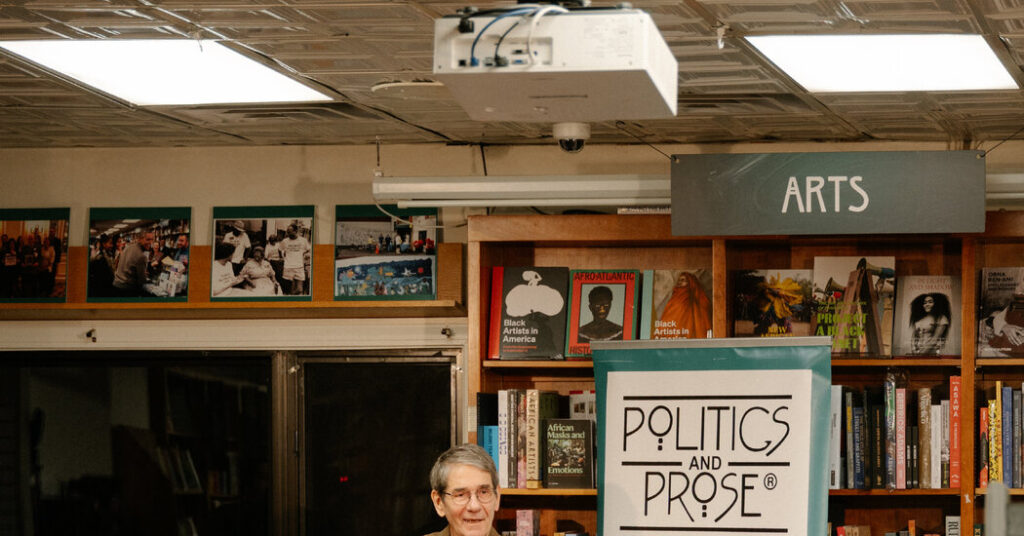
Journalists, policy wonks, speechwriters and erstwhile political aides packed the main branch of Politics and Prose, the storied bookstore, to hear former staff members and others commemorate what Marie Arana, a longtime editor of the section, called “a vanished gem.” She spoke alongside such former marquee critics and writers as Ron Charles, Michael Dirda and Carlos Lozada (now a New York Times Opinion columnist) — a “formidable cavalcade of smarts,” as she put it.
“We find ourselves battling book bans, the trivialization of truth, the bashing of serious journalism,” Arana said. “And now The Washington Post, once one of the most respected journalistic institutions in America, is enduring a mass demolition like no other.”
Attendees flooded the store, draping arms over free-standing bookshelves and craning for a better view. The investigative journalist Bob Woodward, an associate editor at The Post and one of the event’s speakers, sidled in a few minutes after the start, wading through rows of listeners and stopping to quietly greet familiar faces. (Later, at the lectern, he called the shuttering of Book World “one of the tragedies of our era.”)
Nora Krug, an editor and writer at The Post for nearly 20 years who wore red in support of The Post’s union, connected the demise of the section to broader economic convulsions in Washington, particularly in government roles.
“I suspect that some of you have experienced something similar, or know someone who has in the era of DOGE,” she said. “I now have a more visceral sense of what that feels like.”
Throughout the evening the mood swerved from elegiac to blackly funny; the latter is a specialty of journalists of a certain vintage. “I don’t know why I’m so nervous,” Charles, the longtime critic who closed out the prepared remarks, said dryly. “What are they going to do, fire me?”
The anger among many speakers was palpable, if kept at a genteel murmur. It was also personal. Brad Graham, who introduced the event, owns Politics and Prose with his wife, Lissa Muscatine. Both are former Post journalists.
“It is heartbreaking and infuriating, not only a blow to the literary world, but it leaves a further cultural void in our alarmingly eroding democracy,” he said.
The journalist Warren Bass, one of the organizers of the tribute, read statements on behalf of what he described as “three titans of The Washington Post.” One was Martin Baron, a former chief editor of the news organization.
“It is difficult to contemplate, and hard to forgive, a decision to sever The Post’s relationship with books,” Baron wrote.
Merilyn Francis, an expert in health policy who has lived in Washington for the past 20 years, attended the event even though she said she only occasionally read “Book World.” “It was a really good section to see not only all these different writings, but people’s perspective on them,” she said. The writing, she added, had “a lot of relevance into what was going on in the community.”
Saturday’s event was the rare funeral with a question-and-answer session at the end. One attendee asked how to engage in responsible capitalism, while another invoked the Greek philosopher Heraclitus when wondering how technological developments might affect the future of writing.
The final audience question came from a 23-year-old transplant to Washington with hopes of becoming a journalist. She was concerned that many of her peers didn’t understand the depth of the cuts, and asked how to help younger generations recognize the importance of American legacy journalism.
The room burst into applause at her question, though no one had a ready answer.
Saturday’s event felt as much like a referendum on the state of American journalism as a memorial. More than 300 journalists were laid off from The Post this month, and many of them were in the audience on Saturday night, greeting each other in a stupor after the event.
Literary coverage in national newspapers is dwindling. Book World, which returned to print in 2022 after more than a decade on ice, was one of the country’s last free-standing books sections. The Associated Press cut its book reviews in September.
Many veteran critics now seek refuge outside the pages of the daily papers. In his remarks, read aloud by Bass, the former Post publisher Don Graham exhorted people to sign up for Charles’s new newsletter via Substack. Had anyone already subscribed? About a quarter of the audience raised their hands.
John Williams, the most recent editor of Book World and a longtime former New York Times Book Review staff member, joked that Charles would be “even more prolific on Substack than he was at the paper.” It was hardly an exaggeration. Since being let go, Charles has published six posts to the platform.
His most recent, from Feb. 20, is a review of two new nonfiction books. It is headlined, simply, “Do I Still Matter?”
Joumana Khatib is an editor at The Times Book Review.
The post A Wake for The Washington Post’s Books Section appeared first on New York Times.