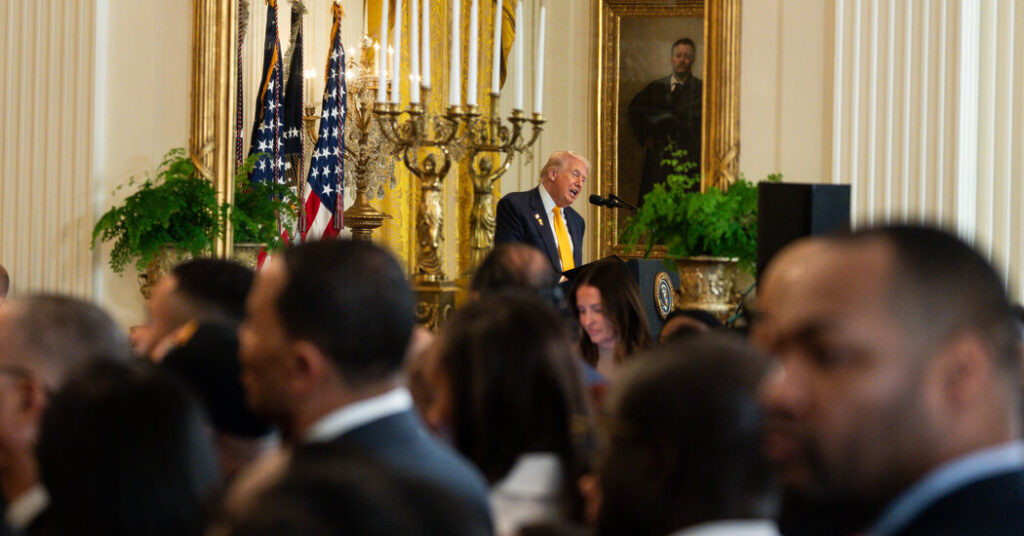
During a Black History Month event at the White House last week, President Trump wanted to make one thing very clear: Some of his “great friends” are Black.
Rattling off names in no particular order, Mr. Trump praised the rapper Nicki Minaj, remarking on her nails and her “beautiful skin”; Jesse Jackson, the civil rights icon who had died just days before, calling him a “real hero” and a “piece of work”; the “silent but deadly” civil rights activist and football star Jim Brown; Lawrence Taylor, the “greatest defensive player, probably in the history of football”; and Muhammad Ali, “another piece of work.”
By the time Mr. Trump got around to mentioning the boxer Mike Tyson, the purpose of this seemingly random list of Black friends became clear.
“Mike Tyson, boy I tell ya, Mike has been loyal to me,” Mr. Trump said. “Whenever they come out, they say ‘Trump is a racist, Trump’s a racist,’ Mike Tyson goes, ‘He’s not a racist, he’s my friend, he’s been there from the beginning, good times and bad.’ But Mike Tyson’s a great guy, and he was so loyal. Always been loyal.”
For Mr. Trump, talking about his loyal Black friends has long been a go-to tactic not only to showcase his clout with the Black community, but also to deflect allegations of racism. To Mr. Trump’s critics, it’s a version of the old trope: I can’t be racist, because some of my best friends are Black.
The White House says that Mr. Trump is delivering for Black Americans and that any suggestion that his commitment is superficial is incorrect.
In a statement, Allison Schuster, a White House spokeswoman, said that “no president in history has done more for Black Americans than President Trump,” pointing to his first term, when he signed a bill increasing funding for historically Black colleges and universities, and signed a criminal justice reform bill intended in part to reduce racial sentencing disparities. (Mr. Trump later said he regretted signing the bill.)
In his second term, Ms. Schuster said, Black Americans will build generational wealth through Mr. Trump’s “Trump accounts” for children.
Mr. Trump made gains with Black voters in 2024, appealing appeal to Black men and young Black Americans who had grown disillusioned with the Democratic Party, which they said had long taken them for granted. Mr. Trump expanded his share with Black voters to 15 percent, up from 8 percent in 2020, according to the Pew Research Center.
It was a notable rise given the group’s historical association with the Democratic Party.
Still, Mr. Trump’s policies, statements and actions over the years have taken aim in particular at people of color. He has made diversity into an all-purpose target for society’s problems; his cuts to the federal work force have disproportionately affected Black employees; he has purged libraries of writings by Black authors like Maya Angelou and he has said the Smithsonian focuses too much on “how bad slavery was.”
A review of Mr. Trump’s interviews dating back a decade show that he has often invoked his unnamed Black friends, or name-checked celebrities and athletes, when asked to discuss anything related to Black voters.
In an October 2015 interview, during his first run for president, he made a reference to “a friend of mine who happens to be a great, great athlete, he happens to be African American,” who said Mr. Trump was an honorary Black person because he was “the greatest trash talker that ever lived.”
In 2016, Mr. Trump tried to brush back allegations that he was racist by citing “friends of mine that are African American” who said “you are the least racist person we know.” That year, he declared on social media: “Don King, and so many other African Americans who know me well and endorsed me, would not have done so if they thought I was a racist!”
In 2018, he boasted in an interview that “I have a tremendous amount of support with African American great athletes” and pointed to the fact that the rapper Kanye West, his newfound supporter at the time, was “very happy” with his record.
Mr. Trump’s fascination with athletes is particularly revealing about what Mr. Trump values about Black people, said Kiese Laymon, an author and professor at Rice University.
Trump Administration: Live Updates
Updated
- Trump’s aides project confidence on tariffs after the loss at Supreme Court.
- A man was fatally shot at Mar-a-Lago, the Secret Service says.
- Denmark rejects Trump’s plan to send a ‘great hospital boat’ to Greenland.
“This man refuses to see the texture of Black life so he hides behind the texture of Black life by hoisting up his love for Black male bodies,” Mr. Laymon said.
“On one hand, you can talk about how much you love what these Black male entertainers do for you when you’re bored, how much these Black men like you. But you can’t talk about how you continually divest from the richness of Black male life with structural deficiencies.”
Courtney R. Baker, a professor at the University of California, Riverside, and a scholar of visual culture and Black life, noted that Mr. Trump’s conception of Black friends revolves around celebrity and fame, and what Black people can do for him.
“His understanding of friendship and association with Black people is so thoroughly saturated in investment and trading and commodity,” Dr. Baker said, “which is so particularly messed up if we think about Black people in this country having actually been traded, commodified, invested in.”
For two years in a row, Mr. Trump has been in the position of commemorating Black History Month after he publicly demeaned Black people. Last year, Mr. Trump had just blamed diversity efforts at the Federal Aviation Administration for a plane crash over the Potomac River.
Then as now, he used the event primarily to show off his Black friends.
“Let me ask you — is there anybody like our Tiger?” Mr. Trump asked last year, as he called Tiger Woods up to the stage. He went on to refer to the golfer 14 times during his roughly 20-minute address.
This year’s celebration came after he drew broad condemnation for posting a racist video clip on his social media feed that portrayed the Obamas as apes. Mr. Trump deleted the post under pressure but refused to apologize for it, blaming an unnamed aide. He then suggested all was well because he had spoken with Tim Scott, the Senate’s only Black Republican.
At this year’s Black History Month event, Mr. Trump highlighted Herschel Walker, the former football player who made a failed run for a Senate seat in Georgia. Mr. Trump met him in the early 1980s when he bought the United States Football League.
“And Herschel Walker, speaking about loyal — how good a football player was Herschel? Now he’s the ambassador to the Bahamas,” Mr. Trump said, before seeming to forget where he had appointed him. “I don’t know — Bahamas, Bermuda — is he Bahamas, Bermuda? Whatever, it’s a nice place.” (It’s the Bahamas.)
In addition to listing the Black athletes and celebrities he counts as friends, Mr. Trump featured the few Black members of his administration: Scott Turner, the former pro football player who leads the Housing and Urban Development Department; Ben Carson, the former housing secretary who is now an adviser for the agriculture department; and Alice Johnson, Mr. Trump’s “pardon czar” who advises him on clemency issues.
While most African American voters disapprove of him, Mr. Trump maintains strong backing from many of his Black supporters, who chanted “four more years” as he spoke at the White House.
He also invited some everyday Black Americans to the lectern to talk about how Mr. Trump’s policies have improved their lives. They included a business owner who said that his “no tax on tips” deduction allowed her to hire more employees, and a mother whose daughter benefited from his championing of school choice.
Mr. Trump took particular delight in remarks made by a Washington, D.C., resident, Forlesia Cook, whose grandson was killed by gun violence in 2017. Ms. Cook offered a forceful defense of the president’s decision to deploy the National Guard to help combat crime in the district, despite a recent plunge in rates of violent crime.
She said that as an advocate for safety in Washington, she was ignored by Democrats, but Mr. Trump’s team took her seriously.
“I marched, I rallied, nobody heard me,” she said. “Democrats get mad at me. This Republican sent his constituents, his people, out there to interview me in my home.”
“I love him,” Ms. Cook said. “I don’t want to hear nothing you got to say about that racist stuff. And don’t be looking at me on the news hating on me because I’m standing up for somebody that deserves to be stood up for. Get off the man’s back. Let him do his job. He’s doing the right thing. Back up off him. And Grandma said it.”
As the crowd roared with applause, Mr. Trump made a keen observation.
“Wow, that’s pretty good,” he said. “When is she running for office?”
Erica L. Green is a White House correspondent for The Times, covering President Trump and his administration.
The post When Faced With Claims of Racism, Trump Points to His Black Friends appeared first on New York Times.